0–25
Trust
Public third-party signals from Google, Trustpilot and G2, together with verified-claim status.
HostList.io now covers 30,000+ companies across 60+ countries. I built it to replace commission-led top-ten lists with an auditable ranking algorithm, live data, useful buyer tools and a product that keeps expanding.
Visit HostList.io Want one built? →
HostList began as a large directory. It has become a web hosting intelligence platform: 30,000+ company profiles, live rankings, side-by-side comparisons, an AI-assisted matching flow, verified owner claims, public research, tools, awards, jobs, editorial coverage and games built from the same underlying data.
The core promise has not changed. A hosting company cannot buy its position. HostList separates commercial deals from ranking order, publishes the scoring methodology and gives buyers enough evidence to make their own decision.
Every company receives an HRI, the HostList Ranking Index, from 0 to 100. The base score is divided equally across four components. The same formula runs across the directory, and commercial relationships contribute zero points.
Public third-party signals from Google, Trustpilot and G2, together with verified-claim status.
How thoroughly the company, location, plans, features and supporting profile data are documented.
How recently the listing and its evidence were checked, with stale data losing weight over time.
Controlled benchmarks where available, then CrUX field data and a clearly labelled infrastructure-tier fallback.
HRI is designed to be inspectable rather than mysterious. HostList publishes the full methodology, performance-evidence ladder and a dated changelog. When the algorithm changes, the change is documented instead of silently rewriting the leaderboard.
Browse the full directory, filter by country or category, follow the live HRI leaderboard, or put any two providers side by side.
Browse the directory →Answer questions about your stack, traffic and budget. The matching engine filters 30,000+ companies into a reasoned shortlist.
Try HostMatch →Hosting companies can claim a profile, verify ownership and correct their data without buying rank. Recent claims appear in the live activity feed.
Claim a listing →The State of Web Hosting, data reports, weekly rankings, Hoster of the Month and annual awards turn the directory into an industry record.
Read the research →Free domain tools, a hosting glossary, WordPress plugin data, ownership maps, jobs and country hubs make the data useful beyond host profiles.
Open the tools →Three browser games turn real hosts into playable characters, use live HRI data for their stats and unlock verified hosting deals.
Play the arcade →The strangest and most useful proof that HostList is a data product is the Hosting Arcade. Real companies become game characters, and their abilities inherit from live HRI data. A better score is not just a number on a profile; it changes how a character plays.
A three-wave shooter where hosting companies fight downtime. Trust, Performance and Freshness become combat stats.
A three-lap race powered by live company data, with the leaderboard and host attributes moved into an arcade cabinet.
A maze game built around real hosting vocabulary. Spell the terms, finish the run and unlock verified offers.
It is free to play. No host can pay to appear or improve its stats, and successful runs can unlock coupon codes supplied by verified companies.
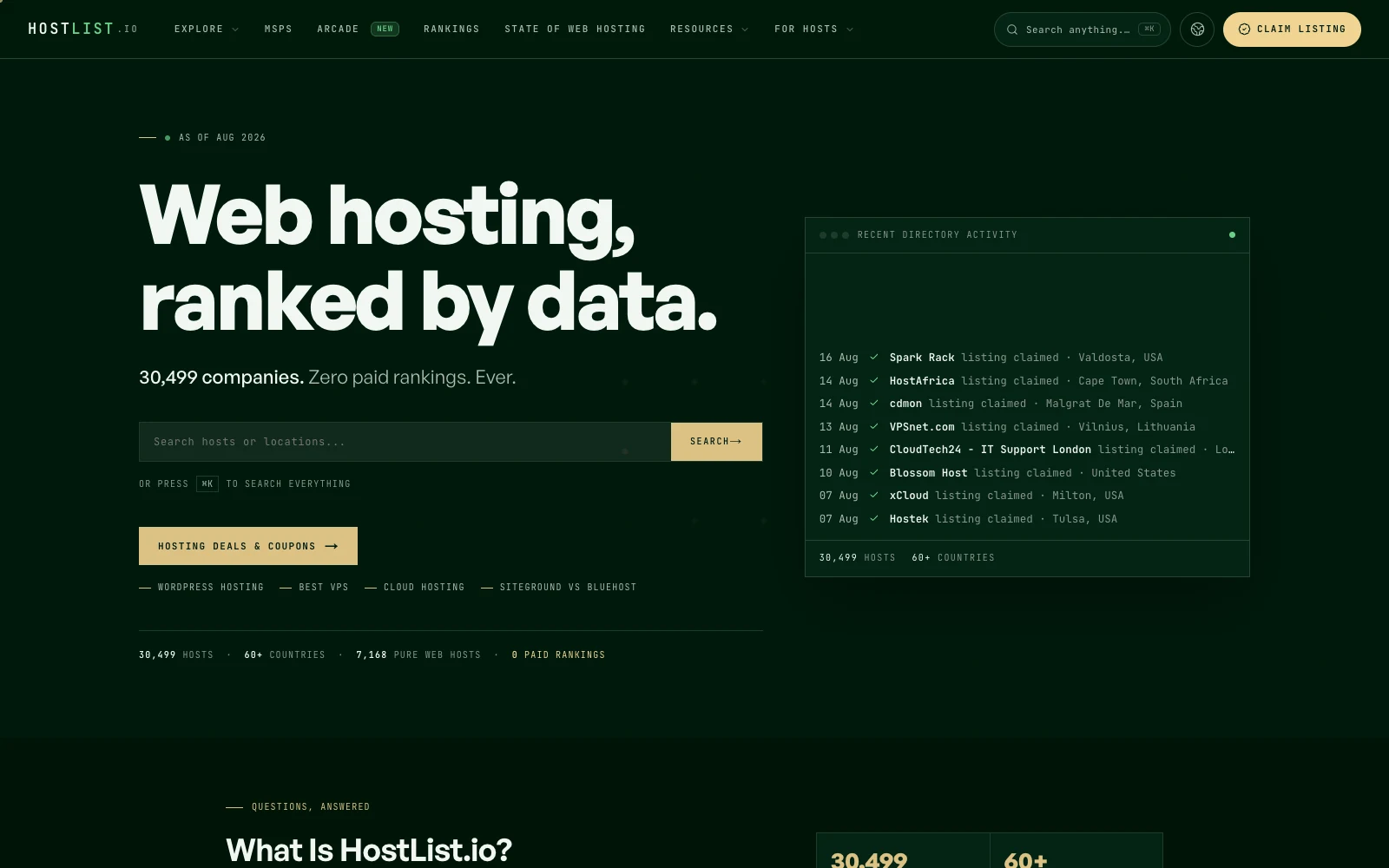
The screenshot above records 30,499 companies on 17 August 2026. Live directory totals move as the enrichment pipeline adds and reclassifies companies.
If you are building a directory, marketplace or comparison product, the useful part is not the page count. It is the system behind the pages:
See it live at hostlist.io Programmatic SEO playbook → Directory builds → Build something like this →
HostList is an independent web hosting intelligence platform covering 30,000+ companies across 60+ countries. It combines a searchable directory, algorithmic rankings, comparisons, verified claims, matching, reports, tools and editorial research in one product.
Every company receives an HRI, or HostList Ranking Index, from 0 to 100. The base score is split equally across Trust, Completeness, Freshness and Performance. The methodology, evidence rules and change history are public, and commercial relationships cannot buy HRI points.
No. HostList keeps sponsorships and deals outside the ranking algorithm. Commercial placements are labelled, while directory order and HRI scores are produced from public and verifiable data signals.
HostMatch is HostList's guided matching experience. A buyer describes their stack, traffic, budget and requirements, then the system filters the directory and returns a ranked shortlist with reasons.
The Hosting Arcade is a free browser gaming hub with 404 WARS, HRI Grand Prix and PACWORDS. Real hosting companies become characters, live HRI data influences their stats, and winning can unlock verified hosting coupon codes.
HostList runs on Next.js App Router, Supabase Postgres and Storage, and Vercel. Data ingestion and enrichment pipelines feed the HRI scoring engine, profile pages, rankings, comparisons, reports, claims and other product surfaces from one source of truth.