Brand Naming, Identity, Logo Design and Global Trademark Search
A working guide for founders shipping a new brand. How naming actually gets done, the patterns that ship, what a real identity system contains, and how to screen a name across major jurisdictions. Written from 12,000+ sites of practical experience.
WHAT BRAND IDENTITY ACTUALLY IS
Brand identity is the system of visual and verbal assets that make a company recognisable across every surface a customer touches. The logo is one component. A complete identity includes the rules and assets needed to apply that logo across packaging, web, app, social, signage, and print without the result losing coherence as it spreads.
If you only have a logo, you have a starting point. If you have a logo, type system, colour palette, voice guide, application templates, and a guidelines document, you have a brand identity that can ship and survive contact with a marketing team.
WHAT BRAND NAMING IS, AND WHAT A NAMING CONSULTANCY DOES
Brand naming is the work of choosing the word a company trades under and then proving that word is usable. It has two halves, and founders treat them as one. The creative half generates candidates against a map of what the category already sounds like. The commercial half screens those candidates for pronunciation, spelling, meaning in other markets, trademark conflict and domain availability. A name that wins the first half and fails the second is not a name. It is a shortlist entry.
A brand naming consultancy sells the second half as hard as the first. The deliverable is usually a territory map, thirty to a hundred candidates, a screened shortlist of three to five, and a written rationale you can take to a board without it turning into a taste argument. What a naming consultancy cannot sell you is legal clearance. Screening tells you which names are obviously dead. Clearance is a written opinion from a qualified trademark professional about the ones that survived. Any firm that blurs those two is selling risk with a nice deck on top.
The order that works, four steps:
- Map the category. Say every competitor name out loud and write down what they have in common. Crowded sounds, repeated prefixes, the suffix everyone reached for in 2019. You cannot argue for a name without something to argue against.
- Generate wide, then stop. Thirty candidates is thin. Three hundred is procrastination. Most territory maps are exhausted somewhere around a hundred.
- Screen hard. Say it, spell it, search it. Read it down a phone line to someone who has never seen it written. If two of those three are difficult, the name will cost you money every year you own it.
Shortlist and defend. Take two or three survivors, run a first-pass registry and domain screen with the business name generator and trademark checker, then hand the survivors to counsel. Filing before that pass is how rebrands happen in year two.
On budget: naming is a phase inside the identity numbers further down this page, not a separate invoice, unless you hire a naming specialist on their own. Ask for it to be priced and timeboxed separately in the proposal anyway. If naming disappears into a single identity line item you cannot tell whether you are paying for twenty candidates or two hundred, and you lose the option to stop after the naming phase when the shortlist comes back wrong. Trademark search and filing sit outside that number again, because fees move with jurisdiction, class count and whether anyone objects.
THE NAMING PATTERNS THAT ACTUALLY SHIP
Most naming taxonomies run to seven or eight types: descriptive, suggestive, coined, arbitrary, eponymous, acronym, geographic, metaphorical. Useful for a lecture. In practice almost everything that ships for a small company lands in one of three patterns, and the pattern you pick writes the identity brief before a designer opens a file.
Three of my own properties, three different answers, all of them public so you can check the work.
Descriptive compound: HostList.io
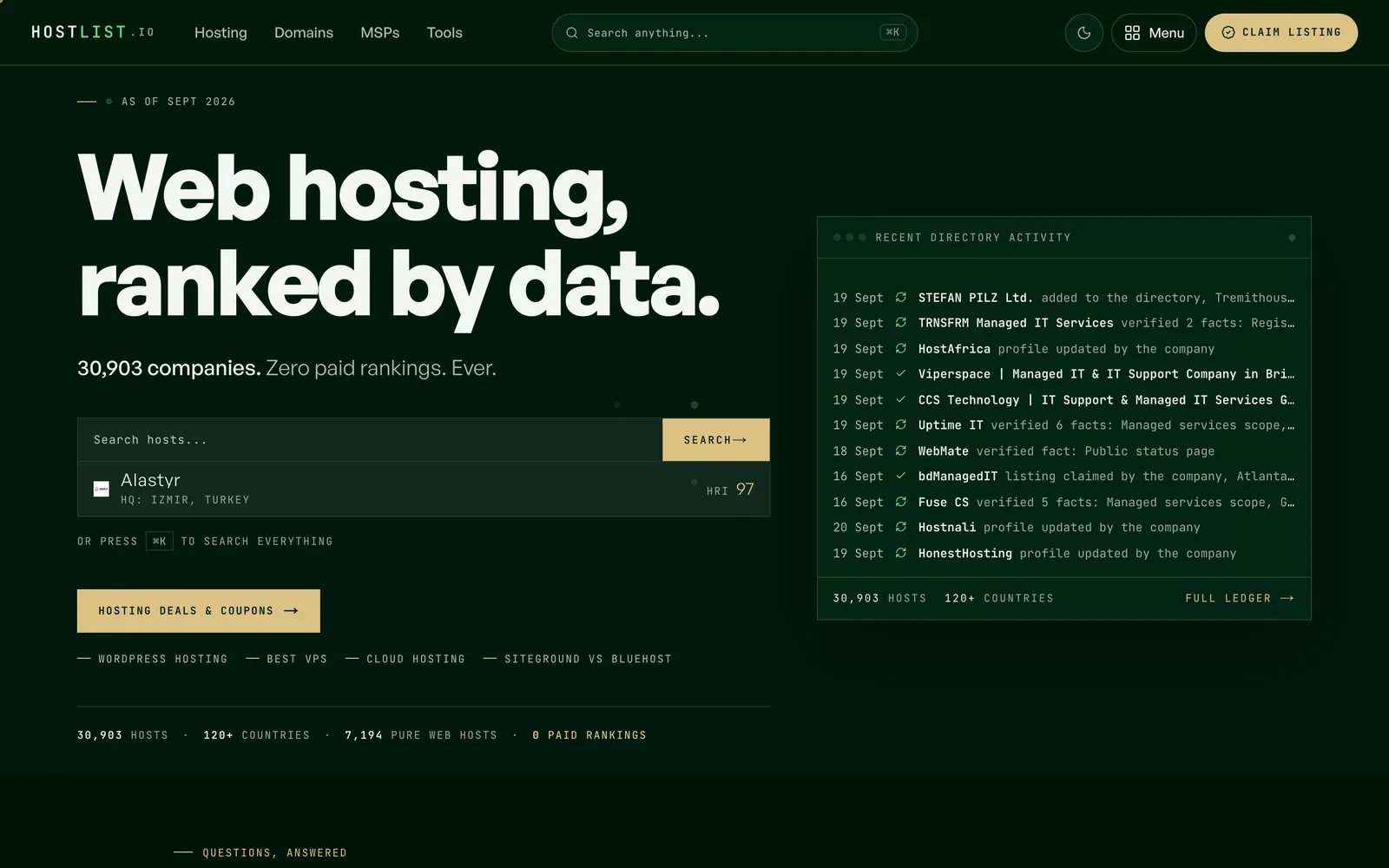
HostList.io says what it is before you read a word of copy. Host, plus list. The wordmark keeps the TLD inside the lockup, letterspaced in mono, with HOST set light and LIST picked out in green so the two halves of the compound stay readable as two ideas rather than one long word. Descriptive names are cheap to explain and expensive to protect. You get instant comprehension and a weaker trademark position, because registries are reluctant to hand anyone a monopoly on ordinary category words.
So the identity has to supply the distinctiveness the name cannot. Here that is the near-black green ground, the heavy grotesque display against mono data type, and a claim the business can be held to: thirty thousand nine hundred and three companies, zero paid rankings, ever. A category-word name plus a specific checkable promise is what stops a descriptive brand reading as generic.
The domain as the name: girl.dad
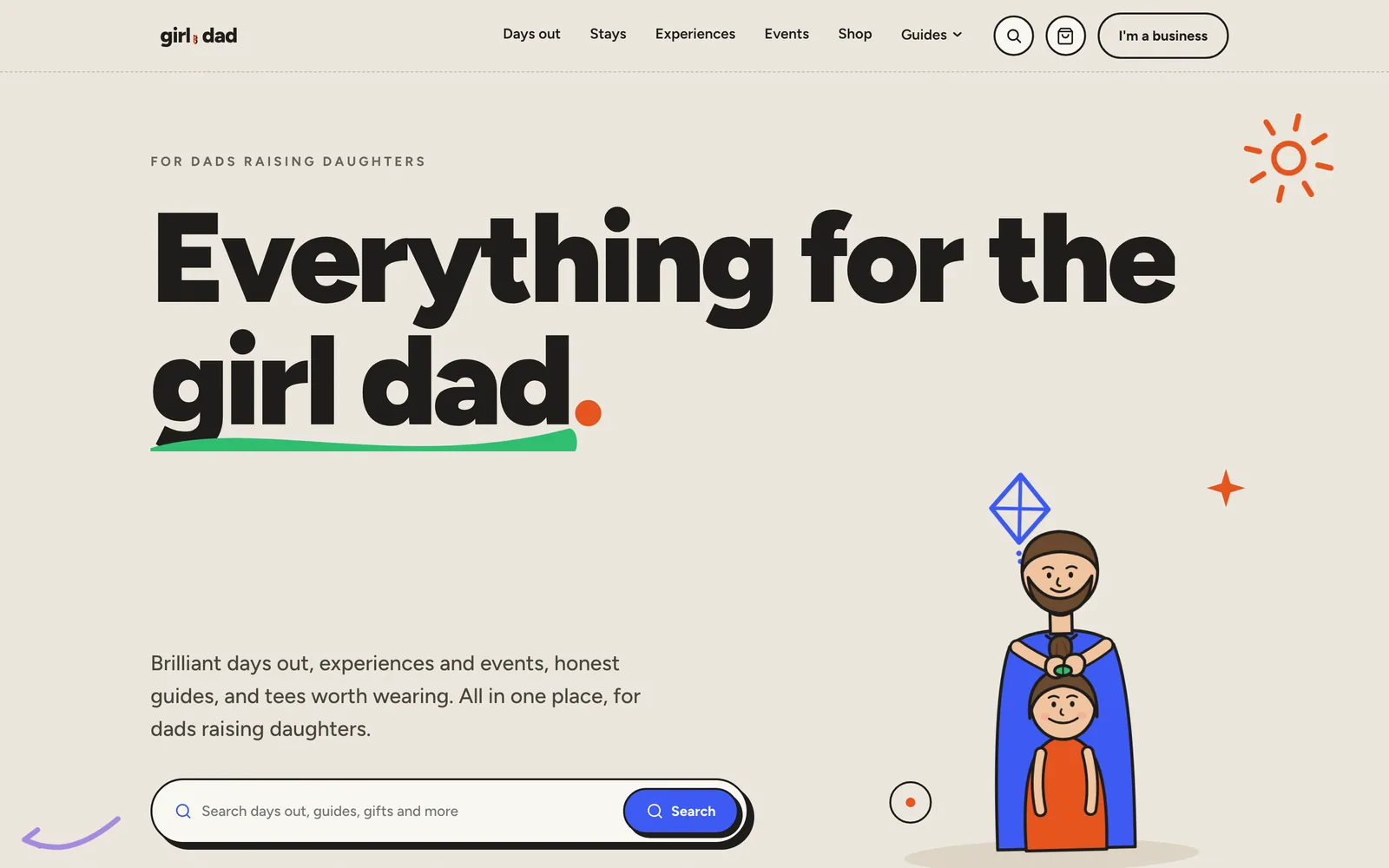
girl.dad does not have a domain. It is one. The TLD finishes the phrase, so the address bar and the wordmark are the same three syllables, and there is no gap between what someone hears and what they type. That is the most efficient naming pattern available right now, and the most exposed: you are renting the back half of your brand from a registry. If pricing or policy on .dad moves, you move with it in a way a .com owner does not.
It was worth taking here because the phrase already existed in the language. The name had no new word to teach anyone. The identity then leans into the warmth the phrase promises rather than fighting it: heavy geometric lowercase, an off-white ground instead of white, an outline illustration set that stays friendly without going childish, and a single orange glyph between the two words as the only place the logo does anything clever. That is about the right amount of clever.
Category plus claim: GemsVerified.com
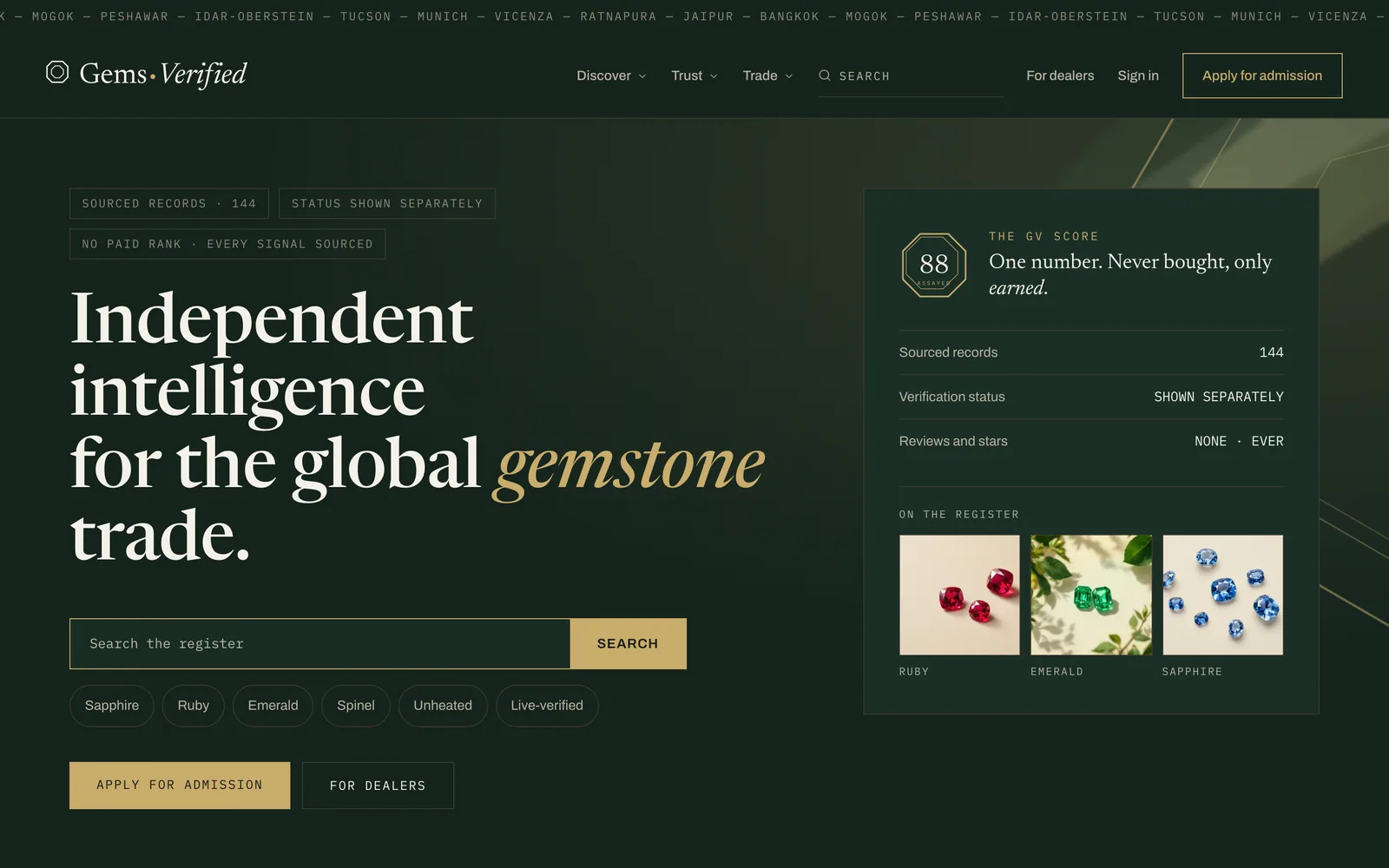
GemsVerified puts the promise inside the name. Category noun, then the thing the product does to it. The pattern buys you positioning for free and writes a cheque the business then has to honour, because a brand called Verified that ships anything unverified has a bigger problem than a naming problem.
Which is why the identity is built as evidence rather than decoration. The mark is an octagonal assayer stamp. The palette reads closer to an auction house than a marketplace, deep green and gold, serif display against mono labels. And the homepage leads with receipts instead of adjectives: one GV score, a hundred and forty-four sourced records, verification status shown separately, reviews and stars none, ever. When the name makes a claim, every surface has to carry proof of it. Harder identity brief. Much better long-term position.
Pick the pattern first, because it decides the brief
Descriptive names need the identity to supply distinctiveness. Domain-phrase names need it to supply warmth and a sense of permanence the registry does not give you. Claim names need it to supply evidence, on every surface, forever. Same three designers, same budget, three completely different jobs. That is the argument for buying naming and identity from the same conversation even when they arrive as two separate invoices.
WHAT A COMPLETE BRAND IDENTITY SYSTEM CONTAINS
Nine components, in roughly the order they get built. The logo system comes first — a primary mark, a secondary mark, a monogram or favicon, lockups for horizontal and stacked layouts, safe zones, minimum sizes, and file formats from SVG to favicon to embroidery-ready vector. Typography follows — a display face, a body face, a UI face, hierarchy with sizes, weights, line heights, and a defined fallback stack for the web.
Colour comes next — primary, secondary, accent, and functional (success, warning, danger), with every pair tested for WCAG AA contrast at minimum 4.5:1 for body text and 3:1 for large text. Imagery defines photography direction with mood references and do-not examples, plus illustration style if relevant. Iconography uses a single source — Lucide, Phosphor, or a custom set with one stroke weight, one corner radius, one grid.
Voice gives written examples of how the brand sounds in three contexts: marketing copy, product UI, and support replies. Do-not examples are as valuable as do examples in this section. Layout defines the grid, spacing scale, container widths, and breakpoints — token-named so engineering can implement without re-deriving the values. Motion sets durations, easing curves, and the principles for what should and should not animate. The guidelines document brings everything into a single source of truth, whether that lives in PDF, Notion, or a hosted brand portal.
WHY TRADEMARK SEARCH MATTERS BEFORE YOU LAUNCH
The cost of finding out late is brutal. If you launch a name that infringes an existing mark in your category, you can be forced to rebrand under a cease-and-desist, lose your domain, lose social handles you just spent twelve months building, and potentially pay damages on top. I have watched it happen to two startups in the past five years. Both rebranded inside ninety days and both said the same thing afterward — a thirty-minute search before commit would have saved them.
A preliminary registry search can remove obvious conflicts before you commit to identity, domains or packaging, but it cannot prove that a name is clear. Broader clearance by a qualified trademark professional should happen before a high-investment launch or filing.
HOW TO DO A GLOBAL TRADEMARK SEARCH YOURSELF
This is the practical workflow. Two hours, free, before you commit to a name. The order matters because catching a conflict early saves the cost of searching jurisdictions further down the chain.
Start with the USPTO Trademark Search system for the United States. Search exact wording and close variants, then review related goods or services rather than relying on a Nice class number alone. A preliminary automated screen is useful for shortlisting, but the USPTO recommends a broader clearance search beyond federal records.
Move to EUIPO TMview or eSearch plus for European Union trade mark applications and registrations. Then use the WIPO Global Brand Database for Madrid System records and participating national or regional collections. WIPO recommends searching relevant national and regional registers directly because the global database does not contain every mark filed with every office.
UKIPO is separate from EU filings since Brexit, so check it independently. National offices for key markets follow — IP India, Japan Patent Office, KIPRIS for South Korea, CNIPA for China, IP Australia. Cover every market where you operate, sell or plan a meaningful launch.
Domain availability comes next — check .com, .co, .io, .ai, plus your country TLD. A name without at least one premium domain at reasonable cost is functionally untenable. Social handles on LinkedIn, X, Instagram, YouTube, GitHub, and TikTok matter for brand integrity; tools like Namechk run them in parallel. Finally, Google the candidate name plus your category to surface unregistered common-law marks. Many jurisdictions still recognise these and they can block your registration even though the prior user never filed.
TRADEMARK VS COPYRIGHT VS DESIGN RIGHTS
These three protect different things and people confuse them constantly, sometimes in the middle of a filing process where the confusion costs real money.
Trademark protects names, logos, slogans, and other source identifiers used in commerce. Anything that signals "this product comes from this company". Registration is jurisdictional — a US trademark does not protect you in Germany — and the protection expires unless renewed, typically every ten years.
Copyright protects original creative works automatically on creation in most jurisdictions. It covers blog posts, photos, code, music, and illustration. Most countries do not require registration for the protection to exist, but registration helps in litigation when you need to prove the priority date.
Design rights protect the ornamental appearance of a product — the shape of a bottle, the unique layout of an interface, the silhouette of a piece of furniture. These are called design patents in the United States and design rights elsewhere. A logo is typically registered as a trademark; the artwork inside the logo is also automatically protected by copyright; the product the logo appears on may have its own design rights. They stack rather than substitute.
WHEN TO HIRE A TRADEMARK ATTORNEY
Hire a qualified trademark professional once you have shortlisted two or three candidate names and before you file or commit significant launch spend. Automated and self-directed searches can miss phonetic similarity, related goods or services, unregistered rights and jurisdiction-specific issues.
Professional help matters especially when a filing spans multiple jurisdictions or uses the Madrid System. Search depth, government fees, number of classes, local-representation requirements and objections can change the scope materially. Ask for a written jurisdiction-by-jurisdiction estimate covering clearance, filing, responses and renewal responsibilities.
HOW LONG A BRAND IDENTITY PROJECT TAKES
Three weeks for a tight startup brand. One designer, fast decisions, single founder making the call. Logo, type, colour, basic guidelines. The output is workable but minimal — enough to launch, not enough to scale a marketing team off.
Six to ten weeks for a typical small business engagement. Full logo system, type system, colour system, applications across digital and print, guidelines document. This is where most funded startups and small businesses sit.
Twelve to twenty weeks for a corporate identity programme. Research, naming if needed, identity system, applications across thirty or more surfaces, animation, brand-management portal. The biggest variable across all three timelines is decision-making speed, not design time. Projects that miss timelines almost always do so because the client cannot decide between two directions, not because the studio cannot ship.
WHAT BRAND IDENTITY COSTS IN 2026
Indie or freelance work runs one thousand five hundred to eight thousand US dollars. Logo, type, colour, basic applications, one-page guideline. Right for startups validating an idea or solo founders getting from zero to launchable.
Studio engagements run fifteen thousand to forty-five thousand. Full identity system, applications across digital and print, full guidelines document. Right for funded startups and small businesses where the brand will carry serious sales pressure within twelve months.
Corporate identity programmes run seventy-five thousand to three hundred thousand. Research, naming, identity, thirty-plus application surfaces, motion, brand-management portal. Right for funded scale-ups, enterprise rebrands, and acquisitions that need to consolidate brands.
Budget trademark work separately from design. Professional-search and filing fees vary materially by country, number of classes, application route and whether objections arise, so request a written jurisdiction-by-jurisdiction scope.
WHY I AM WRITING THIS GUIDE
I am not an IP attorney and this is not legal advice. Use a qualified trademark professional for clearance, filing and advice about a specific name.
I co-founded Seahawk Media in 2018 and have shipped twelve thousand websites since — most of them carrying the brand work of agencies, studios, and in-house teams across the United States, United Kingdom, Europe, and Asia. I have watched what works in production at scale: which guideline formats actually get followed, which logo systems hold up at favicon and billboard scale, and which colour palettes survive contact with a marketing team that is shipping content five times a week.
I personally co-founded Brandy HQ, a brand-identity workspace that helps founders ship logos, palettes, and guidelines without the six-month studio engagement. The product exists because the gap between freelance Fiverr work and a forty-five thousand dollar studio engagement is the place most early-stage brands actually need to be. This guide covers practical identity and preliminary-search workflow; qualified counsel handles legal clearance and filing.
FREQUENTLY ASKED QUESTIONS
What is brand naming?
Brand naming is the work of choosing the word a company trades under and then proving that word is usable. It has two halves. The creative half generates candidates against a map of what the category already sounds like. The commercial half screens those candidates for pronunciation, spelling, meaning in other markets, trademark conflict and domain availability. A name that wins the first half and fails the second is not a name, it is a shortlist entry.
What are the types of brand names?
Standard taxonomies list seven or eight: descriptive, suggestive, coined, arbitrary, eponymous, acronym, geographic and metaphorical. In practice almost everything that ships for a small company lands in one of three patterns. Descriptive compounds say what the product is, like HostList.io, trading instant comprehension for a weaker trademark position. Domain-phrase names use the TLD as part of the word, like girl.dad, which is efficient and ties half the brand to a registry. Category-plus-claim names put the promise in the name, like GemsVerified.com, which buys positioning and obliges every surface to carry proof of it.
What does a brand naming consultancy do, and can it clear a name legally?
A brand naming consultancy maps the naming territory in your category, generates candidates against that map, screens them for pronunciation, spelling and meaning across your markets, runs a first pass against trademark registries and domain availability, and defends a shortlist of three to five with a written rationale. It cannot clear a name legally. Screening tells you which candidates are obviously dead. Clearance is a written opinion from a qualified trademark professional about the ones that survived, and a naming firm that blurs those two is selling risk with a deck on top.
How much does it cost to create a brand name?
Naming is usually a phase inside an identity engagement rather than a separate invoice, so it sits within the ranges further down this page, unless you hire a naming specialist on their own. Ask for the naming phase to be priced and timeboxed separately in the proposal regardless. If it disappears into a single identity line item you cannot tell whether you are paying for twenty candidates or two hundred, and you lose the option to stop after naming when the shortlist comes back wrong. Trademark search and filing are budgeted separately again, because fees move with jurisdiction, class count and whether objections arise.
Should the domain decide the brand name?
The domain constrains the name, it does not decide it. A name with no reasonable domain at any sensible price is functionally untenable, so availability belongs in the screening pass rather than as a check at the end. Some names use the domain as part of the word: girl.dad reads as a phrase because the TLD completes it, which removes any gap between what someone hears and what they type. That is efficient, and it means renting the back half of your brand from a registry, so weigh the exposure before you commit.
What is brand identity?
Brand identity is the system of visual and verbal assets that make a company recognisable across every surface a customer touches, logo, typography, colour, voice, photography, motion, and the rules that hold them together. A brand identity is not a logo. The logo is one component. A complete identity includes the rules and assets needed to apply that logo across packaging, web, app, social, signage, and print without losing coherence.
What is included in a complete brand identity system?
A complete brand identity system has nine components: (1) primary and secondary logos with safe zones and minimum sizes, (2) typography hierarchy with display, body, and UI scales, (3) a colour palette with primary, secondary, accent, and functional colours plus accessibility-checked contrast pairs, (4) imagery and photography direction, (5) icon system at consistent stroke and grid, (6) verbal voice and tone with do/do-not examples, (7) layout grid and spacing tokens, (8) motion and interaction principles, (9) a brand guidelines document and a working file library so the team can apply it without asking.
Why does trademark search matter before launching a brand?
Trademark search matters because finding an earlier right after launch can force an expensive rename. A preliminary registry search can remove obvious conflicts before you commit to identity, domains or packaging, but it cannot prove a name is clear. Broader clearance by a qualified trademark professional should happen before a high-investment launch or filing.
How do I do a global trademark search before launching a brand?
Start with a preliminary search across UKIPO, USPTO, EUIPO and WIPO Madrid. Then verify the shortlist in the official USPTO Trademark Search system, EUIPO TMview guidance, WIPO Global Brand Database and UKIPO search. Search similar wording and related goods or services, not only exact spellings. Add the national offices for every other market where the brand will trade, plus ordinary web and business-directory research for unregistered use.
What jurisdictions should I check first for a trademark?
Start with every country or region where you operate, sell or plan a meaningful launch. For many digital products that includes the United States via USPTO, the European Union via EUIPO and the United Kingdom via UKIPO. Add WIPO for international Madrid registrations, but do not treat it as a universal search: WIPO recommends checking relevant national and regional registers as well.
What is the difference between trademark, copyright, and design rights?
Trademark protects names, logos, slogans, and other source identifiers used in commerce, anything that signals "this product comes from this company". Copyright protects original creative works automatically on creation, your blog posts, photos, code, music. Design rights (or design patents in the US) protect the ornamental appearance of a product, the shape of a bottle, the layout of an interface. A logo is typically registered as a trademark. The artwork inside the logo is also automatically protected by copyright. The product the logo appears on may have its own design rights.
How long does a brand identity project take?
Three weeks for a tight startup brand with one designer making fast decisions. Six to ten weeks for a typical small business engagement covering logo, type, colour, applications, and guidelines. Twelve to twenty weeks for a corporate identity programme with research, stakeholder rounds, multiple deliverables, and a brand-management portal. The biggest variable is decision-making speed, not design time.
What does a brand identity project cost in 2026?
Indie / freelance: 1,500-8,000 USD covers logo, type, colour, basic applications, and a one-page guideline. Studio engagement: 15,000-45,000 USD covers full identity system, applications across digital and print, and a guidelines document. Corporate identity programme: 75,000-300,000 USD covers research, naming, identity, applications across 30+ surfaces, animation, and a brand-management portal. Budget trademark work separately: professional-search and filing fees vary materially by country, number of classes, application route and whether objections arise, so request a written jurisdiction-by-jurisdiction scope.
When should I hire a trademark attorney instead of doing it myself?
Hire a qualified trademark professional once you have shortlisted two or three candidate names and before you file or commit significant launch spend. Automated and self-directed searches can miss phonetic similarity, related goods or services, unregistered rights and jurisdiction-specific issues. Fees vary by market, search depth, classes and filing strategy, so request a written scope for clearance and filing.
Why is Gautam Khorana qualified to write about brand identity?
I co-founded Seahawk Media in 2018 and have shipped 12,000+ websites since, many carrying the brand work of agencies, studios and in-house teams across the United States, United Kingdom, Europe and Asia. I also co-founded Brandy HQ, a brand-identity workspace for founders. I am not an IP attorney. This guide covers practical identity and preliminary-search workflow; use qualified counsel for clearance, filing and advice about a specific name.
WHEN YOU ARE READY TO TALK
If you are mid-build on a brand identity or stuck on trademark workflow, the fastest path is a 30-minute call. No pitch deck.
START A PROJECT