Brand Identity, Logo-Design und globale Markenzeichensuche
Ein praktischer Leitfaden für Gründer, die eine neue Marke lancieren. Was ein echtes Identity-System enthält, wie man einen Namen über wichtige Jurisdiktionen hinweg freimacht, und wo man sein Geld investiert. Ungekünstelt, geschrieben aus 12.000+ Sites praktischer Erfahrung.
WAS BRAND IDENTITY WIRKLICH IST
Brand Identity ist das System visueller und verbaler Assets, das ein Unternehmen auf jeder Fläche erkennbar macht, die ein Kunde berührt. Das Logo ist eine Komponente. Eine vollständige Identity umfasst die Regeln und Assets, die nötig sind, um dieses Logo auf Verpackung, Web, App, Social Media, Beschilderung und Print anzuwenden, ohne dass das Ergebnis seine Kohärenz verliert, wenn es sich ausbreitet.
Wenn du nur ein Logo hast, hast du einen Ausgangspunkt. Wenn du ein Logo, ein Typografiensystem, eine Farbpalette, einen Voice-Guide, Anwendungsvorlagen und ein Guidelines-Dokument hast, hast du eine Brand Identity, die ausgeliefert werden kann und den Kontakt mit einem Marketing-Team übersteht.
WAS EIN VOLLSTÄNDIGES BRAND-IDENTITY-SYSTEM ENTHÄLT
Neun Komponenten, ungefähr in der Reihenfolge, in der sie gebaut werden. Das Logo-System kommt zuerst: eine Hauptmarke, eine Sekundärmarke, ein Monogramm oder Favicon, Lockups für horizontale und gestapelte Layouts, Schutzbereiche, Mindestgrößen und Dateiformate von SVG über Favicon bis zu stickerei-gerechtem Vektor. Typografie folgt: eine Display-Schrift, eine Textschrift, eine UI-Schrift, Hierarchie mit Größen, Gewichten, Zeilenhöhen und ein definierter Fallback-Stack für das Web.
Farbe kommt als nächstes: Primär, Sekundär, Akzent und funktional (Erfolg, Warnung, Fehler), jedes Paar getestet auf WCAG AA Kontrast von mindestens 4,5:1 für Fließtext und 3:1 für großen Text. Bildmaterial definiert die Fotografie-Richtung mit Stimmungsreferenzen und Gegenbeispielen, plus Illustrationsstil falls relevant. Ikonografie nutzt eine einzige Quelle – Lucide, Phosphor oder ein Custom-Set mit einem Strichgewicht, einem Eckradius, einem Raster.
Stimme gibt schriftliche Beispiele, wie die Marke in drei Kontexten klingt: Marketing-Texte, Produkt-UI und Support-Antworten. Gegenbeispiele sind in diesem Abschnitt genauso wertvoll wie positive Beispiele. Layout definiert das Raster, Spacing-Skala, Container-Breiten und Breakpoints, Token-benannt, damit Engineering die Werte ohne Neuberechnung umsetzen kann. Motion setzt Dauern, Easing-Kurven und die Prinzipien fest, was animiert werden sollte und was nicht. Das Richtlinien-Dokument bringt alles in eine einzige Quelle der Wahrheit, egal ob diese in PDF, Notion oder einem gehosteten Brand-Portal lebt.
- Map the category. Say every competitor name out loud and write down what they have in common. Crowded sounds, repeated prefixes, the suffix everyone reached for in 2019. You cannot argue for a name without something to argue against.
- Generate wide, then stop. Thirty candidates is thin. Three hundred is procrastination. Most territory maps are exhausted somewhere around a hundred.
- Screen hard. Say it, spell it, search it. Read it down a phone line to someone who has never seen it written. If two of those three are difficult, the name will cost you money every year you own it.
Shortlist and defend. Take two or three survivors, run a first-pass registry and domain screen with the business name generator and trademark checker, then hand the survivors to counsel. Filing before that pass is how rebrands happen in year two.
On budget: naming is a phase inside the identity numbers further down this page, not a separate invoice, unless you hire a naming specialist on their own. Ask for it to be priced and timeboxed separately in the proposal anyway. If naming disappears into a single identity line item you cannot tell whether you are paying for twenty candidates or two hundred, and you lose the option to stop after the naming phase when the shortlist comes back wrong. Trademark search and filing sit outside that number again, because fees move with jurisdiction, class count and whether anyone objects.
WARUM MARKENRECHERCHE VOR DEM START WICHTIG IST
Die Kosten herauszufinden, dass es zu spät ist, sind brutal. Wenn du einen Namen startest, der eine bestehende Marke in deiner Kategorie verletzt, kannst du gezwungen sein umzubranden unter einer Cease-and-Desist, verlierst deine Domain, verlierst Social-Handles, in die du gerade zwölf Monate investiert hast, und musst möglicherweise obendrein Schadensersatz zahlen. Ich habe es in den letzten fünf Jahren bei zwei Startups beobachtet. Beide haben innerhalb von neunzig Tagen umgebrandet und beide haben danach das Gleiche gesagt: eine dreißigminütige Recherche vor dem Commit hätte ihnen das erspart.
Eine vorläufige Registry-Suche kann offensichtliche Konflikte entfernen, bevor du dich auf Identity, Domains oder Packaging festlegst, aber sie kann nicht beweisen, dass ein Name frei ist. Breitere Freigabe durch einen qualifizierten Trademark-Fachmann sollte vor einem großinvestigen Launch oder einer Anmeldung erfolgen.
Descriptive compound: HostList.io
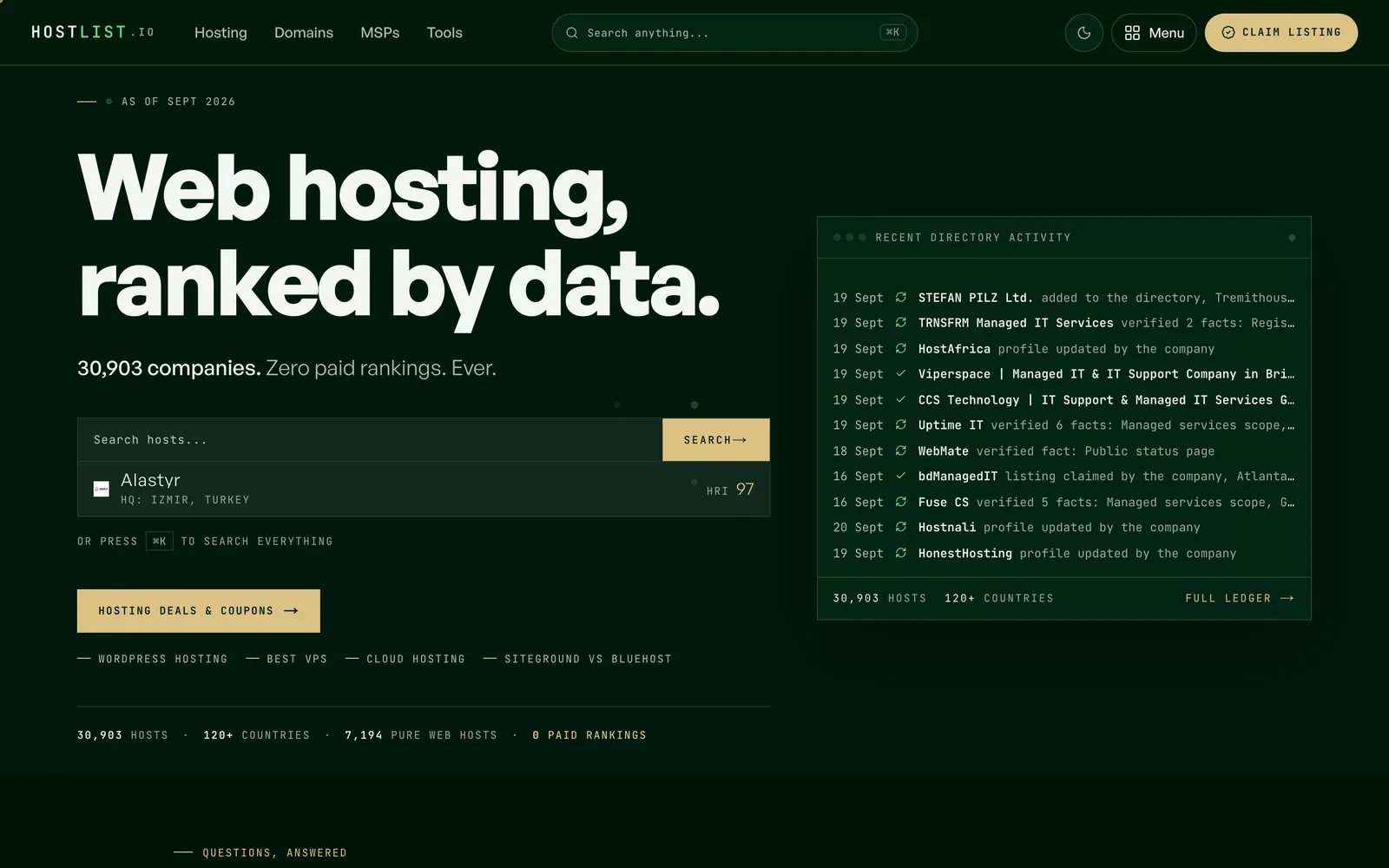
HostList.io says what it is before you read a word of copy. Host, plus list. The wordmark keeps the TLD inside the lockup, letterspaced in mono, with HOST set light and LIST picked out in green so the two halves of the compound stay readable as two ideas rather than one long word. Descriptive names are cheap to explain and expensive to protect. You get instant comprehension and a weaker trademark position, because registries are reluctant to hand anyone a monopoly on ordinary category words.
So the identity has to supply the distinctiveness the name cannot. Here that is the near-black green ground, the heavy grotesque display against mono data type, and a claim the business can be held to: thirty thousand nine hundred and three companies, zero paid rankings, ever. A category-word name plus a specific checkable promise is what stops a descriptive brand reading as generic.
The domain as the name: girl.dad
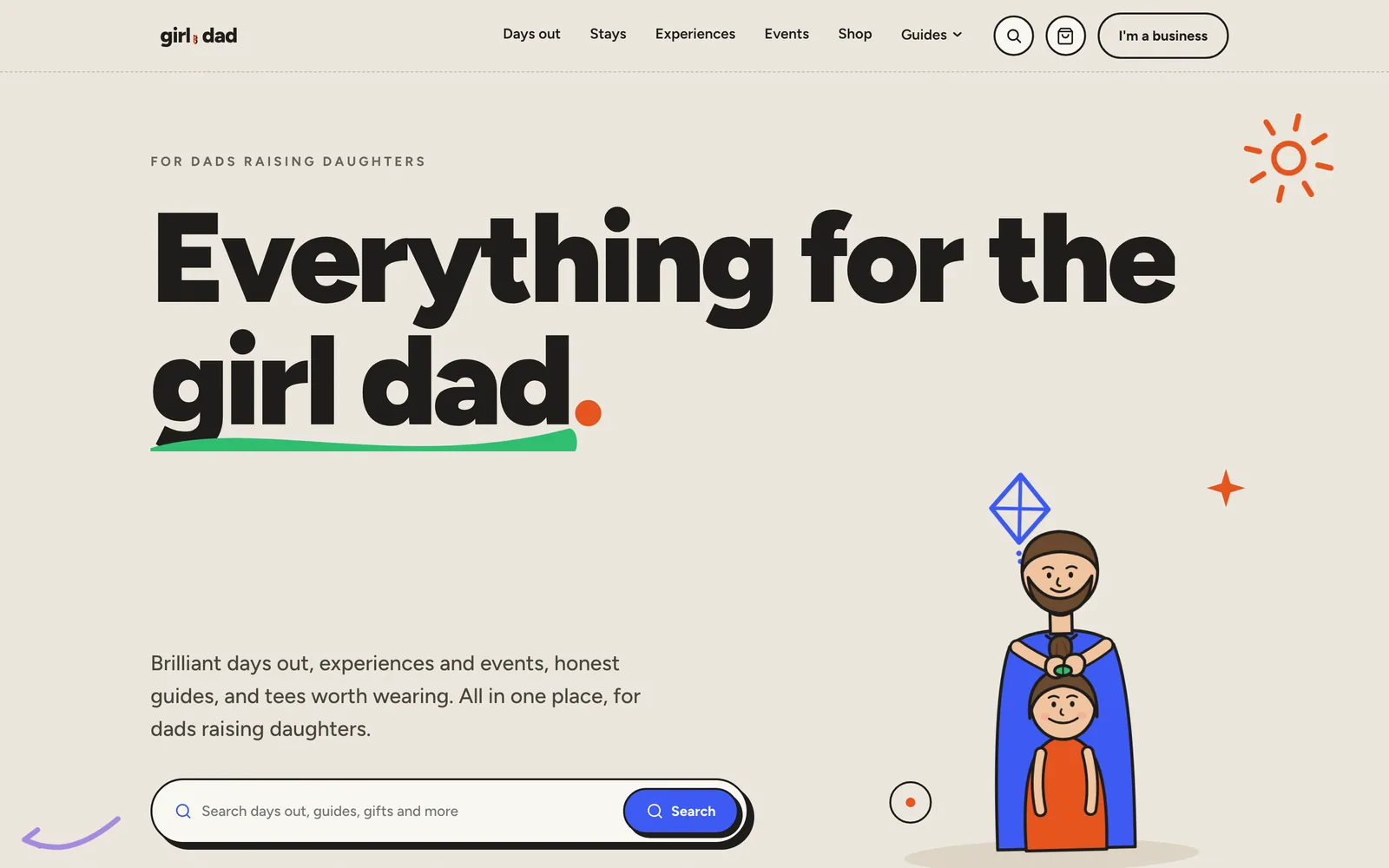
girl.dad does not have a domain. It is one. The TLD finishes the phrase, so the address bar and the wordmark are the same three syllables, and there is no gap between what someone hears and what they type. That is the most efficient naming pattern available right now, and the most exposed: you are renting the back half of your brand from a registry. If pricing or policy on .dad moves, you move with it in a way a .com owner does not.
It was worth taking here because the phrase already existed in the language. The name had no new word to teach anyone. The identity then leans into the warmth the phrase promises rather than fighting it: heavy geometric lowercase, an off-white ground instead of white, an outline illustration set that stays friendly without going childish, and a single orange glyph between the two words as the only place the logo does anything clever. That is about the right amount of clever.
Category plus claim: GemsVerified.com
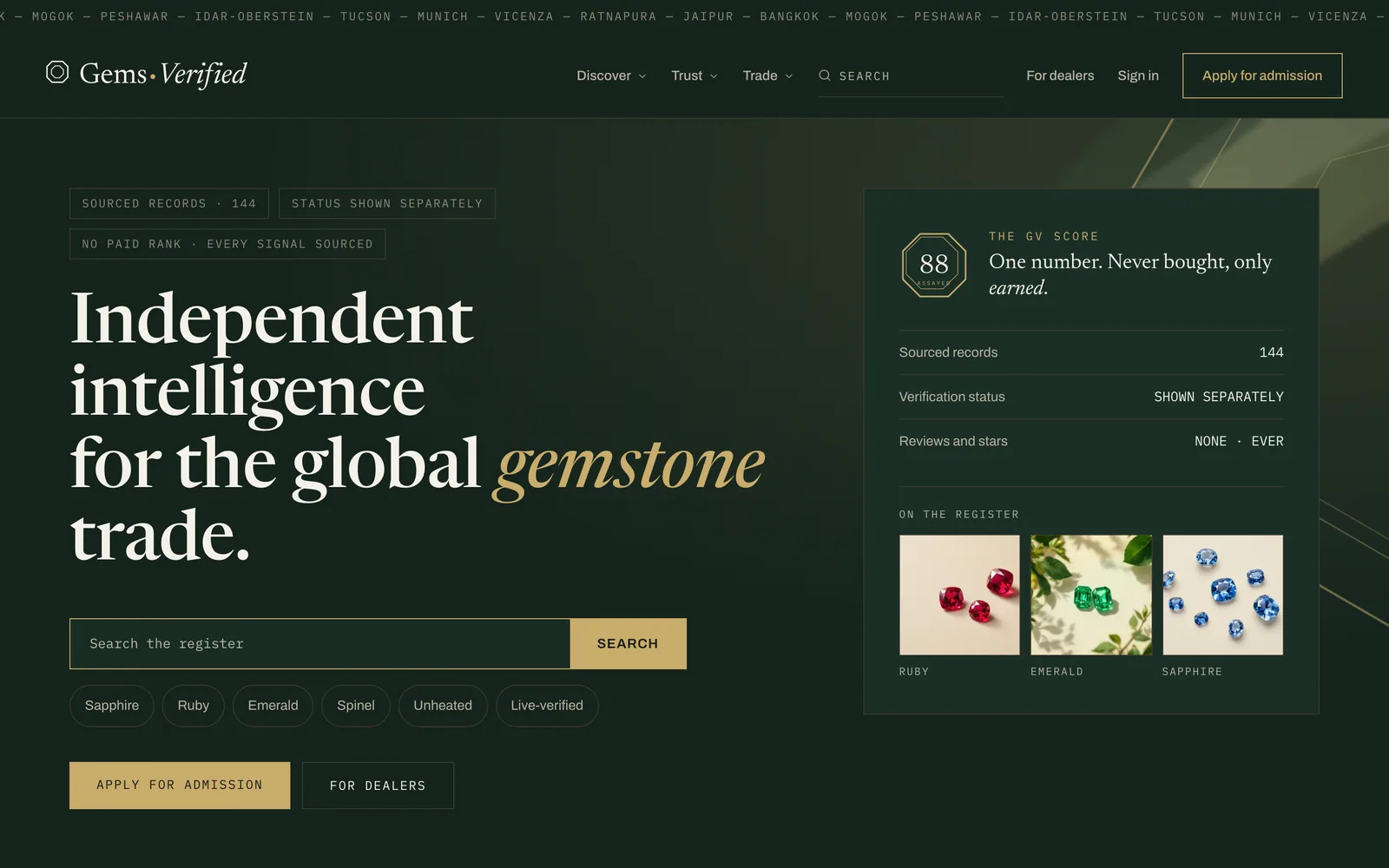
GemsVerified puts the promise inside the name. Category noun, then the thing the product does to it. The pattern buys you positioning for free and writes a cheque the business then has to honour, because a brand called Verified that ships anything unverified has a bigger problem than a naming problem.
Which is why the identity is built as evidence rather than decoration. The mark is an octagonal assayer stamp. The palette reads closer to an auction house than a marketplace, deep green and gold, serif display against mono labels. And the homepage leads with receipts instead of adjectives: one GV score, a hundred and forty-four sourced records, verification status shown separately, reviews and stars none, ever. When the name makes a claim, every surface has to carry proof of it. Harder identity brief. Much better long-term position.
Pick the pattern first, because it decides the brief
Descriptive names need the identity to supply distinctiveness. Domain-phrase names need it to supply warmth and a sense of permanence the registry does not give you. Claim names need it to supply evidence, on every surface, forever. Same three designers, same budget, three completely different jobs. That is the argument for buying naming and identity from the same conversation even when they arrive as two separate invoices.
WIE DU EINE GLOBALE MARKENRECHERCHE SELBST DURCHFÜHRST
Das ist der praktische Workflow. Zwei Stunden, kostenlos, bevor du dich auf einen Namen festlegst. Die Reihenfolge ist wichtig, weil das frühe Erkennen eines Konflikts die Kosten für Recherchen in weiteren Jurisdiktionen spart.
Beginne mit dem USPTO Trademark Search System für die Vereinigten Staaten. Suche exakte Formulierungen und enge Varianten, überprüfe dann verwandte Waren oder Dienstleistungen, anstatt dich nur auf eine Nice-Klassennummer zu verlassen. Ein vorläufiger automatisierter Scan ist nützlich zum Shortlisten, aber das USPTO empfiehlt eine breitere Clearance-Suche über Bundesaufzeichnungen hinaus.
Gehe zu EUIPO TMview oder eSearch plus für Anmeldungen und Eintragungen von Unionsmarken. Nutze dann die WIPO Global Brand Database für Madrid-System-Eintragungen und teilnehmende nationale oder regionale Sammlungen. WIPO empfiehlt, relevante nationale und regionale Register direkt zu durchsuchen, weil die globale Datenbank nicht jede Marke, die bei jedem Office angemeldet ist, enthält.
MARKENRECHT VS. URHEBERRECHT VS. DESIGNRECHT
Diese drei schützen unterschiedliche Dinge und Menschen verwechseln sie ständig, manchmal mitten im Anmeldeprozess, wo die Verwechslung echtes Geld kostet.
Trademark schützt Namen, Logos, Slogans und andere Quellenidentifikatoren, die im Geschäftsverkehr genutzt werden. Alles, das signalisiert: „dieses Produkt kommt von diesem Unternehmen". Die Registrierung ist räumlich gebunden, ein US-Trademark schützt dich nicht in Deutschland, und der Schutz verfällt, wenn er nicht erneuert wird, typischerweise alle zehn Jahre.
WANN MAN EINEN MARKENANWALT EINSTELLT
Engagiere einen qualifizierten Markenspezialisten, sobald du zwei oder drei Kandidatennamen ausgewählt hast und bevor du einreichst oder erhebliche Kosten für den Launch aufwendest. Automatisierte und eigenständige Recherchen können Lautähnlichkeit, verwandte Waren oder Dienstleistungen, eingetragene Rechte und landesspezifische Fragen übersehen.
Professionelle Hilfe ist besonders wichtig, wenn eine Anmeldung mehrere Jurisdiktionen umfasst oder das Madrider System verwendet. Recherchieftiefe, Behördengebühren, Anzahl der Klassen, Anforderungen an lokale Vertreter und Einsprüche können den Umfang erheblich verändern. Fordere eine schriftliche Kostenberechnung für jede Jurisdiktion an, die Recherche, Anmeldung, Antworten und Erneuerungsverpflichtungen abdeckt.
Move to EUIPO TMview or eSearch plus for European Union trade mark applications and registrations. Then use the WIPO Global Brand Database for Madrid System records and participating national or regional collections. WIPO recommends searching relevant national and regional registers directly because the global database does not contain every mark filed with every office.
UKIPO is separate from EU filings since Brexit, so check it independently. National offices for key markets follow — IP India, Japan Patent Office, KIPRIS for South Korea, CNIPA for China, IP Australia. Cover every market where you operate, sell or plan a meaningful launch.
Domain availability comes next — check .com, .co, .io, .ai, plus your country TLD. A name without at least one premium domain at reasonable cost is functionally untenable. Social handles on LinkedIn, X, Instagram, YouTube, GitHub, and TikTok matter for brand integrity; tools like Namechk run them in parallel. Finally, Google the candidate name plus your category to surface unregistered common-law marks. Many jurisdictions still recognise these and they can block your registration even though the prior user never filed.
WIE LANGE EIN MARKENIDENTITÄTSPROJEKT DAUERT
Drei Wochen für eine enge Startup-Brand. Ein Designer, schnelle Entscheidungen, einzelner Founder trifft die Entscheidung. Logo, Typografie, Farbe, grundlegende Richtlinien. Das Ergebnis ist funktionierend aber minimal, genug zum Starten, nicht genug um ein Marketing-Team hochzufahren.
Sechs bis zehn Wochen für ein typisches kleines Geschäftsprojekt. Vollständiges Logo-System, Schriftartsystem, Farbsystem, Anwendungen über Digital und Print, Guidelines-Dokument. Hier sitzen die meisten finanzierten Startups und kleinen Unternehmen.
Zwölf bis zwanzig Wochen für ein Corporate-Identity-Programm. Recherche, eventuell Naming, Identity-System, Anwendungen auf über dreißig Flächen, Animation, Brand-Management-Portal. Der größte Faktor über alle drei Timelines ist nicht die Design-Zeit, sondern wie schnell Entscheidungen fallen. Projekte geraten in Verzug? Fast immer, weil der Kunde zwischen zwei Richtungen nicht wählen kann. Nicht, weil das Studio nicht liefert.
Design rights protect the ornamental appearance of a product — the shape of a bottle, the unique layout of an interface, the silhouette of a piece of furniture. These are called design patents in the United States and design rights elsewhere. A logo is typically registered as a trademark; the artwork inside the logo is also automatically protected by copyright; the product the logo appears on may have its own design rights. They stack rather than substitute.
WAS BRAND IDENTITY 2026 KOSTET
Indie- oder Freelance-Arbeit kostet zwischen eintausendfünfhundert und achttausend US-Dollar. Logo, Schriftart, Farbe, grundlegende Anwendungen, eine-Seite-Guideline. Richtig für Startups, die eine Idee validieren, oder Solo-Gründer, die von null zum launchbar kommen.
Studio-Projekte kosten fünfzehntausend bis fünfundvierzigtausend. Vollständiges Identity-System, Anwendungen über Digital und Print, vollständiges Guidelines-Dokument. Richtig für finanzierte Startups und kleine Unternehmen, bei denen die Marke innerhalb von zwölf Monaten unter ernsthaftem Verkaufsdruck stehen wird.
WARUM ICH DIESEN LEITFADEN SCHREIBE
Ich bin kein Anwalt für Geistiges Eigentum und dies ist keine Rechtsberatung. Konsultiere einen qualifizierten Markenspezialisten für die Recherche, Anmeldung und Beratung zu einem bestimmten Namen.
Ich habe Seahawk Media 2018 mitgegründet und habe seitdem zwölftausend Websites umgesetzt, die meisten davon mit der Brand-Arbeit von Agenturen, Studios und internen Teams in den USA, UK, Europa und Asien. Ich habe beobachtet, was in der Produktion im großen Maßstab funktioniert: welche Richtlinien-Formate tatsächlich befolgt werden, welche Logo-Systeme in Favicon- und Billboard-Größe standhalten und welche Farbpaletten Kontakt mit einem Marketing-Team überstehen, das fünfmal die Woche Inhalte deployed.
Ich habe persönlich Brandy HQ mitgegründet, einen Brand-Identity-Workspace, der Gründern hilft, Logos, Paletten und Richtlinien ohne sechsmonatige Studiotätigkeit zu realisieren. Das Produkt existiert, weil die Lücke zwischen Freiberufler-Fiverr-Arbeit und einem fünfundvierzigtausend-Dollar-Studio-Engagement genau der Platz ist, wo die meisten frühen Marken wirklich sein müssen. Dieses Handbuch behandelt praktische Identität und vorläufige Recherche-Workflows; qualifizierte Anwälte kümmern sich um rechtliche Recherche und Anmeldung.
WHAT BRAND IDENTITY COSTS IN 2026
Indie or freelance work runs one thousand five hundred to eight thousand US dollars. Logo, type, colour, basic applications, one-page guideline. Right for startups validating an idea or solo founders getting from zero to launchable.
Studio engagements run fifteen thousand to forty-five thousand. Full identity system, applications across digital and print, full guidelines document. Right for funded startups and small businesses where the brand will carry serious sales pressure within twelve months.
Corporate identity programmes run seventy-five thousand to three hundred thousand. Research, naming, identity, thirty-plus application surfaces, motion, brand-management portal. Right for funded scale-ups, enterprise rebrands, and acquisitions that need to consolidate brands.
Budget trademark work separately from design. Professional-search and filing fees vary materially by country, number of classes, application route and whether objections arise, so request a written jurisdiction-by-jurisdiction scope.
WHY I AM WRITING THIS GUIDE
I am not an IP attorney and this is not legal advice. Use a qualified trademark professional for clearance, filing and advice about a specific name.
I co-founded Seahawk Media in 2018 and have shipped twelve thousand websites since — most of them carrying the brand work of agencies, studios, and in-house teams across the United States, United Kingdom, Europe, and Asia. I have watched what works in production at scale: which guideline formats actually get followed, which logo systems hold up at favicon and billboard scale, and which colour palettes survive contact with a marketing team that is shipping content five times a week.
I personally co-founded Brandy HQ, a brand-identity workspace that helps founders ship logos, palettes, and guidelines without the six-month studio engagement. The product exists because the gap between freelance Fiverr work and a forty-five thousand dollar studio engagement is the place most early-stage brands actually need to be. This guide covers practical identity and preliminary-search workflow; qualified counsel handles legal clearance and filing.