
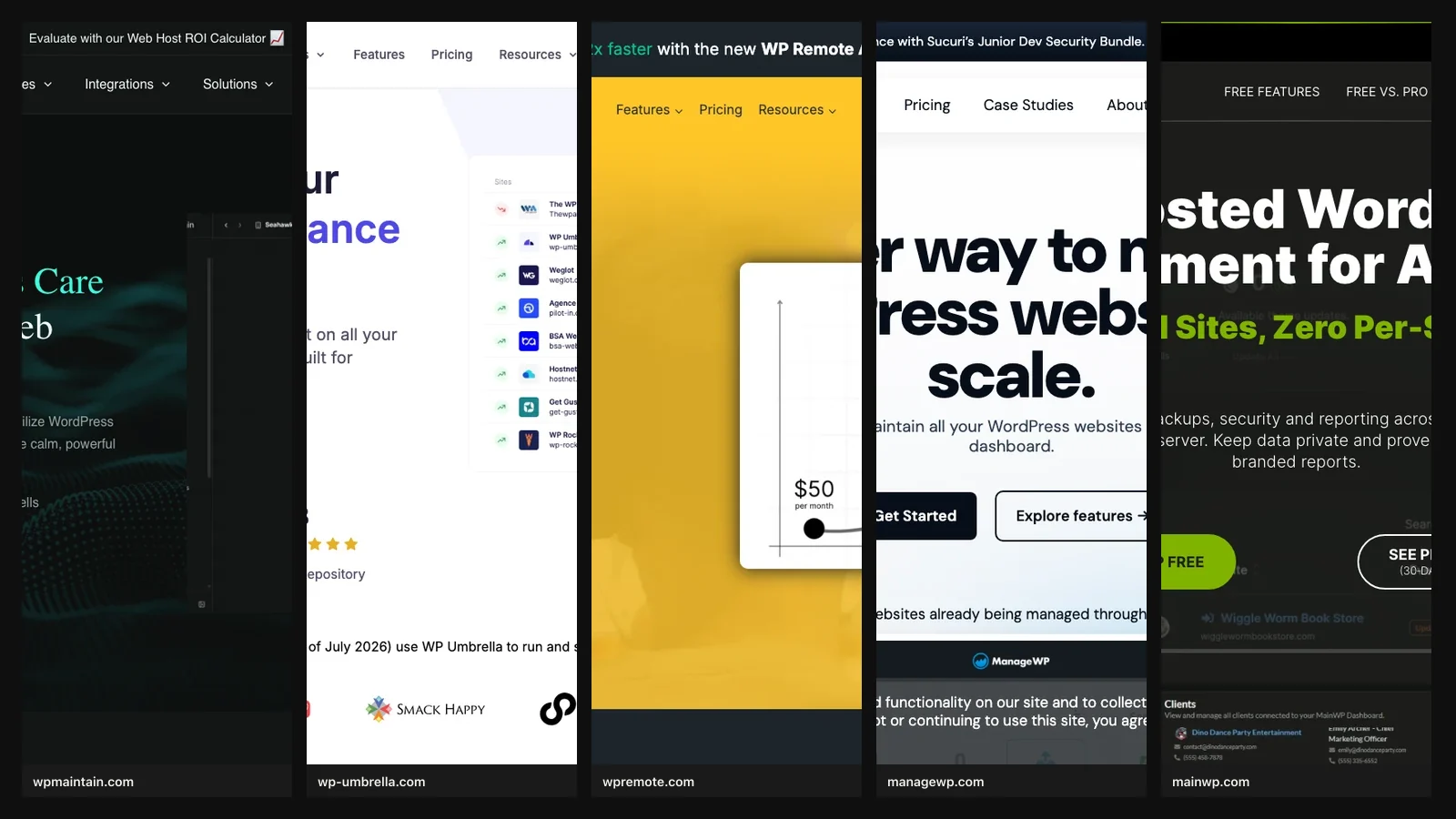
ManageWP was the default answer when an agency asked how to manage fifty client sites from one dashboard. Then GoDaddy acquired it in 2016, add-on pricing crept up, the dashboard aged, and a whole category of alternatives appeared. If you are searching for ManageWP alternatives in 2026, you are probably managing more than a handful of WordPress sites and wondering whether there is something faster, cleaner, or better suited to how you actually work.
I have managed client WordPress sites for over a decade at Seahawk Media. I have been a paying customer of WP Umbrella and WP Remote. I co-own WP Maintain as part of Seahawk. I will be direct about all three. This article ranks the ManageWP alternatives worth considering, explains who each tool is actually for, and makes the case that agencies and hosts running WordPress at scale need a different category of platform entirely.
Key takeaway: Freelancers and small agencies with under twenty sites should compare WP Umbrella, WP Remote, MainWP, and SolidWP. Hosting companies and agencies provisioning care across hundreds or thousands of sites should evaluate WP Maintain — it is infrastructure, not a dashboard plugin.
Why people leave ManageWP in 2026
ManageWP still offers a free core tier and remains the most recognised name in WordPress site management. The problem is the economics and the product direction. Core management is free, but unlocking backups, uptime monitoring, white-label reports, security checks, and vulnerability protection requires premium add-ons that stack to roughly $12 per site per month at list price. Agencies with fifty sites are looking at $600/month before anyone has touched a ticket. Bundle pricing exists at volume, but the model still treats every feature as an optional bolt-on rather than a unified care stack.
The GoDaddy ownership also matters politically, even when the product works. Agencies that compete with GoDaddy hosting do not love routing their entire client portfolio through a GoDaddy-owned SaaS. Data residency, GDPR, and the question of whether your management layer will still exist in five years are legitimate concerns that did not exist when ManageWP was independent.
Most ManageWP alternatives articles — including good ones from WP Umbrella and InstaWP — solve the freelancer-and-small-agency problem well. They compare dashboards, per-site pricing, and white-label reports. What they rarely address is the hosting-company problem: how do you proactively maintain ten thousand WordPress sites, reduce support tickets, embed proof-of-care inside your control panel, and upsell premium care tiers without hiring an army? That is the gap WP Maintain was built to fill.
ManageWP alternatives at a glance
| Tool | Best for | Starting price | Malware removal | Visual regression | Host panel embed |
| --- | --- | --- | --- | --- | --- |
| WP Maintain | Hosts, large agencies, registrars | Custom MSA / ~$6+ retail | Yes (Imunify) | Yes (AI-driven) | Yes (drop-in HTML) |
| WP Umbrella | Freelancers, small agencies | €1.99/site/mo | No (Patchstack virtual patching) | Yes | No |
| WP Remote | Security-first small portfolios | From $15/mo (10 sites) | Yes (one-click restore) | Limited | No |
| WP Foreman | Agencies keeping backups in their own cloud | Free for 1 site, then from $1.99/site | No (vulnerability alerts only) | Before/after screenshots on updates | No |
| MainWP | Self-hosted, privacy-first | Free core / $199/yr Pro | Via extensions | Via extensions | No |
| SolidWP | iThemes/Solid Security users | Bundled | Via Solid Security | No | No |
| ManageWP | GoDaddy-adjacent agencies | Free + add-ons | Via add-ons | No | No |
| InfiniteWP | Self-hosted large portfolios | One-time license | Via extensions | No | No |
| InstaWP | Staging and dev workflows | Usage-based | No | Via staging | No |
1. WP Maintain — best ManageWP alternative for agencies and hosts at scale
WP Maintain is not a ManageWP clone with a fresher UI. It is an infrastructure-grade WordPress care platform built for hosting operations teams, support teams, and agencies that want to monetise maintenance across an entire install base — not log into a dashboard and click update on twelve sites every Monday morning.
Where ManageWP, WP Umbrella, WP Remote, and MainWP all assume you are the operator clicking buttons in a SaaS dashboard, WP Maintain assumes your hosting platform runs care automatically in the background. Sites are bulk-enrolled at provisioning. Updates run with guardrails on staging. Visual regressions are caught by AI before customers notice. Proof-of-care reports embed directly inside your control panel via a drop-in HTML component. Customers see that their site is maintained without installing anything or opting in.
This is the fundamental category difference. Every other tool on this list works for a person managing even one site. WP Maintain works for a company managing ten thousand.
What WP Maintain includes that ManageWP alternatives typically do not
Safe updates with staging guardrails. Plugin, theme, and core updates run through controlled staging workflows with labels for sites that require manual handling. Not just bulk update and pray.
AI-driven visual regression testing. The Regression Test Agent captures pixel-accurate snapshots before and after every update, uses AI to detect layout breaks (not just pixel diffs), and can auto-rollback the offending update before customers are affected. ManageWP has no equivalent. WP Umbrella added VRT recently but targets the agency dashboard, not fleet-wide hosting operations.
Premium and nulled license coordination. Wordfence data shows 20% of hacked WordPress sites trace back to nulled plugins or themes. WP Maintain's Premium License Coordination triages every managed site for expired or pirated premium software and coordinates customer outreach to fix it — a manual, human-driven layer that no automated scanner can replace. No other tool on this list does this at the platform level.
Native malware scan and removal. Essentials Care includes security monitoring powered by Imunify (scan and remove). This matters because not every alternative includes native malware remediation — see WP Umbrella below.
Proof-of-care reporting with upsell triggers. White-label reports show customers what was monitored, updated, and prevented. Reports embed in your hosting panel and drive natural upsells to higher-tier WP Care plans ($29 to $199/month retail tiers fulfilled by Seahawk Pro Services). ManageWP white-label reporting is a paid add-on. WP Maintain treats reporting as infrastructure.
mAIn Chat — AI co-pilot wired to your fleet data. Connect Claude, OpenAI, or Gemini to WP Maintain site data so support staff diagnose issues with full site context instead of logging into WordPress blind. Chat-to-staging execution is coming — plain-English changes executed through safe staging without touching production.
API-first host integration. Deploy in hours via the WPM connector plugin, API access, and panel embed. Integrations include Google PageSpeed Insights, Imunify, BitNinja, Google Analytics, and flexible API slots for hosts who want their own stack. Pricing is volume-based MSA for hosts, with suggested retail tiers at $6/$9+ for foundational care and $29–$199 for Pro Services tiers.
ROI modelling built in. Before you commit, run your numbers through the WP Care ROI Calculator. It models support ticket savings, escalation reduction, emergency incident avoidance, churn recovery, and upsell revenue projections across a five-year horizon. Patchstack, Hostinger, and Wordfence data underpin the defaults. Replace with your actual ticket volumes and the model becomes precise.
Who WP Maintain is not for
If you are a freelancer managing five client sites and you want a clean dashboard to bulk-update plugins on a Sunday, WP Maintain is overkill. Use WP Umbrella or MainWP. WP Maintain is for the hosting company with five hundred WordPress sites generating support tickets every time a plugin auto-updates badly, or the agency that wants to productise care and embed it in client hosting plans rather than invoice maintenance hours manually.
2. WP Umbrella — best ManageWP alternative for small agencies on a budget
I have used WP Umbrella on client sites. It is good software. The dashboard is fast and modern — genuinely faster than ManageWP's interface. Flat pricing at €1.99 per site per month with every feature included beats ManageWP's add-on stacking. Uptime monitoring runs in-house with fewer false positives than many competitors. White-label client reports are included, not gated. Patchstack-powered vulnerability scanning is solid. Visual regression testing is available. For an agency managing ten to thirty sites, WP Umbrella is probably the best pure ManageWP replacement in 2026.
The honest limitation: WP Umbrella does not include native malware protection or removal. It relies on Patchstack virtual patching — which patches known vulnerabilities at the application layer without scanning for existing infections. Virtual patching is valuable for prevention. It is not the same as detecting that a site is already hacked, quarantining the malware, and restoring clean files. If your care plan promises "we fix hacked sites," WP Umbrella alone does not fulfil that without a separate security tool. WP Remote handles this better. WP Maintain includes Imunify scan-and-remove natively.
WP Umbrella is also built for the agency operator, not the hosting platform. There is no panel embed, no bulk provisioning at host level, no license coordination for nulled plugins, and no upsell path from automated care to human-delivered Pro tiers. For a freelancer or boutique agency, that is fine. For a host with ten thousand sites, it does not scale operationally.
3. WP Remote — best ManageWP alternative for security-first small portfolios
I have also used WP Remote (formerly MalCare). The UI is not great — I will say that plainly. The dashboard feels like it was designed three product iterations ago and never fully refreshed. Navigation is functional but sluggish compared to WP Umbrella's interface. If UI polish is your primary selection criterion, WP Remote will frustrate you.
But the security layer is genuinely excellent. Malware scanning and one-click restore are WP Remote's core strength. When a site is compromised, the restore workflow is among the fastest I have used in any WordPress management tool. Clean backup, one click, site back online. For agencies whose primary care deliverable is "we keep your site secure and fix it when it breaks," WP Remote delivers that promise better than WP Umbrella.
Pricing is bundle-based: $15/month for up to 10 sites, scaling to $99/month for 200 sites. The per-site cost depends on which tier you land in, which is less transparent than WP Umbrella's flat rate. Features include updates, backups, uptime monitoring, and security — a complete stack, just not a beautiful one.
Same category limitation as WP Umbrella: WP Remote is a dashboard for a person, not infrastructure for a host. No visual regression at the fleet level, no panel embed, no license coordination, no care upsell engine. Excellent for twenty sites. Awkward for two thousand.
4. WP Foreman — best ManageWP alternative for backups in storage you own
WP Foreman is the newest tool on this list, built by Nate Baldwin, an agency owner who ran client sites on ManageWP for 12 years. That history shows in the feature set. It covers the jobs ManageWP users actually lean on (bulk core, plugin and theme updates with a backup taken first, uptime, SSL and domain-expiry alerts, white-label client reports) and then adds a few that ManageWP either charges extra for or never built.
Backups go where you choose. Encrypted incremental backups with at least 90 days of history, stored either in WP Foreman's storage or in your own Google Drive, Dropbox or S3 bucket, with one-click restore, clone and migrate. For agencies that want client backups sitting in an account they control rather than a vendor's, that alone is a reason to shortlist it.
Pricing starts free: the first site gets every feature with no card. After that it is per site, from $1.99, with the rate dropping in bands as you add sites, unlimited team members, and two months free on yearly billing. Every plan also includes daily vulnerability scanning with the fixing update named in the alert, daily PageSpeed checks, before-and-after screenshots on updates, a log of changes made in wp-admin, a public API and webhooks, and an AI assistant called Ask the Foreman.
The limits are worth knowing. Vulnerability scanning flags and alerts; it does not patch, and there is no malware removal, so pair it with a security tool if you promise hack clean-up (virtual patching is listed as a planned paid add-on). Like WP Umbrella and WP Remote, it is a dashboard for an operator rather than infrastructure for a host; server-level connections for xCloud and GridPane are listed as coming next. I have not run WP Foreman on client sites yet, so this entry is based on its published features and pricing as of October 2026. I will update it after a hands-on test.
5. MainWP — best self-hosted ManageWP alternative
MainWP is the open-source, self-hosted answer. Install the dashboard on your own WordPress site, connect client sites via the MainWP Child plugin, and manage unlimited sites without per-site SaaS fees. The core is free. MainWP Pro at $199/year unlocks premium extensions. Total cost at fifty sites: roughly $199/year plus your server — versus $600+/month on ManageWP premium or €1,200/year on WP Umbrella.
The tradeoff is operational overhead. You maintain the dashboard server, manage extension updates, configure backups to your own storage, and build your own reporting workflow. MainWP is the right answer for technical agencies that want data sovereignty and already have infrastructure. It is the wrong answer for teams that want care to run itself. MainWP also has no native visual regression, no AI-driven rollback, no malware removal in core, and no host panel integration — all of those require third-party extensions with varying quality.
6. SolidWP (formerly iThemes Sync) — best for existing Solid Security users
SolidWP, formerly iThemes Sync and before that BackupBuddy's ecosystem, bundles remote management with Solid Security, Solid Backups, and StellarSites hosting. If you already run Solid Security on client sites, the management layer is a natural extension. Remote updates, backups, and security monitoring work without adding another vendor.
Outside the Solid ecosystem, SolidWP is less compelling. The dashboard is competent but not best-in-class. Pricing bundles management with security products you may not need. Visual regression, license coordination, and host-level provisioning are not part of the story. SolidWP appears in most ManageWP alternatives lists — including HighGround's 2026 roundup — because of brand recognition in the WordPress security space, not because it leads on features.
7. ManageWP — still viable at small scale on GoDaddy infrastructure
ManageWP remains usable if you are already inside GoDaddy's hosting ecosystem and your portfolio is small enough that add-on pricing does not hurt. Bulk updates, backups, cloning, and SEO tools all work. The free tier covers basic management for unlimited sites. Premium add-ons unlock the features agencies actually need — and that is where the cost adds up.
ManageWP is the incumbent this entire category exists to replace. It set the template: worker plugin, central dashboard, bulk operations. Every alternative on this list follows that model. None of them, except WP Maintain, moved the category forward to infrastructure-grade fleet care.
8. InfiniteWP — self-hosted for large portfolios on a budget
InfiniteWP offers a self-hosted dashboard with a one-time license fee rather than recurring per-site SaaS costs. Unlimited sites on your own server. The model is similar to MainWP — you own the infrastructure, you manage the extensions, you handle backups and storage. InfiniteWP targets agencies with large portfolios that want to escape monthly SaaS bills entirely.
Product velocity has slowed compared to WP Umbrella and WP Remote. The dashboard works but feels dated. Security, VRT, and reporting require paid add-ons. For a cost-conscious agency with a sysadmin on staff, InfiniteWP still makes financial sense at scale. For everyone else, MainWP or WP Umbrella are better defaults in 2026.
9. InstaWP — best ManageWP alternative for staging and development
InstaWP solves a different problem. It is not really a ManageWP replacement for production site management — it is a staging and development platform. One-click staging environments, real-time debugging, Git integration, migration tools, and team collaboration on temporary sites. Agencies that need to test plugin updates before pushing to production will find InstaWP more useful than ManageWP for that specific workflow.
InstaWP does not replace ongoing care — monitoring, updates, reporting, security remediation across a live client portfolio. It complements a care platform like WP Maintain or a dashboard tool like WP Umbrella. Several ManageWP alternatives articles, including InstaWP's own comparison piece, position it as the top overall alternative. That is true if your primary pain is staging. It is misleading if your primary pain is maintaining five hundred live client sites.
10. BlogVault — best ManageWP alternative for backup-centric workflows
BlogVault built its reputation on incremental backups and one-click staging. Real-time backups, migration, and restore are excellent. Management features — bulk updates, monitoring, client reports — exist but are secondary to the backup story. Agencies that came to ManageWP primarily for backups often land on BlogVault when they leave.
BlogVault is backup infrastructure with management bolted on. WP Remote is security infrastructure with management bolted on. WP Umbrella is management infrastructure with security patched in. WP Maintain is care infrastructure with backup, security, VRT, and reporting built as one operational layer. Pick the tool whose core strength matches your primary deliverable.
Two categories of ManageWP alternatives — and why it matters
Every comparison article in this space — WP Umbrella vs ManageWP, WP Umbrella vs WP Remote, InstaWP's roundup, HighGround's agency list — compares tools in the operator dashboard category. One person, one login, one screen full of client sites. That model works from one site to roughly fifty. It breaks down when you are a hosting company provisioning WordPress at scale.
WP Maintain is the only tool on this list built for the hosting infrastructure category. Sites enrol automatically at provisioning. Care runs in the background without customer opt-in. Reports embed in your panel. Support tickets drop because issues are caught upstream. Premium care tiers upsell through proof-of-value, not sales calls. The ROI calculator models the economics: ticket deflection, escalation reduction, churn prevention, and ARPU expansion from care upsells.
If you are a freelancer comparing dashboards, WP Umbrella and WP Remote are your decision. If you are a hosting operator or agency building care into your product, the comparison set is different — and ManageWP was never designed for that job.
Feature comparison: WP Maintain vs the field
Bulk safe updates: All tools offer bulk updates. Only WP Maintain adds staging guardrails, update confidence scoring, and AI regression testing with auto-rollback across the full fleet.
Malware protection: WP Remote (excellent one-click restore). WP Maintain (Imunify scan and remove, plus hacked site repair Pro tiers). ManageWP (paid add-on). MainWP (extension). WP Umbrella (Patchstack virtual patching only — no native malware removal).
Visual regression testing: WP Maintain (AI-driven, fleet-wide, auto-rollback). WP Umbrella (available). WP Remote (limited). ManageWP, MainWP, SolidWP, InfiniteWP (none native).
White-label client reports: WP Maintain (proof-of-care, panel-embeddable). WP Umbrella (included). ManageWP (paid add-on). WP Remote (basic). MainWP (extension).
Nulled/expired license coordination: WP Maintain only.
Host panel integration: WP Maintain only (drop-in HTML embed, API provisioning).
Care upsell engine: WP Maintain only (retail tiers $29–$199/mo via Seahawk PSP).
AI support co-pilot: WP Maintain mAIn Chat only (Claude, OpenAI, Gemini wired to fleet data).
Self-hosted option: MainWP, InfiniteWP. Everything else is SaaS.
How to choose the right ManageWP alternative
Under 20 sites, budget-conscious, want the best dashboard: WP Umbrella. Flat €1.99/site, modern UI, VRT, Patchstack scanning. Add a separate malware tool if you promise hack remediation.
Under 20 sites, security is the primary deliverable: WP Remote. Accept the UI. Trust the one-click restore.
Under 50 sites, want self-hosted and full data control: MainWP. Free core, $199/yr Pro, your server.
Want backups in your own Google Drive, Dropbox or S3: WP Foreman. First site free, then from $1.99/site.
Staging and dev workflows matter more than production care: InstaWP.
Already on Solid Security across your base: SolidWP.
Hosting company, registrar, or agency with 100+ sites to productise care: WP Maintain. Run the ROI calculator, then book a demo.
Model your WP Care ROI before you switch
Switching management tools has a cost — migration time, retraining, client communication. Before you move, quantify the upside. The WP Care ROI Calculator on WP Maintain lets you input your fleet size, support ticket rates, escalation percentages, emergency incident frequency, and staff costs. It outputs annual savings from proactive maintenance, net of platform license cost, plus five-year upsell revenue projections if you productise care tiers.
Even if you choose WP Umbrella or MainWP instead of WP Maintain, running the calculator tells you what proactive care is worth to your business — which makes the conversation with clients about care plan pricing much easier.
FAQ
What is the best ManageWP alternative in 2026?
For freelancers and small agencies: WP Umbrella (best overall dashboard, €1.99/site) or WP Remote (best security, weaker UI). For self-hosted: MainWP. For hosting companies and large agencies productising care at scale: WP Maintain.
Is WP Umbrella better than ManageWP?
For most small agencies, yes. WP Umbrella includes more features at a lower flat rate, with a faster dashboard and no add-on stacking. ManageWP still wins on brand recognition and GoDaddy ecosystem integration. WP Umbrella does not include native malware removal — ManageWP does not either without a paid add-on.
Does WP Remote have better security than WP Umbrella?
For active malware remediation, yes. WP Remote's one-click restore and scanning are stronger than WP Umbrella's Patchstack virtual patching approach. WP Umbrella has the better dashboard and reporting. Many agencies use WP Remote for security-critical clients and WP Umbrella for the rest.
What makes WP Maintain different from ManageWP alternatives?
WP Maintain is infrastructure for hosting operations, not a dashboard for an operator. It bulk-provisions care at host level, embeds proof-of-care in control panels, coordinates nulled license remediation, runs AI visual regression across fleets, and provides an upsell path to human-delivered Pro care tiers. No other ManageWP alternative targets the hosting-company use case.
How much does WP Maintain cost?
WP Maintain uses volume-based MSA pricing for hosts — contact for a quote. Suggested retail care tiers start at $6–$9+/month for foundational automated care and scale to $29–$199/month for Pro Services tiers with human-delivered tasks, SLAs, and hacked site repair. Use the ROI calculator to model your specific economics.
Can I migrate from ManageWP to WP Maintain?
Yes. WP Maintain installs via the WPM connector plugin on each site. Existing sites can be bulk-enrolled by plan, server, or customer segment. Most hosts integrate in hours, not weeks. Migration from ManageWP, MainWP, or any worker-plugin-based tool is straightforward because the connector replaces the existing worker.
Disclosure
I am Co-Founder and COO of Seahawk Media, the company behind WP Maintain. I co-own WP Maintain and have a commercial interest in it. I have also been a paying customer of WP Umbrella and WP Remote — both are competent products and the assessments above reflect my genuine experience, not marketing positioning. WP Umbrella has the better dashboard. WP Remote has the better malware restore. WP Maintain is built for a different buyer entirely: hosting companies and agencies productising care at scale. Evaluate all three against your actual portfolio size and business model.
Next step: Run your numbers on the WP Care ROI Calculator or book a WP Maintain demo if you are a host or agency ready to productise WordPress care.