Law firm website design that reads like a senior partner wrote it
Legal websites have the most predictable failure modes in the entire web design category. Slow, generic, full of stock photos, ranking nowhere on Google. The version that wins is the one that reads like the firm.
BOOK YOUR 30-MIN CALL Discuss your website
Who I build for
Law firms have the worst-performing websites in any commercial category in the UK and US. The reasons are structural: generic agency copy, stock photography, slow WordPress builds, no real SEO transport. The win comes from the opposite: writing that reads like a partner, performance that does not embarrass the firm, and SEO that genuinely ranks.
The legal clients I take on tend to fit one of these three shapes:
- Boutique law firms (5-50 partners) competing on local Google searches for specific practice areas
- Solicitor practices in the UK regions or central London serving SME clients
- Solo lawyers and consulting practices needing a credible brand site that does not look DIY
What legal businesses get wrong about their websites
Local SEO + LocalBusiness schema, not generic SEO
'Lawyer near me' searches dominate the legal category. Local pack rankings depend on Google Business Profile + LocalBusiness schema with proper geo coordinates + practice-area-specific landing pages. Generic SEO advice does not move the needle here.
Practice area pages are the conversion engine
Most law firm sites have one 'Services' page. The firms that rank build a dedicated page per practice area (employment law, immigration, conveyancing, family law, etc.) with deep content. Rank for the long-tail searches the firm actually wins on.
GDPR + cookie compliance is non-negotiable
UK and EU law firms with consumer-facing sites need genuine cookie consent and GDPR data handling. The kind of cookie banner that is technically there is not enough. Get this wrong and you have a regulatory complaint about your own marketing.
What a legal website has to include
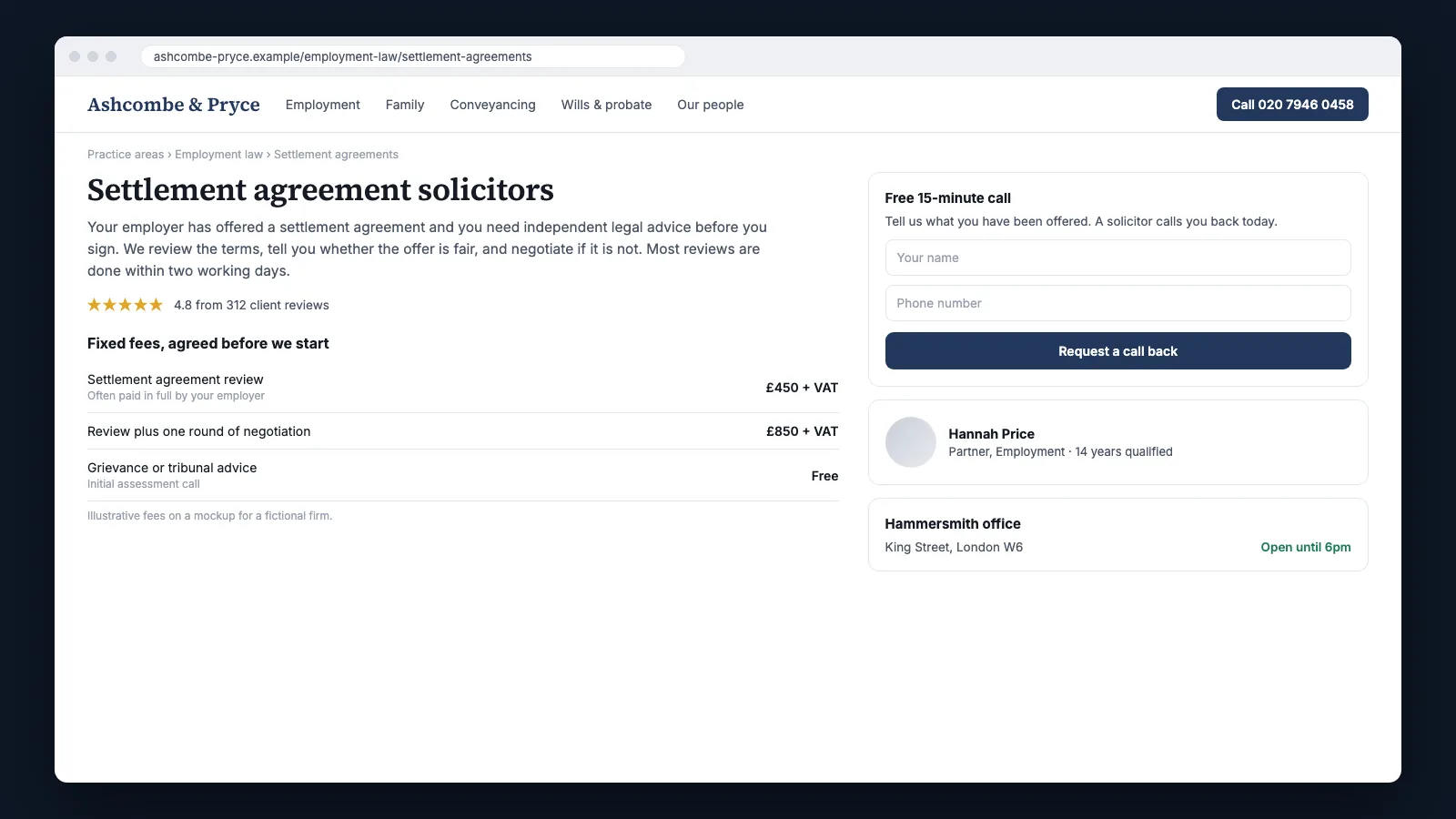
- A page for every practice area, and every sub-area that people search for Employment law is not one page. Settlement agreements, unfair dismissal and discrimination each get their own, with the process, the likely cost and the people who handle it. These long-tail pages are where a small firm can outrank a large one.
- Prices or a quote tool where the rules expect them SRA price transparency rules already require published pricing for services such as conveyancing, probate and employment tribunal claims. Irwin Mitchell, Stephensons and Kingsley Napley go further, with calculators, instant quotes and fixed-fee options. And the page converts better for it.
- An office page for each location Address, opening hours, a local phone number, directions, parking and the lawyers based there, with LegalService markup. It is the page that ranks for '[town] solicitors', and it feeds the Google Business Profile.
- Named people on every practice page List the solicitors who will handle the matter, with profile pages showing qualifications and experience. Clients choose a person as much as a firm. Named experts are a trust signal for search engines too.
- A way to talk today Click-to-call, a callback request and, if the team can staff it, live chat, visible on every page. Most legal enquiries are urgent. A contact form answered tomorrow loses the client to the firm that called back today.
- FAQs that answer the real questions How long it takes, what it costs, what happens next, whether I need to go to court. Answer them on the practice page and mark them up with FAQPage schema, as Irwin Mitchell, Morgan & Morgan and Cordell & Cordell do.
Legal websites worth studying
No affiliation with any of these businesses. They are here because each one gets a specific part of the job right, and that part is worth copying.
- Irwin Mitchell UK
Every office has a page of its own, covering the address, opening hours, parking, walking time from the station and an FAQ. The conveyancing page pairs a fee calculator with a public pricing page. That page sets out rate bands and starting fees.
- Stephensons UK
An instant conveyancing quote and a fixed-price services page sit one click from the homepage. Callback and chat options appear on every page. Office pages carry LegalService markup and link to local pages for each area of law, such as employment, injury and probate in that town.
- Kingsley Napley UK
Visitors can find help by area of law, by their situation, or by who they are, such as founders or regulated professionals. The family page lists the full team with profile links. It also explains a fixed-fee option for settling finances on divorce.
- Morgan & Morgan US
Every office has its own page, with local attorneys, Google reviews, local case results, and LegalService, opening hours and FAQ markup. The personal injury page leads with a free case evaluation form and a plain explanation of how contingency fees work.
- Cordell & Cordell US
Office pages show the address, opening hours, a local phone number, the attorneys based there and the languages the office speaks. Practice pages open with main takeaways and a table of contents, then close with an FAQ marked up for search.
- Cooley US
Cooley GO gives founders free guidance by company stage, plus a generator for documents such as incorporation packages and NDAs. Office pages name the partners in charge with direct contact details. Practice pages open with recent deals.
How I work
I am the senior on every engagement, with twelve years and more than five thousand sites of practice behind the process. The build runs on Next.js, Astro or headless WordPress depending on who edits the site, and if you are replacing an existing site, the redirects, metadata and schema move across with it so the rankings do too.
Legal website design FAQs
Should a law firm publish its fees on the website?
For conveyancing, probate, employment tribunal claims and several other services, the SRA transparency rules already expect it in England and Wales. But even beyond the rules, clear fixed fees or a quote tool answer the first question most clients have. Pages that do this tend to convert better.
How many practice area pages does a law firm website need?
One for each service you want to be found for, including the sub-areas people search for directly, such as settlement agreements or lasting powers of attorney. A single 'services' page cannot rank for any of them.
Do we need a page for each office?
Yes, if you have more than one. Each office page needs its own address, hours, phone number, directions and local lawyers, plus LegalService markup and a matching Google Business Profile.
What schema does a law firm website need?
LegalService markup on each office page with address, geo coordinates and opening hours. Person markup on solicitor profiles. FAQPage markup where you answer questions, and breadcrumbs across the site. Keep it identical to what the page shows.
Is live chat worth it for a law firm?
Only if someone can answer it during the hours it is shown. A callback request with a same-day promise often does the same job with less overhead. Click-to-call on mobile matters more than either.
Related services and industries
When you're ready
Book a 30-minute call. No slide deck, no qualification screen. You describe the legal business, the brief, the timeline. I tell you whether I am the right person, and by the end of the call you have a stack pick, a price range, and a realistic delivery window.