

A good brand name is one that clears five checks before anyone gets attached to it: it is linguistically safe, free of trademark conflicts in your target markets, available as a domain, available as social handles, and distinct enough that search engines and AI assistants don't confuse it with something else. Most naming advice stops at "make it memorable". That's the easy bit. This post lays out a six-stage process (brief, generation, screening, testing, clearance, launch) with a pass/fail screen at each stage, so weak names die cheaply and early. It's aimed at founders and marketing leads naming a company, a product or a rebrand. One caveat up front: this is not legal advice.
Why names fail after launch
Names rarely fail because they were ugly. They fail because someone found a problem after the money was spent. Four problems account for most of it.
Trademark conflicts. Someone already owns a similar mark in your category, and you find out after the signage, the packaging and the domain renewals. One of the naming guides I read puts it bluntly: delaying trademark checks is risky, because legal availability is complicated and a name has to be protectable across markets from the start. Not at the end. From the start.
Unavailable domains and handles. You can live with a slightly clumsy domain, but you can't live with a name where the obvious domain belongs to a competitor and the handle belongs to a dormant account that will never be released. Customers type the obvious thing. If the obvious thing lands on somebody else, you're paying to advertise for them.
Pronunciation and spelling. The same guide calls this the say-spell test: if people can't pronounce, spell or remember your name, they won't recall it or recommend it. Word of mouth is a spoken channel. A name that needs spelling out loud every time it's mentioned is taxing a channel you can't buy.
AI confusion. This one is new enough that most checklists skip it. Starfish describes the scenario well: a coined name in a crowded SaaS category that clears trademark but reads ambiguously to answer engines. A specialist declares victory at clearance, while the name quietly gets described as another company, or as a generic word. Legal availability and findability are different tests. You need to pass both.
So the process below treats each of those failure modes as a gate. If a name can't pass the gate, it doesn't proceed. No exceptions for names the CEO loves (especially not those).
Stage 1: write the brief before any names
Stage 1 is where you decide what a "good" name even means for this business. Skip it and every later stage turns into taste arguments. Lexicon's David Placek describes his agency's process as three steps: identify, invent, implement. The brief is the identify step, and in his telling the goal isn't just a good name but the right one.
A usable brief fits on one page and answers these:
- Positioning. What does the company do, for whom, and how is it different from the two or three nearest alternatives? One sentence each.
- Audience. Who says this name out loud, and in what setting? A name for developers on Slack has different needs from one for parents in a pharmacy.
- Markets. Where will you sell in year one, and where in year three? Trademark and linguistic checks happen per market, so you need the list now.
- Languages. Which languages will your customers, suppliers and press use? These are the languages you'll screen in Stage 3.
- Constraints. Length ceiling, tone, words to avoid, competitor names to stay away from.
Pick your name types on purpose
Naming guides slice the types slightly differently (Starfish lists descriptive, suggestive, arbitrary and coined, for example), but five buckets cover most real candidates:
| Type | What it is | Trade-off |
|---|---|---|
| Descriptive | Says what you do | Easy to understand, hard to trademark, easy to outgrow |
| Suggestive | Hints at a benefit or feeling | Protectable, needs a little explaining |
| Abstract | A real word with no link to the category | Distinctive, needs marketing weight to mean something |
| Compound | Two words fused | Flexible, but domains get crowded fast |
| Invented | A coined word | Strongest legally, weakest on instant meaning |
Descriptive names deserve a warning. Tiepograph calls overly descriptive names "category cages": they're often long, consumers shorten them anyway, and they struggle once the brand expands. The opposite trap is copying the category pattern because it feels safe. Your competitors, as that guide puts it, are hoping you blend in.
Stage 1 pass/fail: can someone who wasn't in the room read the brief and tell you which two name types you're hunting for, and why? If not, it fails. Rewrite it.
Stage 2: generate volume first, then filter
The mistake here is filtering while you generate. Someone says "that's taken" or "that's weird" and the room goes quiet. You end up with eight names, all safe, all similar. Starfish notes that naming teams generate hundreds, sometimes thousands of candidates before anything is cut, using everything from linguistic construction to metaphor mapping to computational tools. You don't need thousands. But a long list of a hundred or so, sorted by type against your brief, beats a short list every time.
Some ways to get volume without going dry:
- Run each name type as its own session. Twenty minutes on descriptive, twenty on suggestive, and so on. Constraints produce more ideas than "just brainstorm".
- Mine adjacent vocabulary. Metaphors from other fields, old words, words from languages your audience speaks (you'll screen them properly later).
- Build compounds mechanically. Take two lists of roots and cross them. Most results are rubbish. A few aren't.
- Use a generator for raw material. Let software produce the dull 80% so humans can spend energy on the odd 20%.
Where generators help, and where they stop
Generators are good at bulk and at combinations you wouldn't try. They're bad at knowing what your name should mean, whether it sounds right aloud, and whether it's safe to use. A generator has no idea that your target market's second language has a rude near-homophone. It can't run a proper trademark clearance either. Treat the output as a raw list, nothing more. If you want to see candidates with a first-pass trademark angle attached, the business name generator with trademark checks is one way to produce a long list quickly, as long as you treat what it returns as a starting point for Stage 3 rather than a verdict.
Same goes for general-purpose AI chat tools. They'll happily give you fifty names in ten seconds, and most will be bland blends of whatever dominates the category. That's the comfort trap again, just faster.
Stage 2 pass/fail: you pass with a long list, sorted by type, with at least some candidates from each of your chosen types. Fail if every name sounds like a competitor's. If the list reads like the category's greatest hits, go back and generate again with a rule that bans category words.
Stage 3: screen hard before you fall in love
Screening is boring, and boredom is why people skip it. But this is the stage that kills names, and it's cheapest here. A knockout search takes minutes. Rebranding takes months.
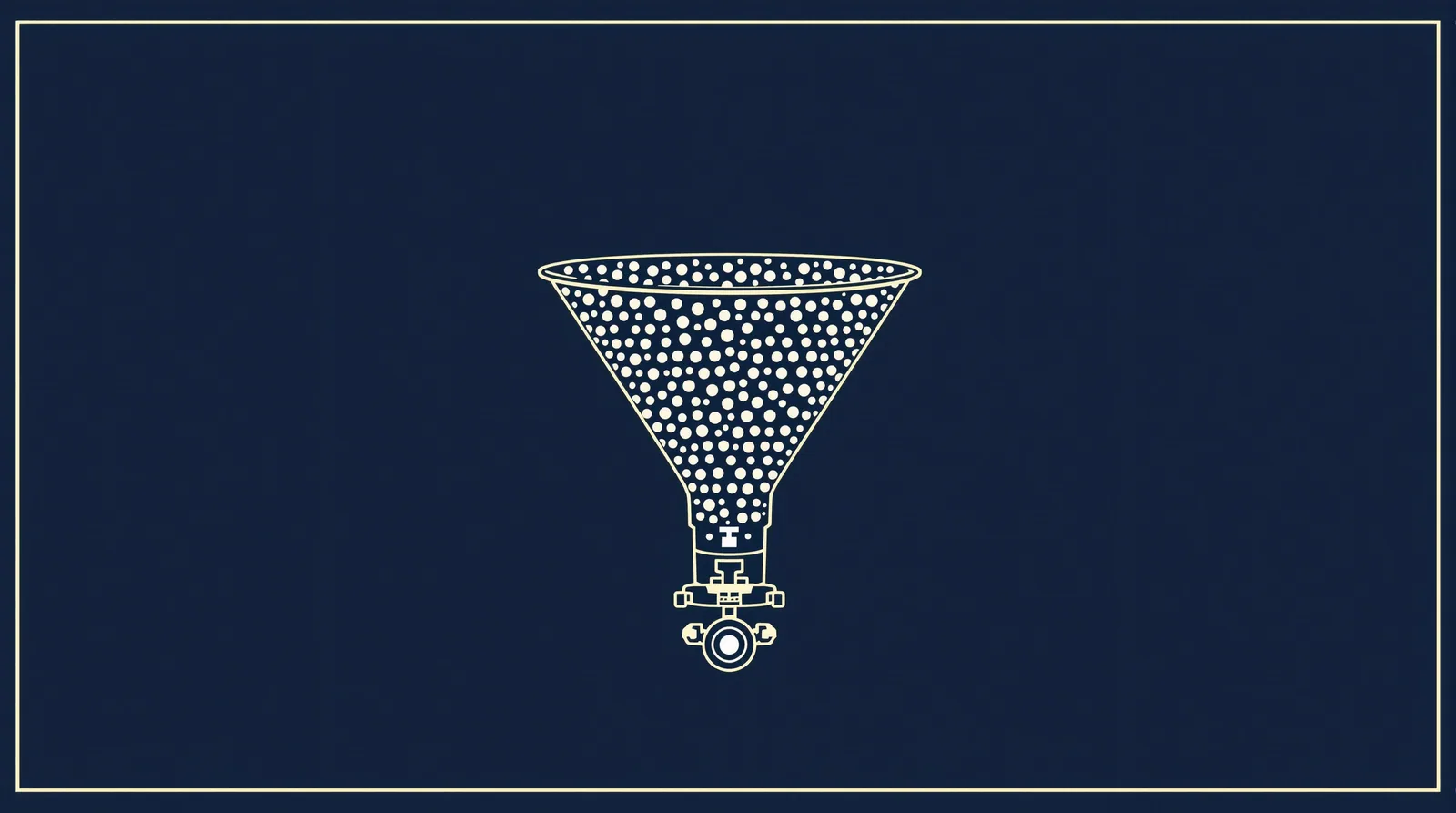
Run the long list through these screens in order, cheapest first. Cut mercilessly.
Trademark knockout search, per market
A knockout search is a fast first pass that catches obvious conflicts. It isn't clearance (that's Stage 5, with a professional). The point is to remove names that are plainly taken.
Search each market where you'll trade, using that market's own register:
- US: the USPTO trademark search.
- UK: the government's search for a trademark service.
- Everywhere else: the relevant national or regional register for each market on your Stage 1 list.
Search the exact name, then variants: alternative spellings, phonetic matches, the name with and without a suffix. A conflict doesn't need to be identical to matter. Similar sound and similar goods or services in the same class is the sort of thing that causes trouble. If you're unsure how close is too close, that's a question for an attorney, not for a spreadsheet. For a longer walkthrough of avoiding the worst outcomes, see how to name a business without a trademark lawsuit.
Domain and handle checks
Check the exact-match domain on the extension your customers would expect, plus the one you'd realistically buy. Check handles on the platforms where your audience actually spends time. Tiepograph's research summary also mentions checking email addresses and app stores where relevant; for a mobile product, the app store listing matters as much as the domain.
Which comes first, the trademark or the domain? There's a real argument either way, and trademark or domain first covers it. My own view: if you must pick, check the trademark first, because you can buy a different domain but you can't talk your way out of an infringement claim.
Linguistic check in key languages
Take every surviving name and check it in each language from your brief. You're looking for meanings, near-homophones, awkward associations and words that are hard for native speakers to say. Ask a native speaker, not a translation tool. Tiepograph's phrase for the point of this boring admin is preventing "cross-cultural goof-ups and embarrassing connotations". Costly goof-ups are rarely subtle ones; they're the ones a five-minute chat with a native speaker would have caught.
AI search distinctness
Last screen, and the one most checklists lack. The procedure: type the bare name into a few search engines and a few AI assistants. Ask "What is [name]?" and "Who makes [name]?". Then read what comes back.
Pass if the answers either find nothing, or find things clearly unrelated to your category. Fail if the name is consistently described as another company in your space, treated as a typo of a better-known brand, or interpreted as a common word with a different meaning. This is a judgement call, not a score, and AI answers change over time, so record the date you checked and re-run it at Stage 5.
Stage 3 pass/fail: a name passes only if it clears all five screens (linguistic, trademark knockout, domain, handles, AI distinctness). Failing one screen isn't a negotiation. A name with a great story and a conflicting trademark is a lawsuit with a great story.
Stage 4: test with real people
By now you should have a handful of survivors. Maybe five, maybe ten. Now, finally, people who aren't on the naming team get a look.
"I like it" is not a test. It's a reaction, and it tells you almost nothing about whether the name works. Founders like names that remind them of the effort they spent finding them. Friends like names because they like you. Neither is your customer. What you want is behaviour you can observe.
Tests that tell you something:
- Say-it-back. Say the name aloud once, then ask the person to repeat it. Note where they stumble or change it.
- Spell-it-blind. Say it, then ask them to type it. Count the different spellings. This is the say-spell test from earlier, turned into an exercise.
- Recall after a gap. Show or say five names mixed in with others, then ask what they remember an hour or a day later. Names people forget don't survive word of mouth.
- Meaning guess. Ask what kind of company they'd expect from the name. For a suggestive or abstract name you aren't looking for the right answer, just for nothing off-putting.
- Search-by-ear. Ask them to find the company online from the spoken name alone. If they land on the wrong thing, you've found your discoverability problem for free.
Use people who resemble your audience, and from the markets you listed in Stage 1. Don't tell them which name you prefer. Don't defend any name in the room (it's tempting, and it poisons the result).
A word on small samples: a handful of conversations won't give you statistics, and you shouldn't pretend otherwise. What they give you is a list of specific, repeatable problems. If three of five people misspell the name the same way, that's a finding. Pick pass criteria before you start, for example "at least most people spell it correctly on the first try", so you aren't moving the goalposts after the results land.
Stage 4 pass/fail: a name passes if people can say it, spell it, remember it and don't infer something wrong from it. Drop the rest. Two finalists is a good place to land, three at most.
Stages 5 and 6: clearance, filing order and launch
Stage 5: clearance and filing
Clearance is not the knockout search again. It's a professional review of whether you can use and register the name in your markets. This is where you bring in a trademark attorney. I'm a developer, not a lawyer, and nothing here is legal advice; a clearance opinion for your specific goods, services and countries has to come from someone qualified to give one.
What you can do beforehand is make their job cheaper. Bring the finalists, your target markets, a description of what you'll sell, and the knockout results you already have.
Then think about filing order. Placek's practical point in the Focus Lab conversation is that if you file for three names, you file three separate applications, so that a rejection of one leaves the others standing. He also describes the application path: after examination, a cleared mark is published for opposition, which is when owners of the same or a similar mark can object. In the recording he recalls the US period as around 60 days, but treat that as his recollection and check the current rules with your attorney or the registry.
A sensible order, as a starting point for discussion with counsel:
- File first in your home market and the market where you'll earn most of your revenue.
- Register the domain and the handles the moment your attorney gives a green light on the name. Not before, and not much after.
- Keep two finalists alive until filing is in. Drop the runner-up once you're comfortable.
- Re-run the AI distinctness screen at this point, since answers drift.
Whether you register the domain before or after filing is a real trade-off, which the trademark or domain first piece goes through in more detail.
Stage 6: launch
Launch is where a name stops being a document and starts being a habit. Three things matter.
First, consistency. Use the name, the handle and the domain the same way everywhere from day one: site, email signatures, invoices, profiles, app store listing. Mixed usage is exactly what makes AI systems and search engines unsure who you are.
Second, describing yourself clearly. Put a plain-English sentence stating who you are and what you do on your homepage and in your profiles. It helps people, and it helps answer engines attach the right description to your name. Starfish's point about aligning the name with the surrounding language system comes down to this.
Third, if you're renaming, plan the handover. Tiepograph notes that legacy names retain recall long after a change, and recommends a phased transition or co-branding period to carry equity across. Don't flip a switch and hope. If the old name is still how customers find you, say "formerly X" for a while. And if the rebrand extends to visuals, choosing a brand name and colours covers how the two decisions fit together.
Stage 6 pass/fail: within a few weeks, searching your name should surface you, not someone else; handles and domain should match; and people should be spelling it correctly. If not, fix the description and consistency problems first, before assuming the name was wrong.
The six stages on one page
Keep this table next to the brief. The pass/fail wording is mine, a working checklist rather than a standard, so adjust the thresholds to your own risk tolerance.
| Stage | What you do | Pass | Fail |
|---|---|---|---|
| 1. Brief | Positioning, audience, markets, languages, name types | A stranger can read it and say what you're hunting | Vague, or nobody agrees what "good" means |
| 2. Generation | Long list, sorted by type | Varied list, all chosen types covered | Everything sounds like the category |
| 3. Screening | Linguistic, trademark knockout, domain, handles, AI distinctness | Clears all five | Fails any one |
| 4. Testing | Say-back, spell-blind, recall, meaning, search-by-ear | People say, spell and remember it; no wrong inference | Repeated mis-spelling or wrong meaning |
| 5. Clearance and filing | Attorney review, separate applications per finalist | Attorney clears it for your markets | Attorney flags a conflict |
| 6. Launch | Consistent usage, clear description, phased transition if renaming | Search surfaces you; spelling is right | Search surfaces someone else |
FAQ
How many names should I generate before screening?
There's no magic number, but think in the low hundreds rather than a dozen. Agencies, per Starfish, produce hundreds or sometimes thousands, then cut most of them on basic trademark searches, obvious linguistic problems and drift from the brief. You'll lose most of your list at screening, so the starting pile has to be large enough to survive that.
Do I need a trademark attorney if I've already searched the register?
Yes, for names you're serious about. Your own register search is a knockout test: it removes obvious conflicts. It can't tell you how similar is too similar for your class of goods or services, or what the risks are in other countries. An attorney does that, and it's cheaper to pay for it before launch than after.
Is a made-up word safer than a real one?
Often it's easier to protect, because it doesn't describe anything. But invented names tend to cost more to explain, and they're not immune to AI confusion if they resemble another entity. Starfish's example is exactly a coined name that clears trademark and still reads ambiguously to answer engines. Safer legally doesn't mean safer overall.
What if the .com is taken but everything else is clear?
It depends on who owns it and what they do. If it's an unrelated dormant site, you might negotiate or choose a close variation. If it's an active business in your space, that's a red flag, because customers will land there. That's a Stage 3 decision, so use your pass/fail rule and be honest about whether the compromise will cost you traffic.
Should I rename an existing company if the name fails the AI distinctness check?
Not automatically. First tighten consistency and add a clear description of what you do across your site and profiles, since that's what answer engines draw on. Rename only if the confusion persists and is costing you customers. If you do, use a phased transition so you keep the recall the old name has built.
A name survives when it clears the trademark register in every market you'll trade in, and the single most common way to get that wrong is leaving the check until after you've fallen for the name. Run the cheap screens first, hand clearance to a trademark attorney, and don't let "I like it" stand in for any of them.