Car dealership website design that gets the test drive booked
Car dealerships, auto repair shops, detailing services, body shops, automotive sites live or die on local search, real-time inventory feeds, and the click-to-call rate from mobile. Most dealership sites do all three badly.
BOOK YOUR 30-MIN CALL Discuss your website
Who I build for
Automotive websites have a marketing equation almost no agency-led brief gets right. The buyer's journey is mobile-dominant, most car research now happens on a phone, and the conversion event is a phone call or a test-drive booking, not a form fill. The dealership that wins the local search war ships AutoDealer schema, a real-time inventory feed, click-to-call buttons that work, and per-model landing pages that load in under 2 seconds. Most agency-built dealership sites are slow Drupal or WordPress builds with stock photography and a contact form that goes to an inbox nobody monitors on weekends.
The automotive clients I take on tend to fit one of these three shapes:
- Independent and franchise car dealerships (single or multi-location) competing on local search for new and used car queries
- Auto repair shops, MOT centres, and tyre fitters needing local-pack rankings and review aggregation
- Detailing services, paint protection, and aftermarket specialists needing portfolio-led conversion with booking integration
What automotive businesses get wrong about their websites
Inventory feed integration is the build, not the bolt-on
Most dealership sites either run a stale CSV-import inventory (updated weekly, often broken), a WordPress plugin that scrapes a third-party feed (slow, ugly), or an iframe-embedded inventory widget (kills SEO, looks dated). The right answer is a real-time API integration with the DMS, Reynolds and Reynolds, CDK Global, AutoMate, Pinewood, that pulls inventory into the site as native indexable pages. Each car becomes its own URL with Car and Offer structured data, which in the US makes the stock eligible for Google's vehicle listing results. Most agencies do not build this; the dealerships that have it dominate the local search SERP.
Click-to-call beats form fills on automotive every time
Automotive buyers in the active-shopping phase want to call. A prominent click-to-call button usually out-converts a contact form by a wide margin. Most automotive sites bury the phone number in the footer and lead with a 'request a quote' form that takes 90 seconds and goes to a sales inbox the dealer checks twice a day. The fix is a sticky mobile click-to-call bar, large above-the-fold phone numbers on every vehicle page, and a CRM integration that logs the call for follow-up.
AutoDealer + LocalBusiness schema dominates the local pack
Schema.org/AutoDealer is the explicit signal Google uses to differentiate automotive businesses in local search. Combined with proper LocalBusiness schema (geo coordinates, opening hours, accepted payment types, brands sold) and aggregateRating from real review platforms, dealerships ship the structured data that wins the 3-pack. Most dealership sites have generic Organization schema or none at all, leaving the local pack to whoever did the schema work.
What an automotive website has to include
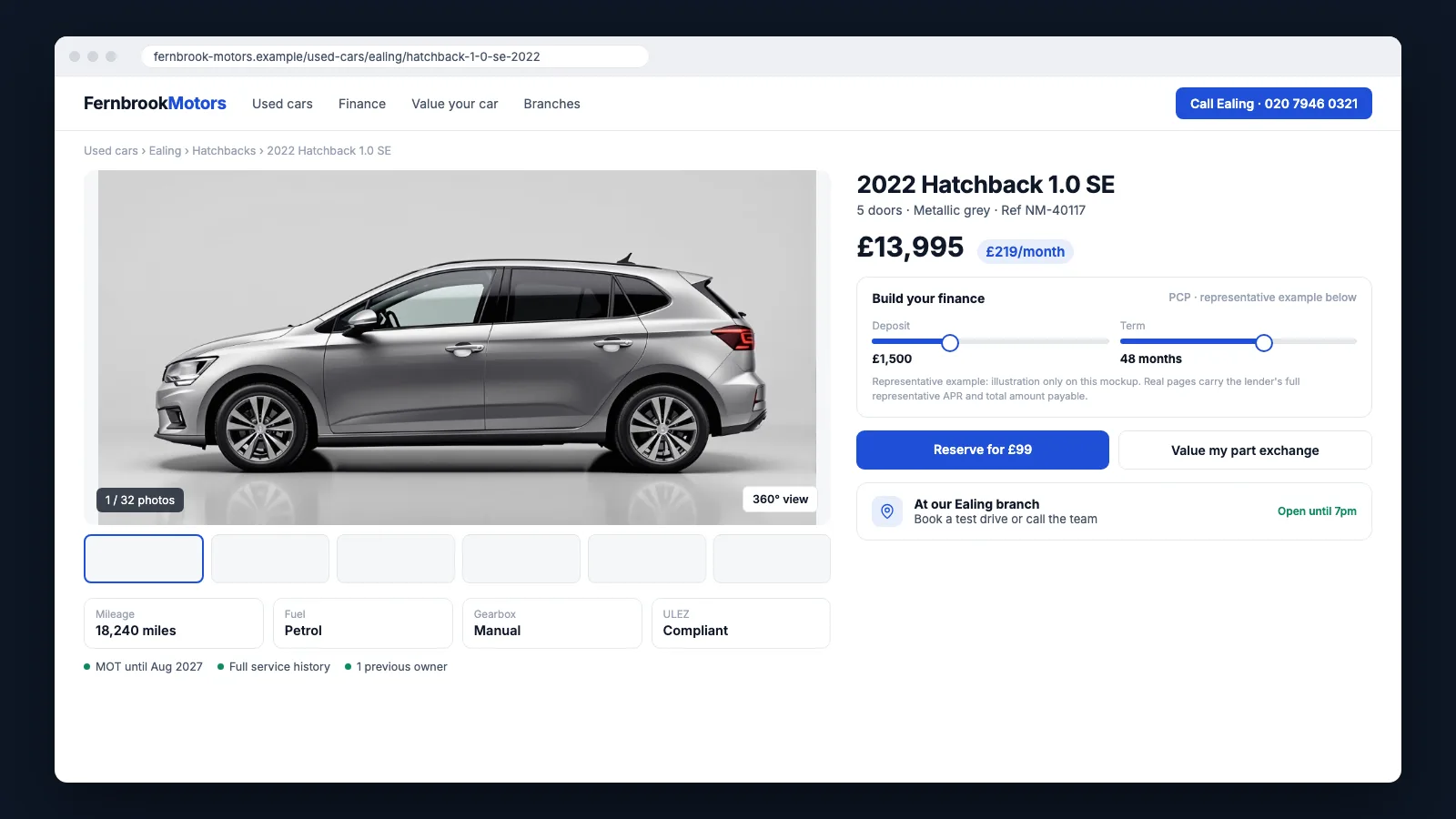
- Every car on its own indexable page Stock arrives from the dealer management system or stock feed by API, and each vehicle gets its own page with its own URL, photos, price and specification. When a car sells, the page is marked sold or redirected to the matching model page. So Google never finds a dead listing.
- Search by monthly payment, not only price Most buyers think in monthly cost. Arnold Clark, Sytner and cinch all let buyers search by monthly budget. It is a pattern worth copying at any size.
- Finance, part exchange and reserve on the car page Add a finance calculator with a representative example (which UK finance promotions need anyway), an instant part-exchange valuation and a reserve-online button. A serious buyer takes these three actions before visiting.
- A page for every branch Each branch page carries the address, opening hours, a phone number that works as click-to-call, the stock held at that branch, and AutoDealer structured data. These pages are what show up for 'used cars near me' and '[town] car dealer' searches.
- Click-to-call that stays on screen A sticky call bar on mobile and the branch number on every vehicle page. Buyers in the final stage want to talk to someone. A form that lands in an inbox nobody checks at the weekend loses them.
- Structured data that matches the page Car and Offer on vehicle pages, AutoDealer on branch pages, BreadcrumbList throughout. Motorpoint and Lithia both ship this. It is what makes vehicle details eligible for richer search results.
Automotive websites worth studying
No affiliation with any of these businesses. They are here because each one gets a specific part of the job right, and that part is worth copying.
- Arnold Clark UK
Buyers can browse the used car hub by town, monthly budget or ULEZ status. That gives every location and budget band its own landing page. Each car page names the branch holding the car, shows a full finance example and offers a reserve button.
- Motorpoint UK
Car pages put the MOT and service history dates beside a finance builder and a part-exchange tool. The buyer's main questions are answered on one screen. The listing and vehicle pages also carry some of the fullest vehicle structured data in UK car retail.
- cinch UK
The search shows how many cars fit each monthly budget before the buyer commits to a filter. Car pages add a 360-degree view. Electric cars get range, charging times and connector type.
- Sytner UK
Prestige stock can be searched by maximum monthly payment or by EV range. Each car page pairs a refundable £99 reserve with a finance calculator, and the buyer adjusts deposit, term and mileage.
- CarMax US
Each car page shows the shipping cost and arrival dates. That removes the question that usually ends in a phone call. The trade-in offer by plate or VIN and the finance pre-qualification sit on the homepage.
- Lithia US
Per-state location pages sit in front of more than 300 dealerships, with one search that filters by distance or by store. Every listing carries Car and Offer structured data.
How I work
I am the senior on every engagement, with twelve years and more than five thousand sites of practice behind the process. The build runs on Next.js, Astro or headless WordPress depending on who edits the site, and if you are replacing an existing site, the redirects, metadata and schema move across with it so the rankings do too.
Automotive website design FAQs
Should every car in stock have its own page?
Yes. A page per vehicle lets Google index the stock and show it for model and town searches. In the US it can also appear in vehicle listing results. Stock hidden inside an iframe or a search widget is invisible to search engines.
Can the website pull stock from our dealer management system automatically?
In most cases, yes. The main systems offer an API or a scheduled stock feed, and the site rebuilds the affected pages when a car is added, repriced or sold. The work lies in mapping the fields and deciding what happens to sold cars, not in the connection itself.
What structured data does a car dealership website need?
Car and Offer markup on each vehicle page, AutoDealer markup on each branch page, and breadcrumbs across the site. The markup must match what the page shows, including price and mileage, or it can be ignored.
Do we need a separate page for each branch?
Yes, if you have more than one location. Each branch page should carry its own address, hours, phone number and local stock, and link to the matching Google Business Profile. One shared contact page cannot rank for several towns.
Does this apply to repair shops and MOT centres too?
The structure is the same, but the pages differ. You need a page per service (MOT, servicing, tyres, bodywork), online booking, AutoRepair structured data for each location, and reviews shown on the page.
Related services and industries
When you're ready
Book a 30-minute call. No slide deck, no qualification screen. You describe the automotive business, the brief, the timeline. I tell you whether I am the right person, and by the end of the call you have a stack pick, a price range, and a realistic delivery window.