School website design that gets the open day booked
Schools, tutoring services, online course platforms, higher-ed marketing, all share one buyer-journey shape. The decision-maker is rarely the student, and the conversion event is almost always an enrolment intent expressed via tour, trial lesson, or open day booking. The site that makes that step easy wins.
BOOK YOUR 30-MIN CALL Discuss your website
Who I build for
Education websites, independent schools, K-12 academies, tutoring services, online course platforms, higher-ed marketing, share a buyer-journey shape that most agency briefs miss. The visitor is rarely the student. It is the parent or the adult learner, researching at 9pm after a difficult parents' evening or a redundancy. The site that earns the trust loads fast, makes the open-day booking two clicks, and treats accessibility as the floor not the ceiling.
The education clients I take on tend to fit one of these three shapes:
- Independent and private schools (K-12, day or boarding) competing on local search and word-of-mouth referrals
- Tutoring services and educational consultancies needing parent-facing landing pages plus lesson booking integration
- EdTech and online-course platforms (B2C and B2B) needing landing-page conversion plus integrations with LMS, payment, and email
What education businesses get wrong about their websites
Term-time announcements need a real CMS path, not a homepage banner
Schools push announcements at three predictable moments, term start, snow days, exam-results day. The marketing team posts urgent updates, often from a phone, sometimes outside business hours. The site that survives this needs a real announcement-banner mechanism with a clear publish-now path in the CMS, not a 'we'll deploy a hero update for you' agency arrangement. Get this wrong and the marketing team works around the website by posting on Facebook instead.
Accessibility is statutory, not optional, for UK and US schools
UK schools must meet WCAG 2.1 AA under the Public Sector Bodies Accessibility Regulations 2018. US schools fall under Section 504 and Title II ADA. Most school sites fail accessibility audits, small text, poor colour contrast, PDFs that screen readers cannot parse, video without captions. The new build must clear AA from day one, with quarterly automated audits and a documented complaint process. The risk is not just regulatory, it is reputational with prospective parents who care about how the school treats neurodivergent or sensory-disabled children.
Open-day booking + virtual tour is the conversion engine
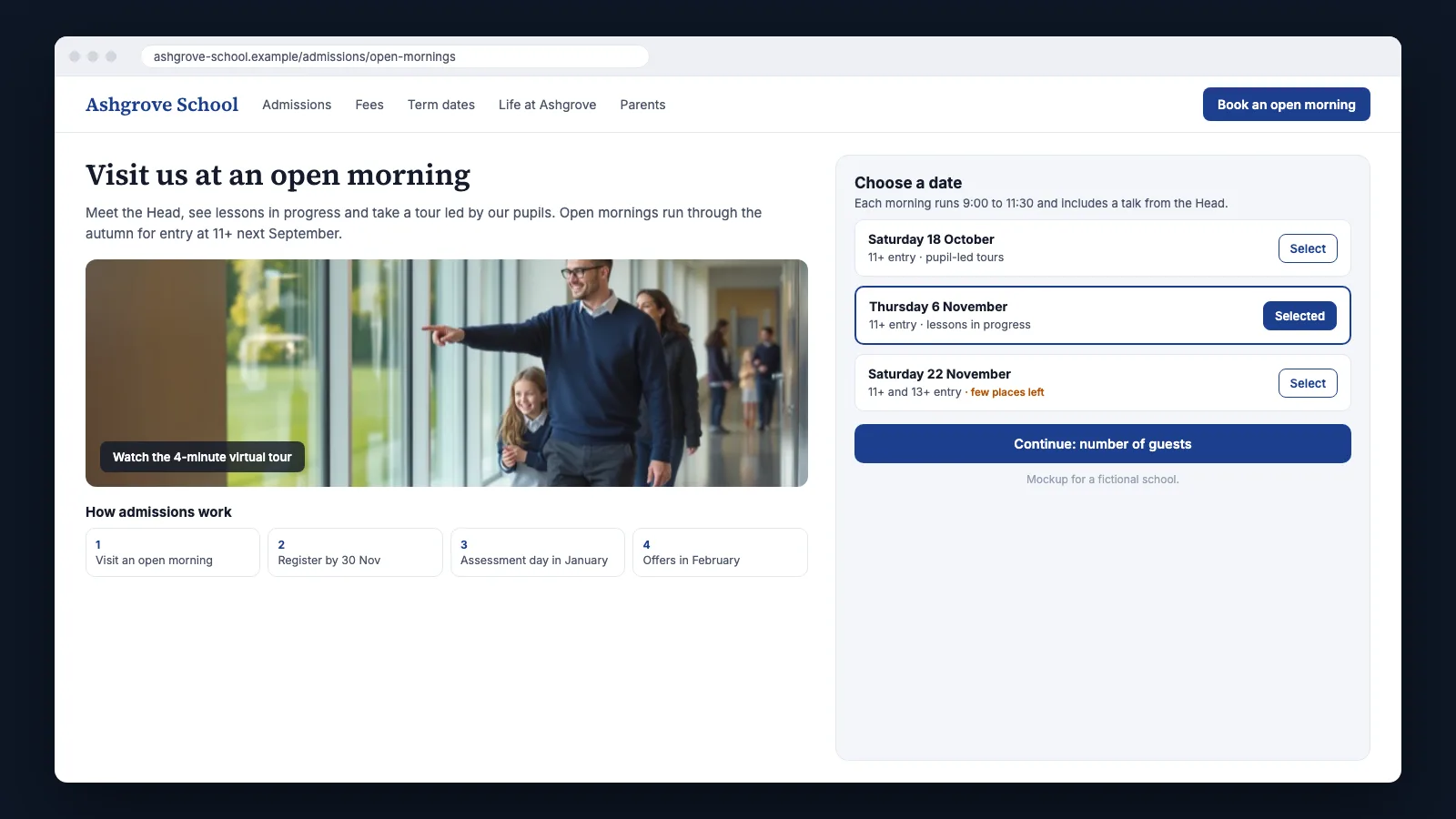
The single highest-converting action on a school site is booking an open day or registering interest in the next intake. Most school sites bury this under three navigation levels and gate it behind a multi-screen form. The fix is a one-click open-day booking flow with calendar integration (school's actual term diary, blocked-out school holidays), a virtual-tour video for parents who cannot visit in person, and email automation that nurtures the registration through the application window without spamming them. Calendly-style embeds work; bespoke booking flows often do not.
What an education website has to include
- The next open day, two clicks from anywhere Upcoming open day dates sit on the page as text, each with a booking link. Brighton College gets a parent to the booking form in one click from the homepage. St Paul's, Dulwich, Lakeside and Sidwell Friends manage it in two.
- Admissions as numbered steps for each entry point Visit, register, assessment, offer, with the real deadlines for each age of entry. St Paul's, Brighton College and Punahou all lay it out this way. It answers the question most parents ring the office to ask.
- Fees, term dates and a virtual tour, before anyone has to ask All six schools above publish fees on the site, and several add term dates and a virtual tour. Parents researching in the evening want those answers without filling in a form.
- An accessibility statement you can actually find UK state schools come under the public sector accessibility regulations, and every school should meet WCAG 2.1 AA. The visible part of that work is a statement linked from the footer, with a contact for problems. It is still rare enough to stand out.
- Events and open days marked up for search Mark open days up as Event structured data, and the school itself as School or EducationalOrganization. Few schools do it. That makes it an easy advantage in search results.
- A CMS the school office can use from a phone Snow closures, exam results days and term start notices go out at short notice, often outside office hours. So the site needs a simple publish-now path for an announcement banner, not a request to an agency.
Education websites worth studying
No affiliation with any of these businesses. They are here because each one gets a specific part of the job right, and that part is worth copying.
- Brighton College UK
Open morning dates sit on the homepage. One link takes a parent straight to the booking form. Each entry point has its own numbered admissions process, and the term dates page runs two years ahead.
- St Paul's School UK
Every entry point gets the same four pages: open days, how to register, selection and important dates. So a parent can see the whole admissions timeline for their child's age before contacting the school.
- Dulwich College UK
The homepage links to an accessibility statement and a campus access guide for visitors. The Year 7 page explains access arrangements for the entrance exams. And each entry page carries open day and tour booking links.
- Lakeside School US
The open house gets a page of its own: times for each school, a registration button and directions by public transport. The application process page sets out every step and deadline in order.
- Sidwell Friends School US
One events page lists every tour day and information session by school division. The admissions FAQ covers the practical questions parents ask, from the hours of the school day to bus transport.
- Punahou School US
Admissions is set out as numbered steps, with a separate page and deadlines for each grade band. And the virtual tour explains how each part of the campus is laid out for students of different ages.
How I work
I am the senior on every engagement, with twelve years and more than five thousand sites of practice behind the process. The build runs on Next.js, Astro or headless WordPress depending on who edits the site, and if you are replacing an existing site, the redirects, metadata and schema move across with it so the rankings do too.
Education website design FAQs
What should be on a school website's homepage?
Put the next open day there with a booking link. Add a clear route into admissions for each entry point, and quick links to fees, term dates and the parent portal. Most visitors are prospective or current parents with one specific task.
Should independent schools publish their fees online?
Yes. Every school in the examples above does. Parents compare schools on cost early, and a fee table on the site saves the admissions team a large share of first enquiries.
Do school websites have to be accessible?
UK state schools fall under the Public Sector Bodies Accessibility Regulations 2018, and US public schools under Section 504 and the ADA. Independent schools should meet WCAG 2.1 AA as well. Parents and pupils with disabilities use the site too.
How do we make open days easier to book?
List the dates as text on the page, put a booking link on each, and keep the form short. Booking should take two clicks from the homepage. And the confirmation email should include directions and parking.
What schema does a school website need?
Use School or EducationalOrganization markup with address and contact details, Event markup for open days, FAQPage markup where you answer common questions, and breadcrumbs across the site.
Related services and industries
When you're ready
Book a 30-minute call. No slide deck, no qualification screen. You describe the education business, the brief, the timeline. I tell you whether I am the right person, and by the end of the call you have a stack pick, a price range, and a realistic delivery window.