

There are 401.6 million registered domain names on the internet as of the end of June 2026, according to the Domain Name Industry Brief. Netcraft's July 2026 survey found 1.49 billion websites (hostnames that answer a web request) spread across 305 million domains. Most of those are parked pages, redirects and placeholders, so the number of websites people actually use is far smaller. And the way new sites get built is shifting fast: in Europe, WordPress fell from roughly 40 percent of new builds in February 2026 to 27 percent by July, according to ShareShift.
That's the short answer. The longer one is more interesting, because the web in 2026 is really three markets stacked on top of each other: the naming layer (registries, registrars and TLDs), the hosting layer (the companies running the servers) and the build layer (WordPress, site builders, frameworks and, now, AI tools). Each one moved this year. This report pulls the best public data on all three into one place, with our own charts.
A disclosure before the numbers. I run HostList, which publishes a monthly State of Web Hosting snapshot, so some of the hosting figures below come from a dataset I'm responsible for. I've kept those clearly labelled and put third-party sources next to them wherever one exists. I also co-run Seahawk Media, which has built well over 5,000 sites, so where I add a view from the agency side, I say so.
The state of the web in 2026 at a glance
| Measure | Figure | Source |
|---|---|---|
| Registered domain names (all TLDs) | 401.6 million, +8.1% year on year | DNIB, Q2 2026 |
| .com and .net combined | 179.1 million | DNIB, Q2 2026 |
| Country-code domains (ccTLDs) | 148.6 million, +3.6% year on year | DNIB, Q2 2026 |
| New gTLD domains | 52.9 million, +34.0% year on year | DNIB, Q2 2026 |
| Websites (hostnames) found | 1.49 billion across 305 million domains | Netcraft, July 2026 |
| Websites running WordPress | 40.2% of all sites | W3Techs, 21 Sept 2026 |
| Websites with no detectable CMS | 31.5% | W3Techs, 21 Sept 2026 |
| ICANN-accredited registrars | 3,322 | HostList registrar directory, Sept 2026 |
| Dedicated web hosting companies tracked | 7,187 across 133 countries | HostList, Sept 2026 |
| WordPress share of new European builds | about 39% (Feb) to 27% (Jul 2026) | ShareShift |
How many domains are there in 2026?
The cleanest count comes from the Domain Name Industry Brief, the quarterly report Verisign has published for years. At the end of the second quarter of 2026 there were 401.6 million domain name registrations across every top-level domain. That's up 9.1 million (2.3 percent) on the first quarter and up 29.9 million (8.1 percent) on a year earlier. It's the first time the total has crossed 400 million.
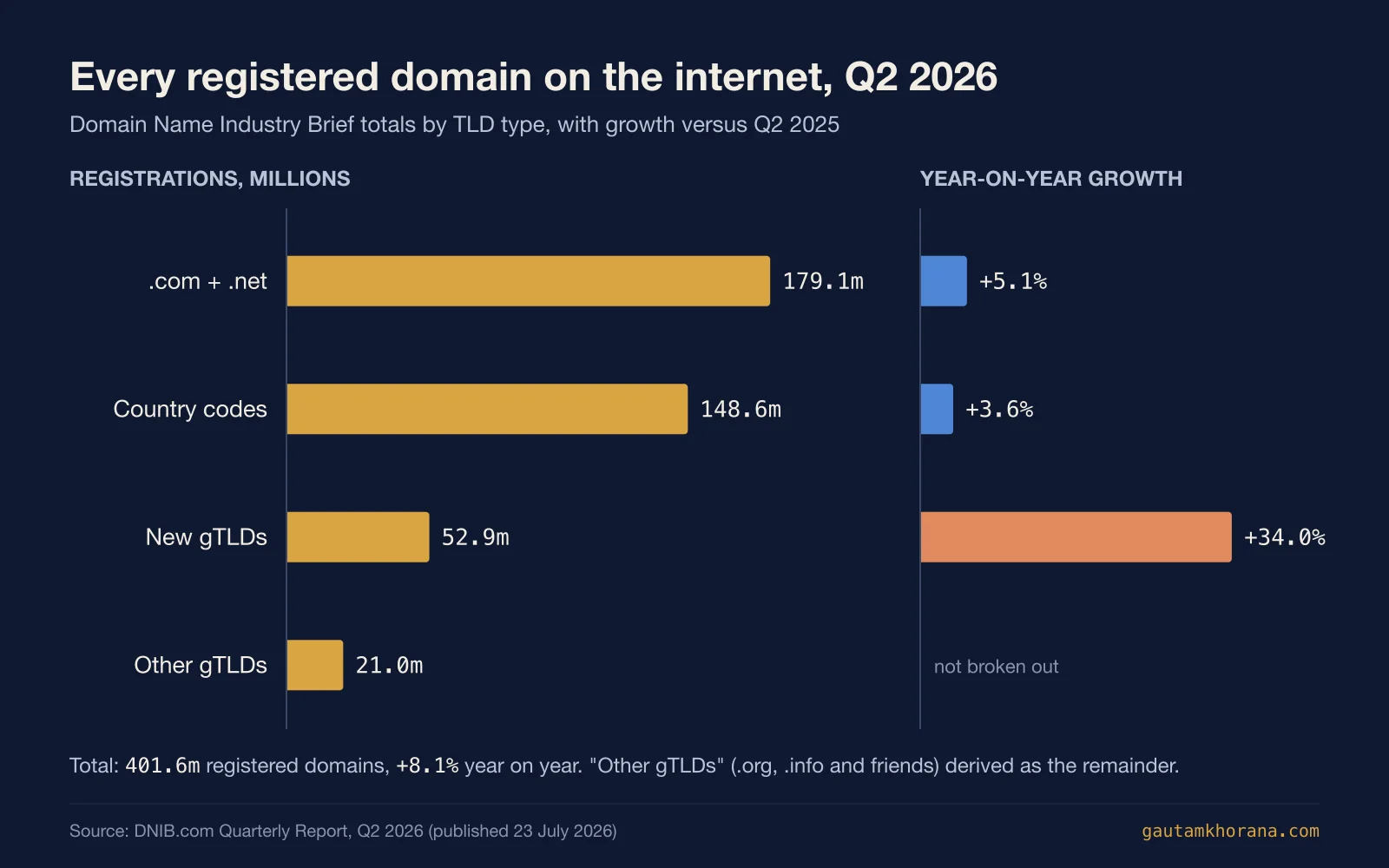
Break that total apart and the shape of the market becomes obvious:
- .com and .net: 179.1 million. Up 5.1 percent year on year. Verisign said on its Q2 2026 results that it processed 12.7 million new registrations in these two zones in the quarter, up from 10.4 million a year earlier, and it raised its full-year guidance. Split out, .com alone stood at 166.6 million names and .net at 12.5 million.
- Country codes: 148.6 million. Up 3.6 percent. The ten biggest are .cn, .de, .uk, .ru, .nl, .br, .fr, .au, .in and .eu.
- New gTLDs: 52.9 million. Up 34.0 percent in a year, the fastest-growing group by a wide margin.
- Everything else: about 21 million. Mostly the legacy generic zones such as .org and .info. The DNIB doesn't break this out in its headline release, so the figure here is the remainder.
Two notes on reading this. First, a registration is not a website. Plenty of domains are held for brand protection, investment or a project that never ships. Second, fast growth in the cheaper new extensions often reflects promotional first-year pricing and bulk registrations, which tend to renew at lower rates. The .com number moves slowly. But it's sticky.
How many websites are there?
This is the question most people actually type into Google, and the honest answer is that it depends what you count.
Netcraft's July 2026 Web Server Survey received responses from 1,494,915,628 sites across 305,348,459 domains and 14.77 million web-facing computers. That was up 5.5 million sites on the month before. But Netcraft counts every hostname that answers, which includes parked domains, placeholder pages, redirects and bulk-generated subdomains. Its separate "active sites" measure, which strips out that autogenerated noise, has sat around the 200 million mark for several years.
So a sensible working range for 2026 is:
- About 1.5 billion hostnames that respond to a web request.
- About 305 million domains with something answering on them.
- About 200 million sites with real, maintained content.
Of those, W3Techs reports that 31.5 percent run no content management system it can detect. That's the hand-coded, framework-built and custom slice of the web, and it matters later in this report, because it's the slice growing fastest in new builds.
Registry, registrar and host: who actually does what
Before the market-share numbers, a quick primer, because these three words get mixed up constantly (and search data suggests plenty of people are trying to untangle them).
| Role | What it does | Examples |
|---|---|---|
| Registry | Operates a top-level domain: runs its database and DNS, sets wholesale price and policy | Verisign (.com, .net), XYZ.COM (.xyz), Google Registry (.app, .dev), Nominet (.uk) |
| Registry backend | Runs the technical platform for a registry that outsources it | CentralNic (Team Internet), GoDaddy Registry, Identity Digital |
| Registrar | Sells domains to the public and manages them on the registry's behalf | GoDaddy, Namecheap, Tucows, IONOS, Cloudflare Registrar |
| Host | Runs the servers where the website or email lives | Anyone from a shared host to Vercel or AWS |
What is a domain registry? It's the organisation that operates a top-level domain. When you buy a .com, the registrar you pay passes a wholesale fee to Verisign, which operates the .com registry under contract with ICANN. For country codes, the registry is usually a national body or a company appointed by one.
Domain registry vs registrar: you never buy directly from most registries. You buy from a registrar, which is accredited by ICANN (for generic TLDs) or by the relevant country-code registry. The registrar is your customer relationship. The registry is the source of truth for who holds the name.
HostList's registrar directory tracks 3,322 ICANN-accredited registrar entities as of 5 September 2026, and 2,777 of them are listed as US-based. That number looks huge because a small number of companies hold many accreditations each, largely to compete for expiring domains the moment they drop. The number of registrars a normal buyer would ever deal with is a few dozen.
The most popular TLDs in 2026
The most popular TLD is still .com, by a distance. On the DNIB's Q2 2026 ranking, the ten largest generic TLDs were .com, .net, .org, .xyz, .top, .info, .shop, .online, .store and .vip. Six of the ten are new gTLDs from the 2012 round.
On the country-code side, .cn leads, followed by .de, .uk, .ru, .nl, .br, .fr, .au, .in and .eu. Germany's .de remains the largest ccTLD in Europe by a long way.
Then there's .ai, which technically belongs to Anguilla and practically belongs to the AI industry. It passed one million registrations at the turn of 2026, and it was expected to generate close to half of Anguilla's government revenue for 2025. It's become the default extension for a whole category of companies, in the way .io did for developer tools a decade ago. It's also expensive: most registrars sell it with a two-year minimum at somewhere between $160 and $220, according to the HostList domain price comparison checked today. A .com, by contrast, starts at roughly $10 to $13 a year.
If you want the lighter end of the naming market, I wrote up 14 fun domain extensions and the registries behind them earlier this year.
New gTLDs grew 34 percent. Who runs them?
The new gTLD segment is where the growth is, so it's worth knowing who operates it. HostList's registry directory, built on nTLDData zone counts, shows how concentrated it is.
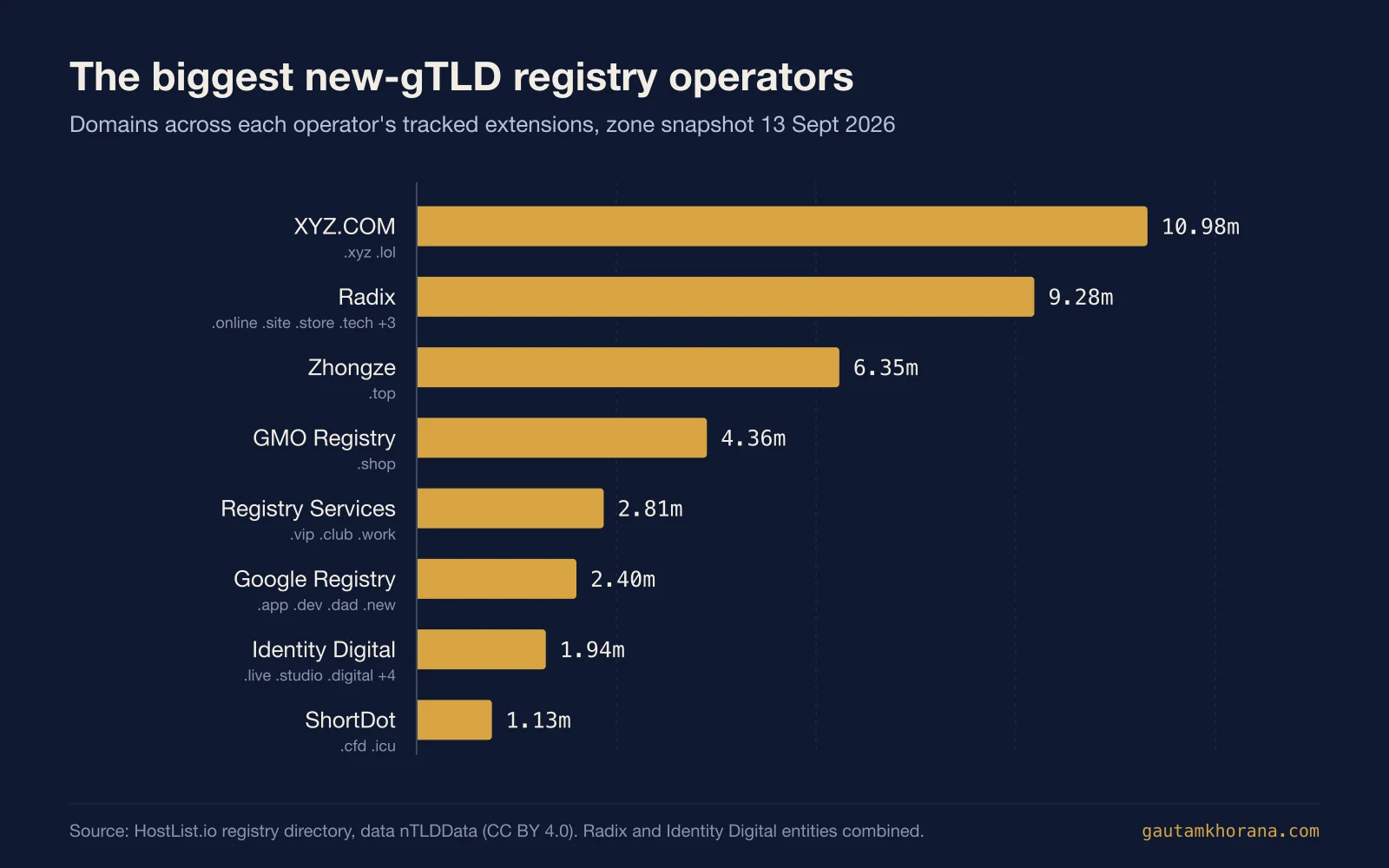
- XYZ.COM runs .xyz and .lol, with just under 11 million domains between them.
- Radix operates .online, .site, .store, .tech, .space, .fun and .website, together about 9.3 million.
- Zhongze runs .top, one extension with 6.35 million names.
- GMO Registry runs .shop with 4.36 million.
- Google Registry (legally Charleston Road Registry) runs .app, .dev, .dad and .new, together 2.4 million. Google put .app and .dev on the browser HSTS preload list, so sites on them only load over HTTPS.
Two things coming next will reshape this layer. Verisign has said .web, which sat in dispute for years, is now delegated to the root, and it plans to start selling .web names through registrars later in 2026. And ICANN opened its first new gTLD application window in over a decade on 30 April 2026, closing on 12 August 2026. The 2012 round produced more than 1,200 new extensions. Application statistics for the 2026 round haven't been published yet, but expect a wave of .brand TLDs from large companies.
The largest domain registrars
Globally, GoDaddy is the largest registrar by some margin. Using ICANN and Verisign data from September 2025, Domain Name Wire's ranking of .com domains under management looked like this:
| Rank | Registrar | .com domains under management |
|---|---|---|
| 1 | GoDaddy | 52,483,879 |
| 2 | Namecheap | 12,129,947 |
| 3 | Newfold Digital | 10,393,702 |
| 4 | Tucows | 10,356,252 |
| 5 | Squarespace | 8,693,581 |
| 6 | IONOS | 5,788,604 |
| 7 | Gname | 4,839,723 |
| 8 | TurnCommerce | 4,128,285 |
| 9 | Alibaba | 4,009,708 |
| 10 | Team Internet Group | 3,203,913 |
Europe looks very different, because Europeans mostly register their own country code rather than .com. ShareShift, which scans more than 56 million European ccTLD domains every week, published the regional leaderboard through Domain Name Wire in June.
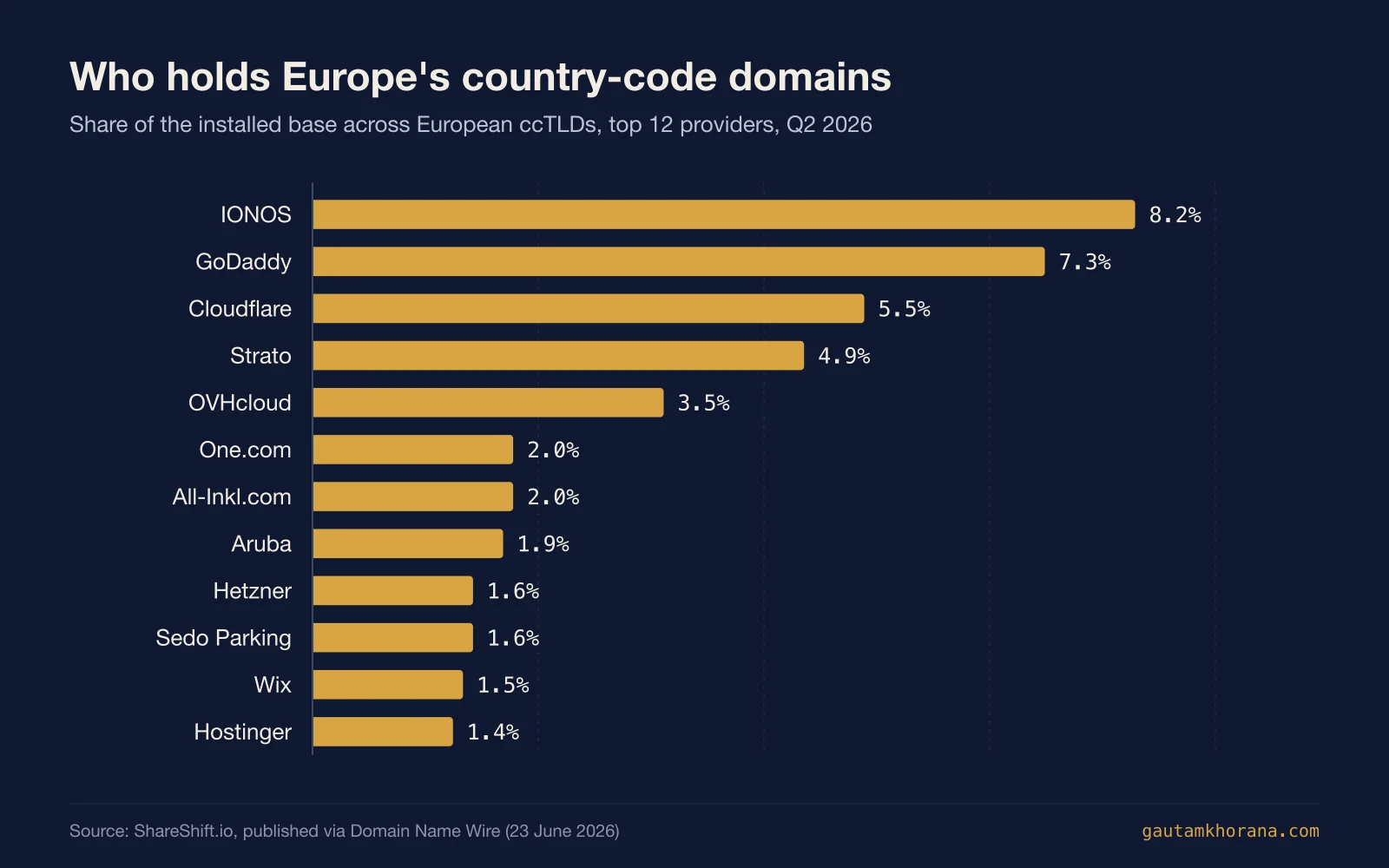
IONOS leads with 8.2 percent of the installed base, followed by GoDaddy at 7.3 percent and Cloudflare at 5.5 percent. At group level, ShareShift puts United Internet (which owns IONOS and Strato) at around 17 percent of the European installed base, with team.blue at 6 percent and group.one at 4 percent, both built by acquiring local champions country by country. Cloudflare is the standout gainer in new inventory. Much of that growth comes from sites moving their DNS and CDN rather than their registration, which is a useful reminder that "who holds the domain" and "who serves the site" are increasingly different companies.
If you're choosing a registrar yourself, I compared the main options on renewal price, privacy and transfers in the best domain registrar in 2026.
Europe: how saturated are the home domains?
One more European cut, because it explains why the registration growth numbers look so flat there. ShareShift's figures, reported by Domain Name Wire, show that local ccTLDs account for 65 to 80 percent of registrations in any given European country. Some of those markets are close to saturated.
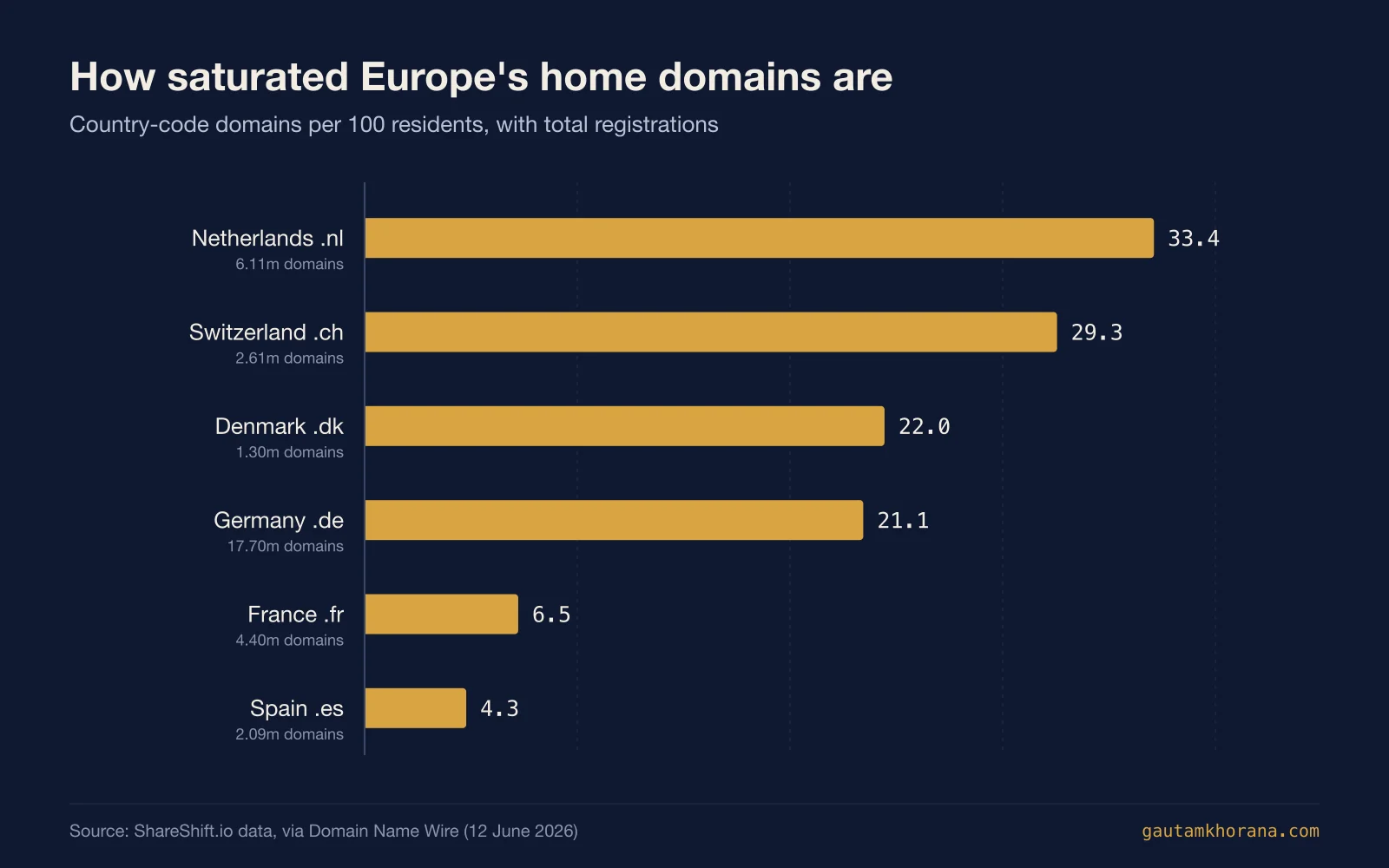
The Netherlands has 6.11 million .nl domains, or 33.4 for every 100 residents. Switzerland (29.3) and Denmark (22.0) aren't far behind, and Germany's 17.7 million .de names work out at 21.1 per 100. France (6.5) and Spain (4.3) sit much lower, which is where the remaining growth probably lives. This lines up with CENTR's view that European ccTLDs are growing slowly overall, held up by strong renewals rather than new registrations.
How new websites are being built
This is the part of the data I find most useful, and it's the chart that started this report. ShareShift's State of the Web 2026 tracks new site builds across roughly 1.5 million newly active European websites and classifies what each one runs on. We redrew their chart below with the values read from the published version, so treat the individual figures as approximate.
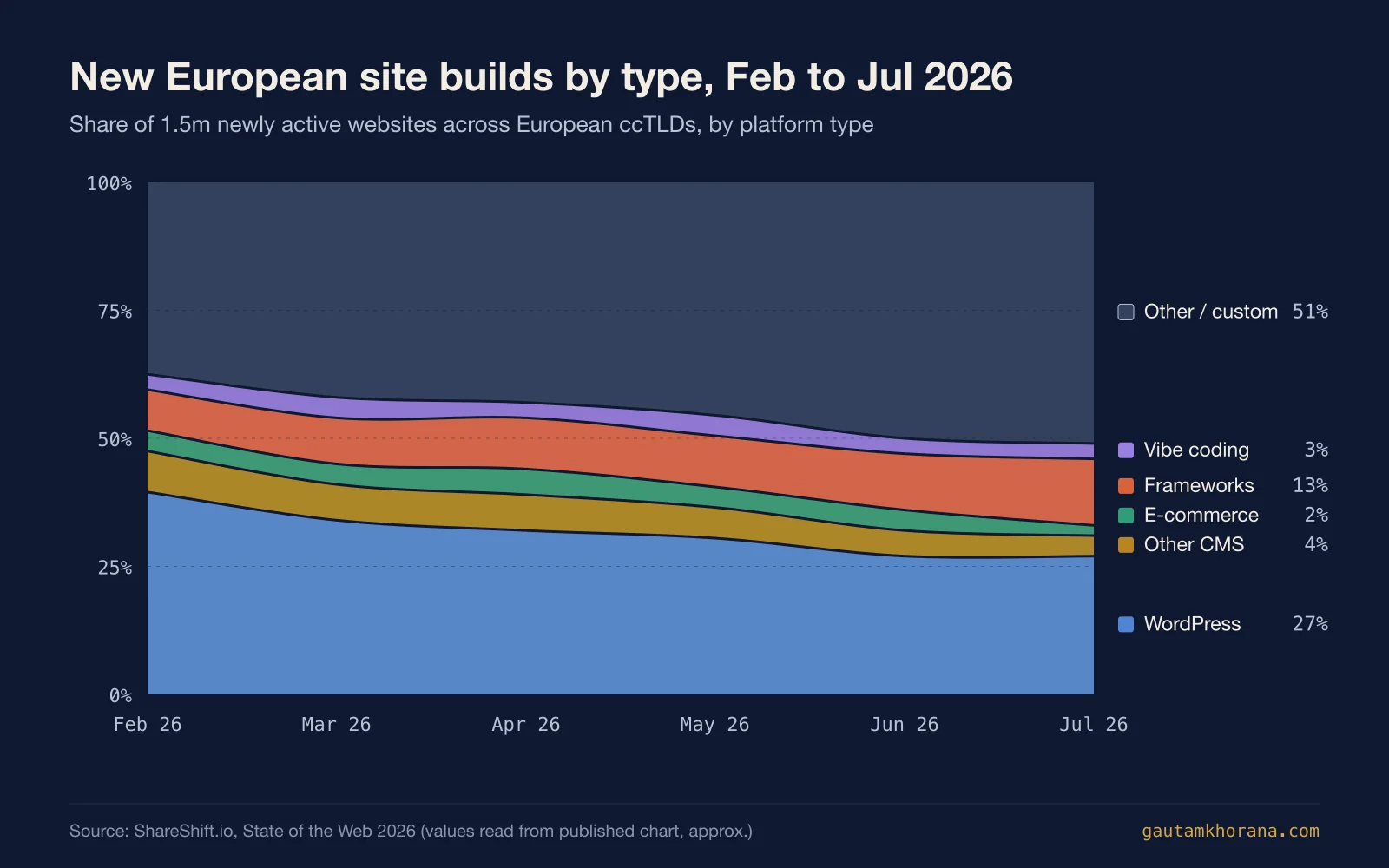
Here's what moved between February and July 2026:
| Build type | Feb 2026 | Jul 2026 | Change |
|---|---|---|---|
| WordPress | ~39% | ~27% | -12 points |
| Other CMS | ~8% | ~4% | -4 points |
| E-commerce platforms | ~4% | ~2% | -2 points |
| Frameworks | ~8% | ~13% | +5 points |
| Vibe coding (AI builders) | ~3% | ~3% | flat |
| Other / custom | ~38% | ~51% | +13 points |
Three readings, with the caveat that six months is a short window.
WordPress is losing share of new builds, not of the web. On the installed base it still runs 40.2 percent of all websites globally and about 38 percent of active sites across European zones. The installed base changes slowly. New builds are a leading indicator, and that indicator has turned. ShareShift's narrower cut of domains registered between February and April 2026 put WordPress at just 8.1 percent, and an earlier report put its share of new builds at 17 percent. Different cohorts give different numbers, but they all point the same way.
Frameworks are the clearest winner. Next.js, Astro, Nuxt and friends went from about 8 to 13 percent of new builds. The same ShareShift work found more than 233,000 active European domains on Vercel alone, with around 85 percent of them coming from brand-new projects rather than migrations. That matches what I see at Seahawk: the modern-stack briefs we win are mostly net-new categories (directories, AI product sites, programmatic SEO properties), not WordPress sites being moved.
"Vibe coding" is real but small as a hosting category. Sites built and hosted directly on AI builder platforms held around 3 percent all year. But that undercounts AI's influence. A lot of AI-generated code ends up deployed on Vercel, Netlify or a hyperscaler, where it shows up as "framework" or "custom" rather than "vibe coding". ShareShift's headline for the latest report is that 12 percent of new sites already sit outside traditional hosting, on framework-native, custom-code and AI-built deployments. Search interest agrees: "vibe coding websites" is searched around 480 times a month in the US, up 129 percent in a year, with almost no ranking competition.
There's a counterweight worth stating. ShareShift also found that 96 percent of migrations away from Wix end up with another hosting operator rather than another site builder or AI tool. People leaving a closed builder still mostly want a conventional host.
CMS market share in 2026
For the global installed base, W3Techs remains the reference. As of 21 September 2026:
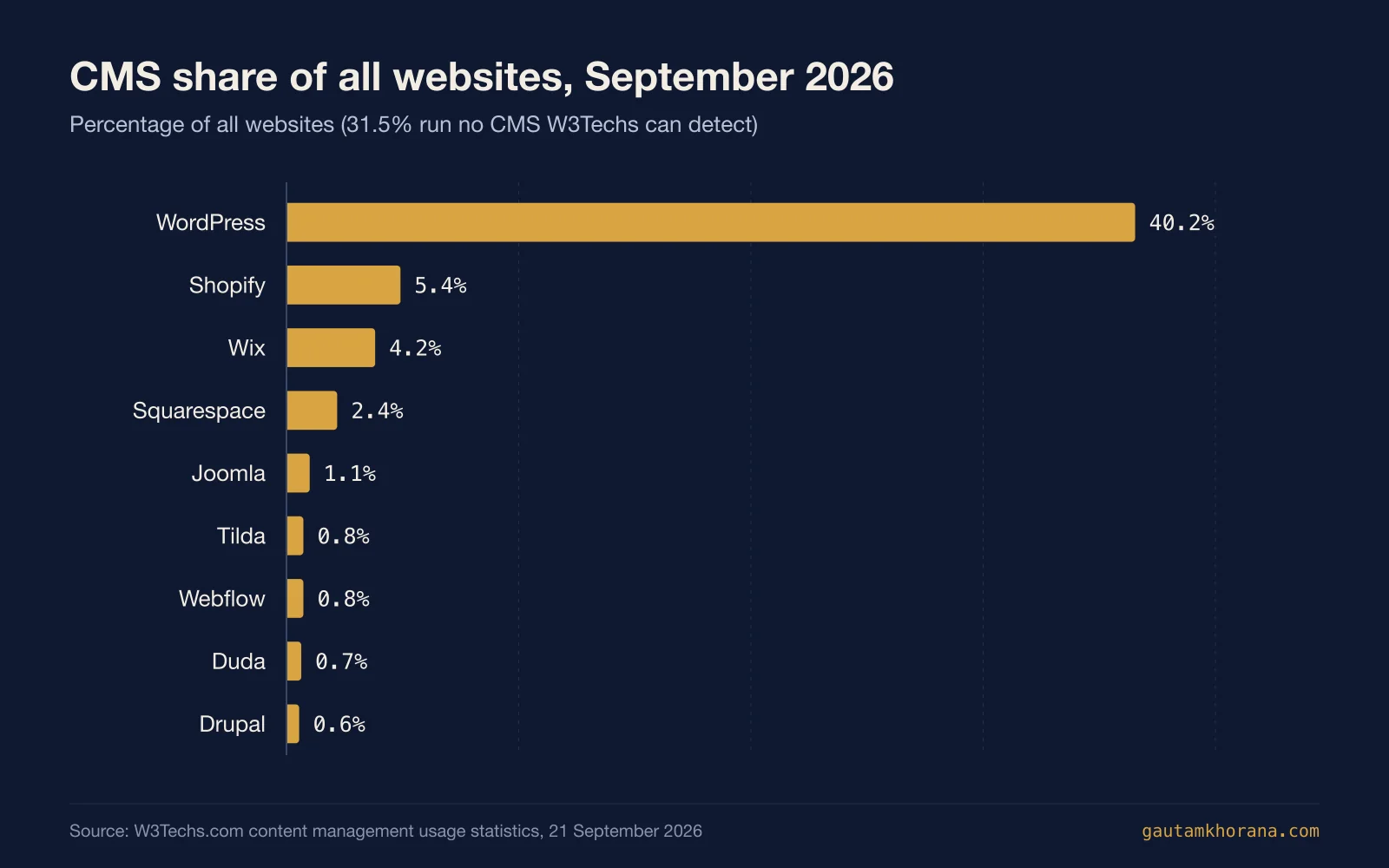
WordPress runs 40.2 percent of all websites and 58.8 percent of sites with a known CMS. Shopify is second at 5.4 percent, Wix third at 4.2 percent and Squarespace fourth at 2.4 percent. Everything else sits below about 1 percent. WordPress peaked at 43.6 percent in 2025, so it's given back a little over three points. I wrote about why I think that's a slow plateau rather than a collapse in WordPress market share in 2026, and the new-build data above is the strongest argument yet that the plateau will keep drifting down.
The web hosting market in 2026
Now the hosting layer, from the HostList State of Web Hosting snapshot for September 2026 (my own dataset, as disclosed above).
HostList tracks 7,187 active, dedicated web hosting providers across 133 countries. The United States has the most (1,826), followed closely by the UK (1,538), then Australia (231), France (221) and India (132). Among the 1,992 hosts with public customer reviews, the average HRI score is 64 out of 100. Reviews are broadly positive: 1,784 hosts carry a Google rating, averaging 4.46 out of 5 across 301,507 reviews, and 89 percent of Google-rated hosts sit at four stars or above.
What hosting costs
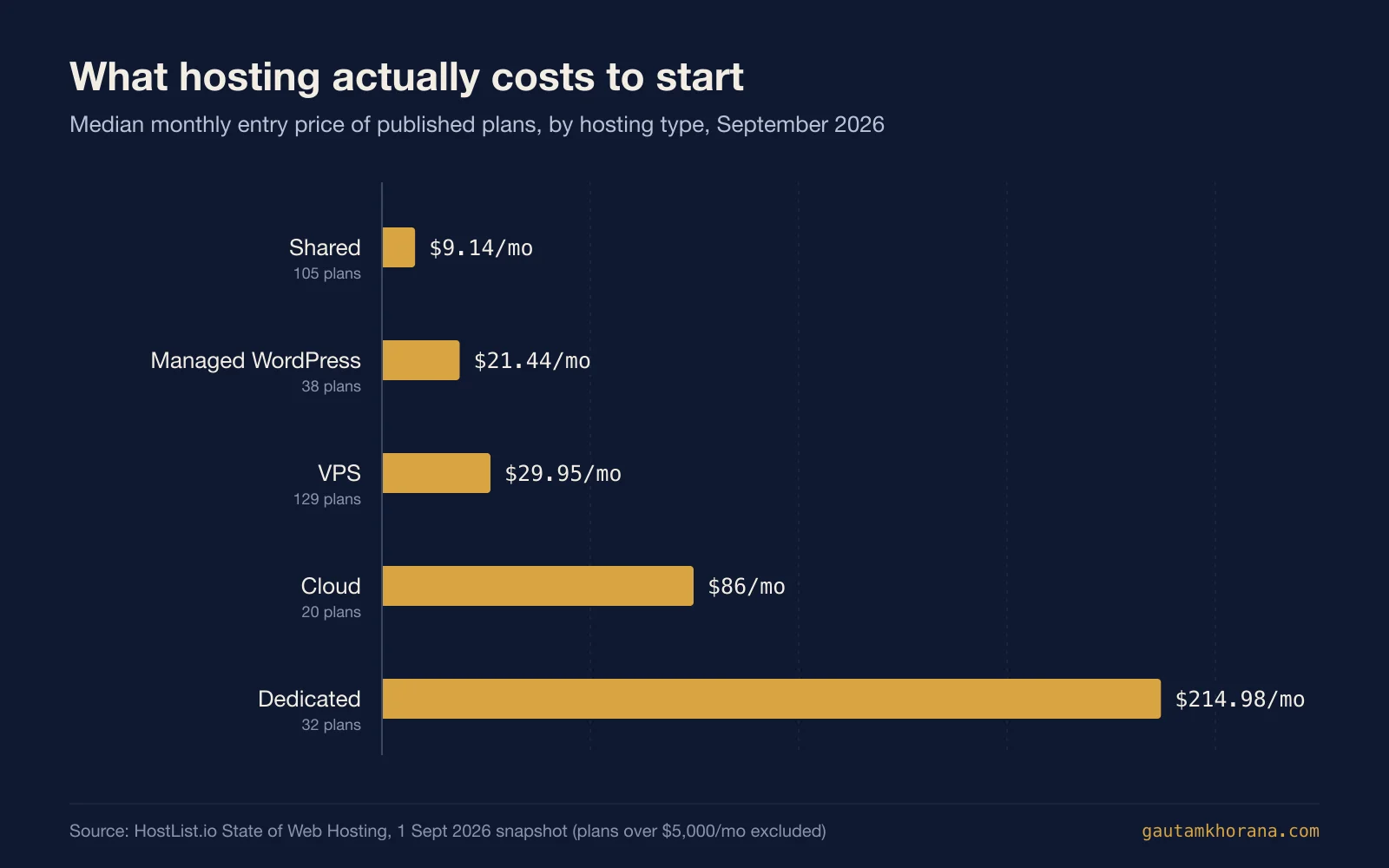
The median entry price of published plans is $9.14 a month for shared hosting, $21.44 for managed WordPress, $29.95 for a VPS, $86 for cloud and $214.98 for dedicated servers. The cloud median moved sharply this month because only 20 plans sit in that bucket, so read it as a range rather than a precise figure. The broader point stands: getting a site online is cheap, and the spend goes up with how much of the server you want to control.
How fast hosting is on real customer sites
Most hosting speed tests measure a provider's own marketing site. HostList's field data instead takes real-user time to first byte from the Chrome UX Report across each provider's actual customer websites, one vote per site, with cohorts under 100 sites excluded.
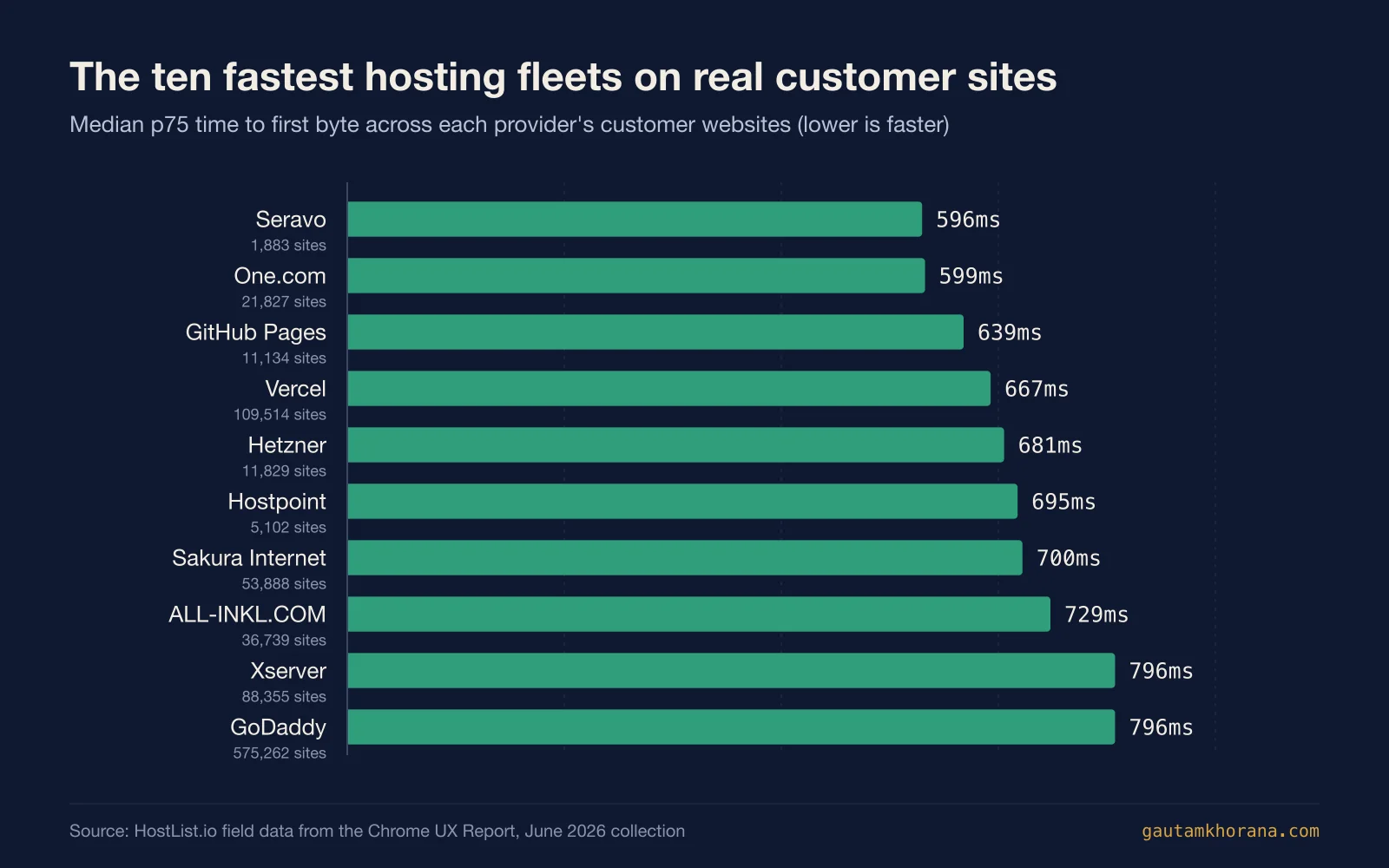
The fastest ten fleets in the June 2026 collection all came in under 800 milliseconds, from Seravo (596ms) and One.com (599ms) through GitHub Pages, Vercel and Hetzner. GoDaddy makes the top ten with a 796ms median across 575,262 measured customer sites, which is a remarkable result at that scale. Across the whole industry, the median Largest Contentful Paint on hosts' own sites is 1.72 seconds, median Interaction to Next Paint is 78ms and median time to first byte is 888ms.
If you're picking a host rather than studying the market, the top 100 web hosting companies and the best WordPress hosting pages pull live HostList data, and I compared the two biggest frontend platforms in Vercel vs Netlify.
What the 2026 numbers mean
Pull the three layers together and a few things stand out.
The naming layer keeps growing, but growth has moved to new extensions. Four hundred million domains is a milestone, and .com keeps adding names at a steady 5 percent. But the 34 percent growth in new gTLDs, the .ai boom and the 2026 application round all say the same thing: a name no longer has to be a .com to be taken seriously, especially for tech and AI companies. If you're naming a business, check the trademark position before you fall in love with a domain. I wrote about that order of operations in trademark or domain first.
The hosting layer is unbundling from the domain layer. Cloudflare gaining European share on DNS moves, Vercel growing on net-new projects, and 12 percent of new sites sitting outside traditional hosting all point to the same split. The company that sold you the domain is less and less likely to be the one serving the site.
The build layer is where the real change is. WordPress still runs four in ten websites, and that installed base will be around for a long time. But the new-build curve in Europe has bent hard towards frameworks and custom code in six months. A lot of that custom code is now written with AI assistance, even when the site isn't hosted on an AI builder. For agencies and hosts, the question for 2027 is less "which CMS" and more "where does AI-written code get deployed, and who is in that path".
What would I do with this as a business owner? Probably nothing dramatic. If your WordPress site works, keep it and keep it fast. If you're starting something new and have engineering help, a framework on a modern host is now the mainstream choice for new European builds, not the fringe one. Either way, own your domain at a registrar with fair renewals and keep it separate from whoever hosts the site.
Sources and methodology
Every figure in this report comes from a published source. Where we redrew a chart, the source is named on the image.
- DNIB Quarterly Report, Q2 2026: total, .com and .net, ccTLD and ngTLD registrations, top-ten TLD lists.
- Verisign Q2 2026 results: 12.7 million new .com and .net registrations in the quarter, .web delegation and launch timing.
- Netcraft July 2026 Web Server Survey: site, domain and computer counts.
- W3Techs CMS usage statistics: CMS shares as of 21 September 2026.
- ShareShift State of the Web 2026 and ShareShift methodology: new European builds by type, installed base by provider, ccTLD saturation. ShareShift scans more than 56 million European ccTLD domains weekly using DNS, HTTP and TLS signals.
- HostList State of Web Hosting, registrar directory and registry directory: hosting counts, reviews, price index, fleet TTFB, registrar and registry data. HostList data is free to reuse under CC BY 4.0.
- ICANN New gTLD Program, 2026 round: application window dates.
The ShareShift build-type values in the first chart were read from the published chart and rounded, so small differences from the original are expected. The "other gTLDs" figure is derived as the DNIB total minus the three named groups.
FAQ
How many websites are there in 2026?
Netcraft's July 2026 survey found about 1.49 billion websites, meaning hostnames that respond to a web request, across 305 million domains. Most of those are parked or placeholder pages. The number of active sites with real, maintained content is closer to 200 million.
How many domains are there?
There were 401.6 million registered domain names at the end of June 2026, according to the DNIB. That includes 179.1 million .com and .net names (166.6 million of them .com), 148.6 million country-code domains and 52.9 million new gTLD domains. The total grew 8.1 percent in a year.
What is a domain registry?
A domain registry is the organisation that operates a top-level domain. It keeps the authoritative database of every name in that extension, runs its DNS and sets wholesale pricing and policy. Verisign runs .com, for example, and Nominet runs .uk.
What is the difference between a domain registry and a registrar?
The registry operates the extension; the registrar sells names in it to the public. You buy a .com from a registrar such as GoDaddy, Namecheap or Cloudflare, which registers it with Verisign, the .com registry, and pays a wholesale fee.
What is the most popular TLD?
.com, with most of the 179.1 million .com and .net registrations. After .com and .net, the largest generic TLDs in mid-2026 were .org, .xyz, .top, .info, .shop, .online, .store and .vip. The largest country code is China's .cn, followed by Germany's .de and the UK's .uk.
Who is the largest domain registrar?
GoDaddy, with around 52.5 million .com domains under management in late 2025, more than four times the next registrar, Namecheap. In Europe's country-code market, IONOS leads with 8.2 percent of the installed base, according to ShareShift.
Is WordPress still the most popular way to build a website?
Yes, on the installed base: it runs 40.2 percent of all websites according to W3Techs. But its share of new builds is falling. ShareShift's European data shows it dropping from about 39 percent of new builds in February 2026 to about 27 percent in July, with frameworks and custom code taking the difference.
How many web hosting companies are there?
HostList tracks 7,187 active, dedicated web hosting providers across 133 countries as of September 2026. The US has the most at 1,826, followed by the UK at 1,538.