services · jamstack development
Jamstack development services for sites that have to load fast, rank, and cost nothing to run.
Next.js, Astro or Nuxt on the front, a headless CMS your editors will use, and a build that lints its own SEO and holds a Core Web Vitals budget. One senior engineer in London; the code is yours at launch.
- 30,000+
- 125,000+
- 3,100+
the work
Three Jamstack builds I run in production.
- HostList.io
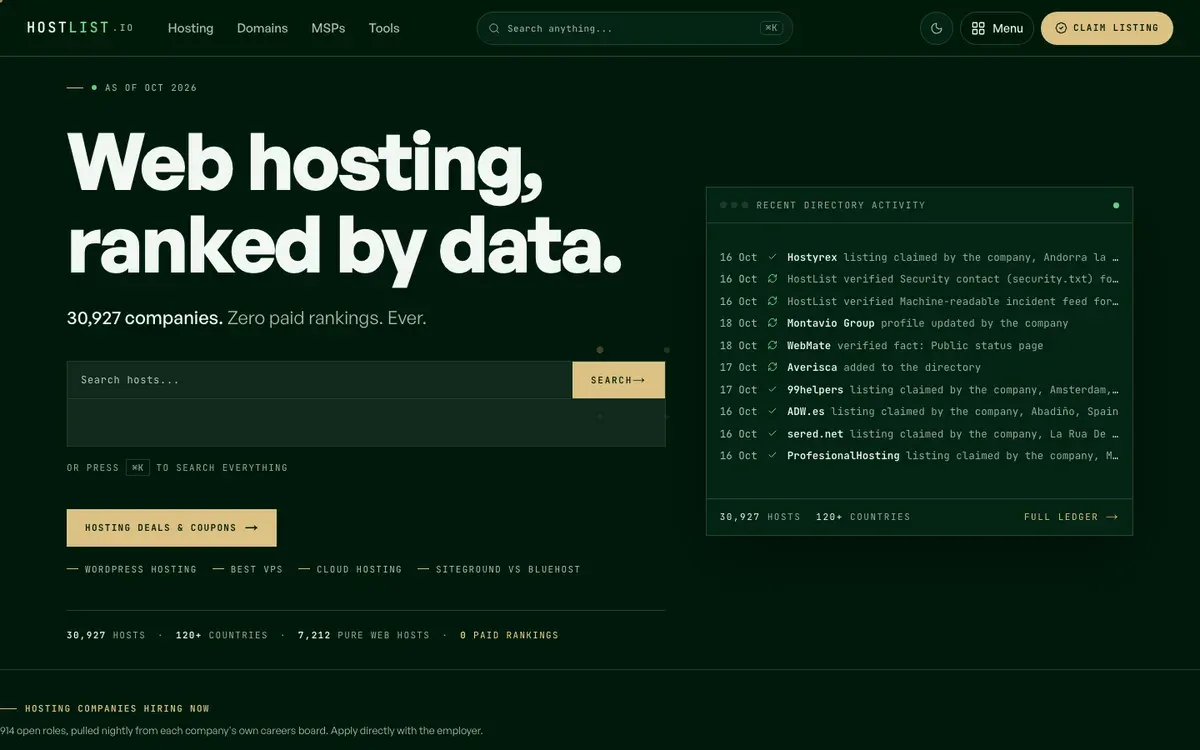 Thirty thousand pages from one data model. A hosting intelligence platform on the App Router. Programmatic pages, an algorithmic ranking, verified claims and a streaming sitemap, all served from the edge.
- Deluxe Astrology
 Thirty languages without a slow deploy. My parents’ Vedic astrology platform on Next.js and Supabase. Subdirectory i18n, bidirectional hreflang and an out-of-band translation pipeline.
- gautamkhorana.com
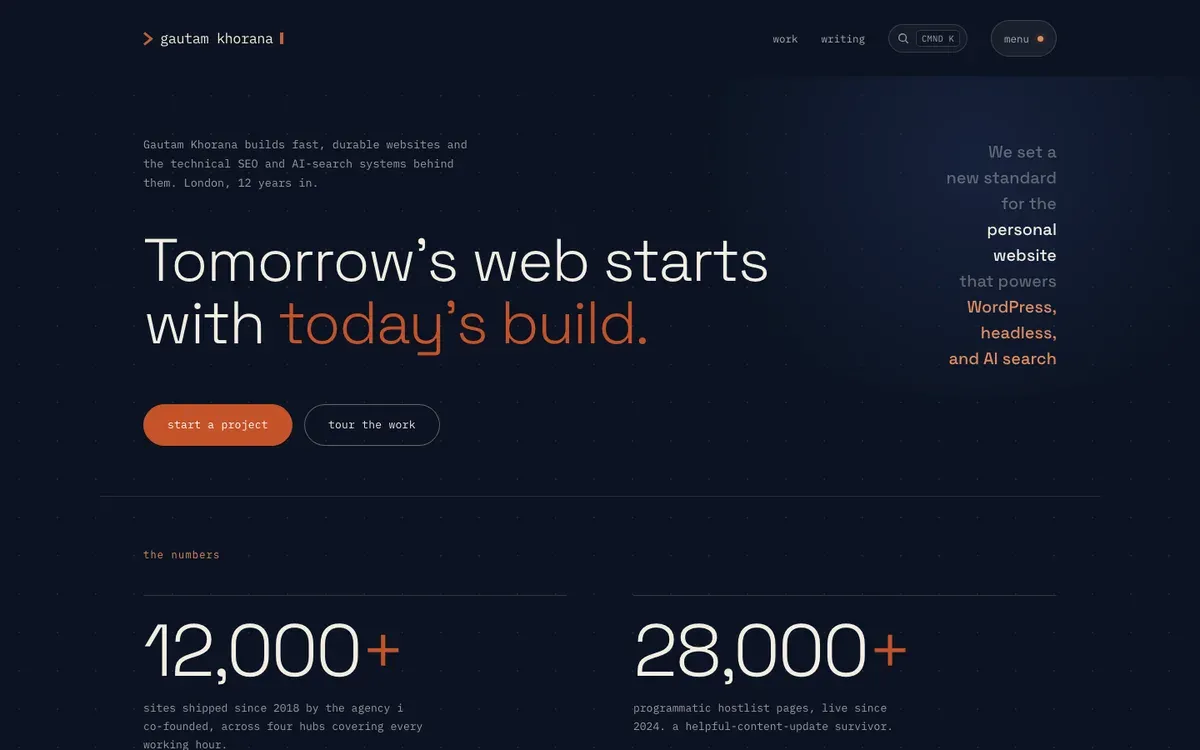 The reference build, measured live. 3,100+ URLs in 8 languages on Astro. A custom admin, a research-gated publishing pipeline, static search and a speed budget on every build.
how an engagement runs
- Stack assessment Your editors, your traffic, your integrations, then a framework recommendation with the reasoning shown.
- Content model and design system Written and agreed before any template work starts.
- Build in sprints A working preview link after every sprint, with SEO lint and a speed budget in the pipeline.
- SEO transport and launch Redirect map, metadata carried byte for byte, cutover with monitoring on.
- Operate and measure Handover with docs, or I stay on and read the field data monthly.
what it costs
- from $4k Marketing site on Astro
- from $10k Content platform
- from $13k Product on Next.js
What Jamstack means now, how I pick between Next.js, Astro and Nuxt, where the CMS fits, and what the SEO pipeline catches.
What Jamstack development means in 2026
The name came from JavaScript, APIs and markup. The idea that survived is simpler: render as much of the site as possible ahead of time, serve it from a CDN, and reach for a server only where a page genuinely needs one. Next.js, Astro and Nuxt all work this way now, so a Jamstack development company in 2026 is really a shop that ships those frameworks well, with a headless CMS behind them and a deploy pipeline that catches regressions before they reach Google.
What it is not: a site with no backend. Forms, search, auth, previews and commerce still run on APIs. The difference is that none of them sit between the visitor and the first paint, and none of them are a PHP runtime that has to be patched on a Tuesday because something like PHP2Shell landed on a Monday.
Which framework, and why
Next.js when the product needs app behaviour: accounts, dashboards, personalised pages, incremental regeneration across tens of thousands of URLs. HostList.io and Deluxe Astrology both run on the App Router with Supabase behind them. The Next.js development agency page covers that work in detail, and the hire a Next.js developer page covers hourly and feature-scoped engagements.
Astro when content and speed lead. It ships zero JavaScript by default and hydrates only the components that need it, which is why this site passes its speed budget with a search index, eight languages and a few thousand pages. The Astro development brief has the fixed-scope version.
Nuxt when your team already writes Vue and the hiring pool matters more than the last few kilobytes. The Nuxt.js developer page is the right door.
If you are between the first two, Astro vs Next.js is the honest comparison, and the 2026 framework comparison has production numbers. I will tell you when the answer is the one you did not want.
Editors keep an editor
None of this works if the content team loses its workflow. A headless CMS, Sanity, Payload, Storyblok or Contentful depending on the brief, gives editors drafts, scheduled publishing, roles and a live preview of the real front-end, while the public site ships as static HTML. The content model is written before the first template, against the way your team actually writes, and that modelling is where most of the value sits. The headless CMS development page goes deeper; the headless CMS hub compares the platforms.
SEO is built in, not bolted on
Every build gets a linter that reads the rendered HTML before Google does: missing or duplicate H1s, meta descriptions outside 120-155 characters, invalid JSON-LD, hreflang clusters that do not link back. It runs on every deploy, so the mistake that cost you a ranking cannot ship twice. A Core Web Vitals budget sits next to it. Schema goes in per template: Organization, Article, Service, BreadcrumbList, FAQ where earned.
When the build replaces an existing site, the migration is run as an SEO project. The redirect map comes from Search Console and Ahrefs traffic, metadata is carried across byte for byte and diffed, and the sitemap is submitted the day of cutover. Legacy CMS migration covers Drupal, Joomla and TYPO3 estates; technical SEO covers the audit and remediation work on its own.
Running costs and hosting
A pre-rendered site on Vercel, Netlify or Cloudflare costs roughly the same at ten visits a day and ten thousand, because the CDN does the work. There is no server to size, no cache plugin to tune and no runtime to patch. The Vercel vs Netlify comparison and the cloud hosting hub show where each fits. When the site needs data, Supabase or Postgres sits behind the APIs and is sized to the actual query load rather than to page views.
If the site you have is slow but structurally sound, a rebuild may not be the first move. The web performance optimization page covers fixing Core Web Vitals on the stack you already run.
What it costs
Three bands. A marketing site on Astro, under 100 pages, with a headless CMS and the SEO pipeline: from $4k over six to eight weeks. A content platform with thousands of pages, multilingual routing and programmatic templates: from $10k. A product on Next.js with Supabase, auth and billing: from $13k, quoted from a written scope. The variable that moves price most is the number of content types and integrations, not the page count, because pages are generated from templates. Starting prices are fixed after a 30-minute discovery call and nothing is built before the scope is written down.
What the first 48 hours look like
Book a 30-minute call. Tell me what the site is for, who edits it and what Search Console is telling you. By the end you will have a framework recommendation with the reasoning shown, a realistic timeline and a price range whether you sign or not. If I am not the right fit I will tell you who is.
Frequently asked questions
What is Jamstack development?
Building a site so that pages are rendered ahead of time, or at the edge, and served from a CDN, with content pulled from a headless CMS and anything dynamic handled by APIs. In practice: Next.js, Astro or Nuxt on the front, Sanity, Payload, Storyblok or Contentful for editors, Vercel, Netlify or Cloudflare to run it. The visitor never waits for a PHP runtime to assemble the page.
Is Jamstack still a thing in 2026?
The word is used less; the architecture is now the default for serious content and marketing sites. Next.js with the App Router, Astro and Nuxt all pre-render by default and add server rendering only where a page needs it. If you search for a Jamstack development company today you are really looking for someone who ships those three frameworks well, with a headless CMS behind them.
Next.js, Astro or Nuxt: which should I use?
Next.js when the product needs app behaviour: accounts, dashboards, personalisation, incremental regeneration across tens of thousands of pages. Astro when content and speed lead and interactivity is the exception; it ships almost no JavaScript by default. Nuxt when your team already writes Vue. I run HostList.io and Deluxe Astrology on Next.js and this site on Astro, so the recommendation comes from production, not preference.
Jamstack or WordPress for a marketing site?
WordPress gives you a mature editor, a plugin for most needs and a large hiring pool; the trade is a PHP runtime in every request and a plugin stack to patch. Jamstack moves rendering to build time or the edge, which is what gets you sub-second loads, a smaller attack surface and hosting that does not scale with traffic; the trade is that editors need a headless CMS and custom features need an engineer. For sites where speed and search matter, I usually recommend Jamstack, and I will say so plainly when I do not.
Can my editors still edit without a developer?
Yes. That is what the headless CMS is for. Sanity, Payload, Storyblok and Contentful all give editors drafts, scheduled publishing, roles and a live preview of the real front-end. The content model is written before any template work starts, so the editing experience fits the way your team actually writes.
What do Jamstack development services cost?
A marketing site on Astro starts from $4k over six to eight weeks. A content platform with a headless CMS, thousands of pages and multilingual routing starts from $10k. A product on Next.js with Supabase, auth and billing starts from $13k. Every figure is a starting price fixed after a 30-minute discovery call and a written scope, and you own the code at launch.
How long does a Jamstack build take?
Six to eight weeks for a marketing site under 100 pages: a week of content model and design system, then short sprints with a preview link after each, then SEO transport and cutover. Content platforms run eight to fourteen weeks depending on content types, integrations and languages rather than page count, since pages are generated from templates.
Can you migrate my existing site to Jamstack?
Yes, and it is run as an SEO project rather than a rebuild. The redirect map comes from Search Console and Ahrefs traffic, not a sitemap export; titles, descriptions, canonicals, hreflang and schema are carried across byte for byte and diffed before launch; cutover happens with monitoring on. Drupal, Joomla, TYPO3 and other PHP estates are covered on the legacy CMS migration page.
Do you build Jamstack ecommerce?
Yes, where the catalogue is content-shaped: Next.js or Astro storefronts on Shopify, Medusa or a headless commerce API, with product pages pre-rendered and the cart as an island. If the brief is a large catalogue with complex merchandising rules, I will tell you where a hosted platform is the better answer.
Who does the work, and who owns it?
Me, Gautam Khorana, from London. I scope, design, build and ship the work myself, with specialists joining for illustration or legal review when a brief needs them. The repository is transferred to your GitHub organisation at launch, hosting and DNS sit in your accounts from day one, and there are no licence fees on anything I build.
Related reading
Pick the stack on a call, not a hunch.
Thirty minutes on the site you have, the team that edits it and the numbers it needs to hit. You leave with a framework recommendation, a timeline and a price range whether you sign or not.