services · ai consultant
AI consultant in London for teams that want agents, automation and AI search to ship, not sit in a deck.
AI agents and agentic engineering with Claude Code, automation and content pipelines, LLM and RAG integration on Next.js and Astro, AI search and generative engine optimization. One senior consultant who builds what he recommends; the code is yours at launch.
- 3,100+
- 125,000+
- 30,000+
where I help
AI consulting services in five shapes. Bring the problem; the model follows.
-
AI strategy and readiness assessment
Two weeks on the problem at the top of your list before anyone writes a prompt. Where a language model earns its place, where a rule or a query does the job for free, what your data allows and what it will cost to run. You leave with a written plan, a build-or-buy call and a price range.
- AI readiness assessment
- AI strategy consulting
- Build-or-buy and vendor review
- Model, cost and privacy plan
-
AI agents for business, built with Claude Code
Agents that do one bounded job well: triage a queue, run an audit, draft from a brief, file the result. Built on Claude and the Vercel AI SDK, with tool use scoped to the minimum, an eval set before launch and hooks that gate anything destructive. I ship with agents every working day.
- Agent development on Claude and the Vercel AI SDK
- Agentic engineering with Claude Code
- MCP servers and tool use
- Evals and guard rails
-
AI automation and content pipelines
Workflows that run without a person until a person is needed. This site publishes through one: a keyword gate, Tavily research, a Claude Sonnet draft, a humanizer pass across Claude, GPT and Gemini, Winston scoring, a FAL hero image behind a vision QA gate, then a human publish step. The same shape fits support, reporting and translation.
- Research-gated content pipelines
- Humanizer and quality gates
- Translation pipelines
- Workflow automation
- How I ship with Claude Code
- Why raw AI content fails
- The automation stack that survives a Monday cron
-
LLM and RAG integration in Next.js and Astro
LLM features inside the product you already run: search that answers, an assistant over your own documents, classification and extraction at the edge. Retrieval on Supabase pgvector with hybrid search and reranking, streaming through the Vercel AI SDK, a gateway with failover between providers, and a cost ceiling per feature before the first user touches it.
- RAG on Supabase pgvector
- LLM features in Next.js or Astro
- AI gateway and failover
- Cost control and prompt caching
-
AI search and generative engine optimization
Being the source ChatGPT, Perplexity and Google AI Overviews cite when your buyers ask. An audit of which prompts mention you today, answer-first pages built to be quoted, entity schema that ties the brand together, and a monthly read of citation share. Two free tools on this site run the first check in a minute.
- AI citation audit
- Answer-first content and page structure
- Entity schema and knowledge graph
- Citation tracking
- AI search optimization
- Generative engine optimization brief
- AI citation checker, free
- AI search keyword research, free
the work
Three platforms where the AI is in production, not in a pitch.
- gautamkhorana.com
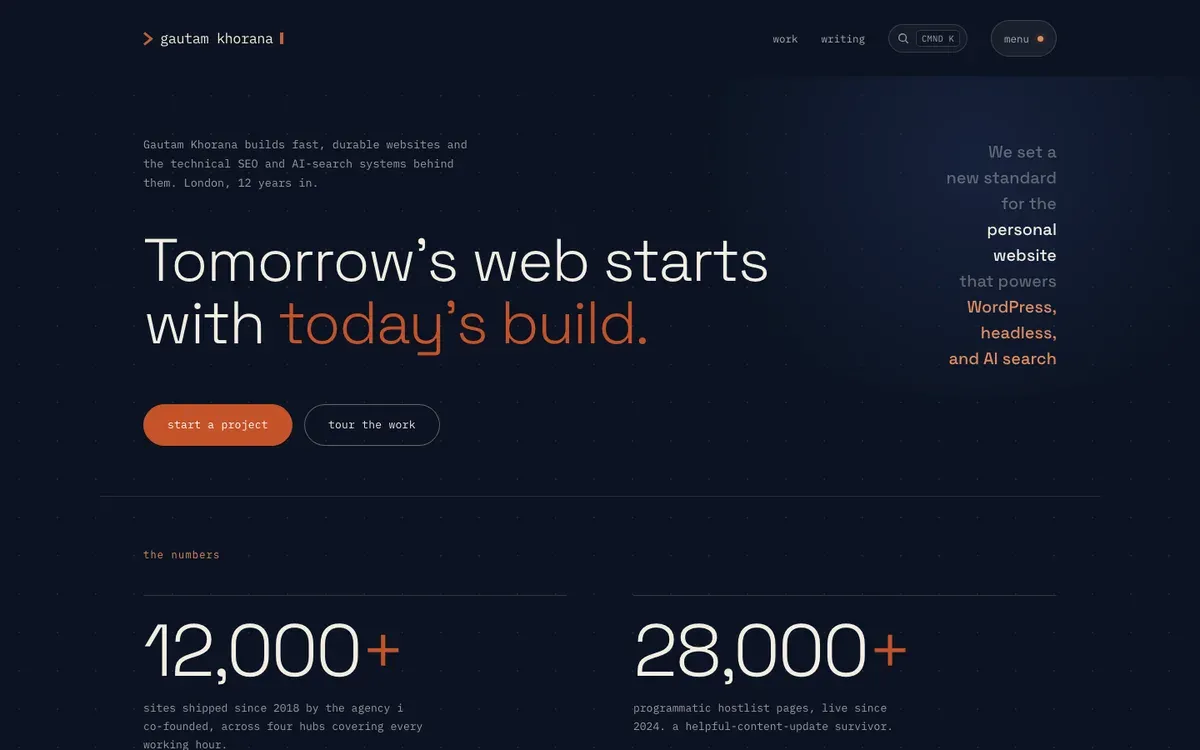 Built and operated with Claude Code. 3,100+ URLs in 8 languages. A research-gated blog pipeline on Claude, GPT and Gemini, an eight-language translation pipeline, SEO lint and a Core Web Vitals budget on every build.
- Deluxe Astrology
 AI quality gates before any page goes live. 125,000+ pages and 93+ free tools on Next.js and Supabase. A humanizer pass, a banned-phrase blocklist and readability floors sit between the model and the publish button.
- HostList.io
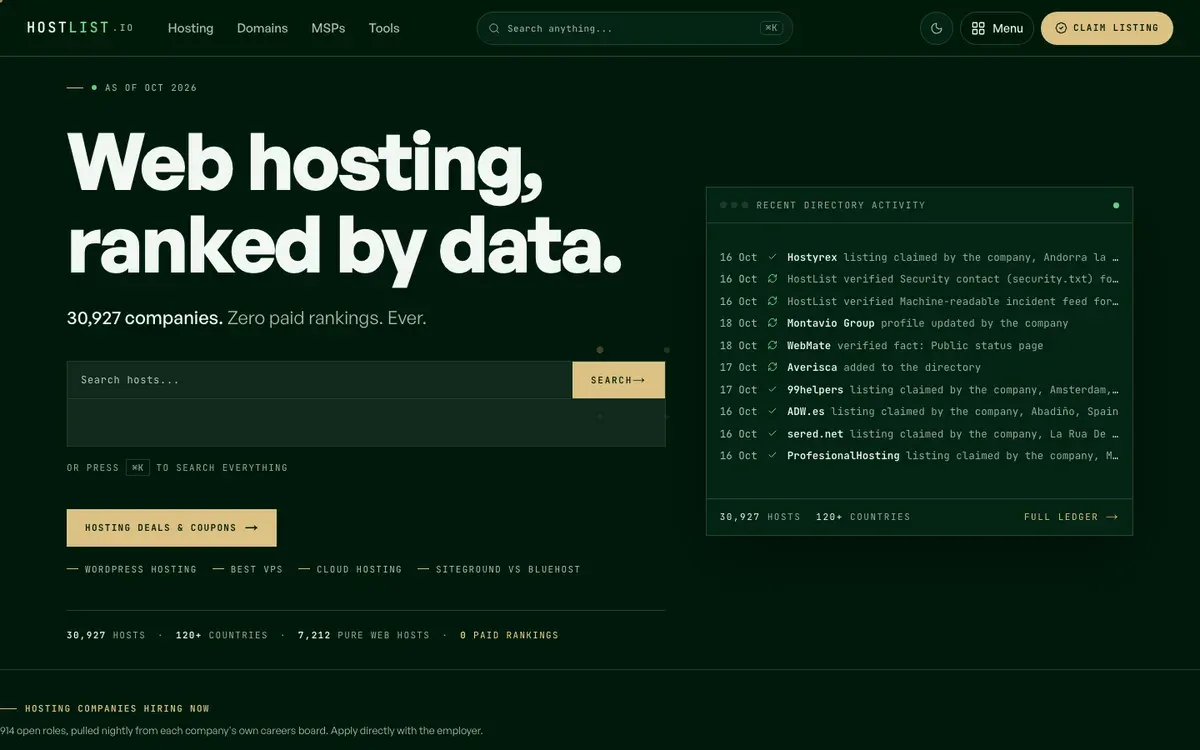 An AI-assisted match on top of real data. 30,000+ web hosting companies across 60+ countries, zero paid rankings. An AI-assisted matching flow narrows the shortlist; a streaming sitemap past 50,000 URLs keeps it indexed.
how an engagement runs
- Readiness assessment Two weeks. A written plan: where AI pays and where it does not, data and privacy constraints, a cost ceiling and a price range.
- Architecture and eval plan Model choice, retrieval design, the eval set and the guard rails, agreed in writing before any code.
- Build in sprints A preview link and a written note after every sprint, with the evals running in CI.
- Harden Rate limits, failover, cost alerts, prompt-injection checks and a red-team pass against the eval set.
- Handover or retainer Code, docs, evals and dashboards in your accounts, or I stay on and read the numbers monthly.
what it costs
- from $2k AI readiness assessment
- from $4k Fixed-price AI feature or automation
- from $10k Agent, pipeline or RAG platform
What an AI consultant does that an agency bench does not, how I pick models and when I leave them out, the Claude Code way of working, evals before launch, and what I will not build.
What an AI consultant does in 2026, and what an agency bench does
An agency sells you a bench: a strategist for the workshops, a prompt engineer, a backend developer and a project manager to hold the three together, on a monthly invoice that assumes the work never ends. The catalogue lists thirty roles because the business model needs thirty roles to be billable.
An AI consultant, in the sense I mean it, is one senior engineer who has shipped language-model features into production and carries a real bill for them. The same person runs the assessment, makes the architecture calls, writes the code and reads the numbers afterwards. Slower than a bench on paper, faster in practice: nothing is lost in handover and nobody is paid to recommend a bigger build than the problem needs. It also means I will tell you when the honest answer is a query, not a model.
Picking the model, and when not to use one
Default to Claude: Sonnet for bulk generation and classification, Opus where judgement or long context matters, Haiku where the task is cheap and frequent. GPT and Gemini come in when a task suits them better, or as a second and third opinion inside a quality gate, which is how the humanizer on this site works. Every call goes through a gateway with failover, and prompt caching and batch endpoints are on from the first sprint, because the cheapest token is the one you did not send twice.
The more useful skill is knowing when to leave the model out. If the input is structured and the rule is known, a SQL query or a regular expression is faster, cheaper and auditable. If being wrong is expensive and nobody will check the output, the task is not ready for an LLM. If per-token cost beats the hours saved, the business case fails before the build starts. Roughly a third of assessments end with one of those answers for part of the brief.
The Claude Code way of working
I build with Claude Code every working day, and the Claude Code workflow page describes how: skills that encode how a project does things, hooks that stop an agent from doing anything destructive, memory that carries decisions between sessions, parallel worktrees for independent tasks, and a senior review of every pull request before it merges. The agentic engineering brief is the fixed-scope version of that practice applied to your codebase.
For clients it changes two things. Throughput: one engineer can run several bounded tasks at once, so a sprint covers more ground than the headcount suggests. Transparency: every change arrives as a pull request with tests and a written note, so your own engineers can review it, learn the patterns and take the work on. The hire a Claude Code developer page covers the engineering-only version.
Evals before launch
No AI feature ships here without an eval set, written before the feature. Fifty to a hundred cases covering the happy path, the edge cases and the inputs that should be refused, scored on accuracy, citation correctness and behaviour under adversarial prompts. It runs in CI on every change and on every model upgrade, because each new version shifts the output. Without the set you find the regression from a customer; with it you find it in a failed build.
Retrieval gets its own measures: precision of what came back, whether the answer used it, whether the citation points where it says. Agents get a budget per run, a stop condition and a log of every tool call, so a loop that goes wrong costs a few cents and leaves a trail. The Vercel AI Gateway guide covers the routing and failover layer in detail.
Data and privacy
Client data stays in your accounts: Supabase project, provider keys, hosting and repository are yours from the first sprint, and I work inside them rather than copying anything out. Nothing is used to train anything. I do not store personal data or health data on my side, and I will not send either to a model without a data processing agreement and a residency plan that fits. For UK and EU teams that means EU-hosted Supabase and a provider region to match; for regulated sectors the HIPAA-compliant AI in Next.js write-up covers what each provider will and will not sign.
What I do not do
I do not train models from scratch or fine-tune for the sake of it; nearly every business problem I see is solved with retrieval, better prompts and an eval set, at a fraction of the cost. I do not run an offshore bench, so if the brief is forty engineers for a year I will point you at a firm that does. I do not build open-ended agents meant to replace a department, because the technology does not do that reliably yet. And I do not take on AI search work for content nobody will read; citations follow pages worth citing.
What it costs
Three bands, all starting prices fixed in writing before work begins. The AI readiness assessment is from $2k over two weeks and is credited against the build. A fixed-price AI feature or automation, one agent, pipeline or LLM feature with its eval set, is from $4k. An agent, pipeline or RAG platform is from $10k; anything larger is quoted from a written scope after the assessment. Advisory time on its own is $250 an hour. The variable that moves price most is the number of systems the feature talks to, not the number of prompts.
What the first 48 hours look like
Book a 30-minute call. Bring the problem, the data you hold and the number you want to move. You leave knowing whether a language model belongs in it, roughly what it would cost to run, and what the first two weeks would produce. If I am not the right fit I will tell you who is.
Frequently asked questions
What does an AI consultant do?
Works out where a language model earns its place in your business, then builds that part and measures it. In practice: a readiness assessment of your data, workflows and risk, a written plan with a cost ceiling, then agents, automation, retrieval or AI search work shipped in sprints with an eval set behind it. The difference from an agency bench is that one senior engineer does the thinking and the building, so the plan is one that can actually be shipped.
What does AI consulting cost?
Three starting points. An AI readiness assessment is from $2k and is credited against the build if you go ahead. A fixed-price AI feature or automation, one agent, pipeline or LLM feature with its evals, is from $4k. An agent, pipeline or RAG platform is from $10k and is quoted from a written scope. Advisory time on its own is $250 an hour; an ongoing engineering retainer is priced on the hire an AI engineer page. Every figure is a starting price, fixed in writing before work begins.
Do you build AI agents for business?
Yes, where the job is bounded: triage a queue, run an audit, draft from a brief, reconcile two systems, file the result. I build them on Claude and the Vercel AI SDK with tool use scoped to the minimum, an eval set that covers the failure modes, and hooks that gate anything destructive. Open-ended agents that are meant to run a department are not something I will sell you, because they do not work yet.
Which AI models do you use?
Claude by default: Sonnet for bulk work, Opus where judgement matters, Haiku for cheap classification. GPT and Gemini when the task fits them better or as a second opinion in a quality gate, which is how the humanizer on this site works. Routing goes through a gateway with failover so a provider outage is a log line, not an incident. I do not train models from scratch, and I will say so when a rule, a query or a regular expression does the job for free.
Can you integrate AI into our Next.js or Astro site?
Yes, that is the most common shape of work. Search that answers rather than lists, an assistant over your own documents, extraction and classification at the edge, drafting tools inside your admin. Retrieval runs on Supabase pgvector with hybrid search and reranking, streaming goes through the Vercel AI SDK, and the feature ships with a cost ceiling and rate limits before the first user reaches it. HostList.io, Deluxe Astrology and this site all run LLM features in production on exactly that stack.
How do you measure whether it worked?
With numbers agreed before the build. Every feature gets an eval set of 50 to 100 cases that scores accuracy, citation correctness and refusal behaviour, and it runs in CI so a model upgrade cannot quietly regress it. Then the business measure: hours saved per week, tickets closed without escalation, pages published per month, citations in AI answers. The assessment names the measure; the handover report shows it.
Do you do AI SEO and generative engine optimization?
Yes. The work is being the source that ChatGPT, Perplexity, Gemini and Google AI Overviews cite when your buyers ask. It starts with an audit of which prompts mention you today, then answer-first pages built to be quoted, entity schema that ties the brand together, and a monthly read of citation share. The AI citation checker and AI search keyword research tools on this site are free and run the first check in a minute.
Where are you based, and do you work with US teams?
London. Most clients are in the UK, Europe and the US. Calls run on UK hours with early-evening slots for US time zones, and the work itself is asynchronous: a preview link and a written note after every sprint, so nobody waits for a meeting to see progress.
Who does the work, and who owns the code?
Me, Gautam Khorana. I scope, build and ship the work myself, with Claude Code as the execution tool and specialists joining for legal or security review when a brief needs them. The repository sits in your GitHub organisation from the first sprint, API keys and hosting are in your accounts, and there are no licence fees on anything I build. When I leave, nothing leaves with me.
Will you sign an NDA?
Yes, before the first call if you prefer. Your own paper or mine. Client data used during a build stays in your accounts, nothing is used to train anything, and I do not store personal data or health data on my side.
What is an AI readiness assessment?
Two weeks on the problem at the top of your list before anyone writes a prompt. I look at the data you hold and how clean it is, the workflow the AI would sit in, who is accountable for its output, the privacy and residency constraints, and what it would cost to run at your volume. You leave with a written plan, a build-or-buy recommendation with the reasoning shown, and a price range whether you continue with me or not. The fee is credited against the build.
When should we not use an LLM?
When the input is structured and the rule is known: a SQL query, a lookup table or a regular expression is faster, cheaper and auditable. When being wrong is expensive and nobody will check the output. When the volume is so high that per-token cost beats the hours saved. Roughly a third of assessments end with one of those answers, and the client keeps the fee credit for the part that does need a model.
How long does an AI project take?
Two weeks for the assessment. Two to four weeks for a single feature or automation with its eval set. Six to twelve weeks for an agent, pipeline or RAG platform. The part that takes time is rarely the model call; it is the eval set, the guard rails and the integration with the systems around it, and anyone promising a production agent in a week is skipping one of them.
Can you work alongside our own engineers?
Yes, and it is often the better shape. I run the assessment and the architecture, build the first feature with your team watching the pull requests, and leave the eval set, the Claude Code skills and the documentation so the next feature is yours to ship. Advisory time at $250 an hour covers design reviews and model decisions after that.
Related reading
Bring the problem, not the model.
Thirty minutes on the problem, not the model. You leave with a view on whether AI belongs in it, what it would cost to run, and what the first two weeks would look like, whether you sign or not.