
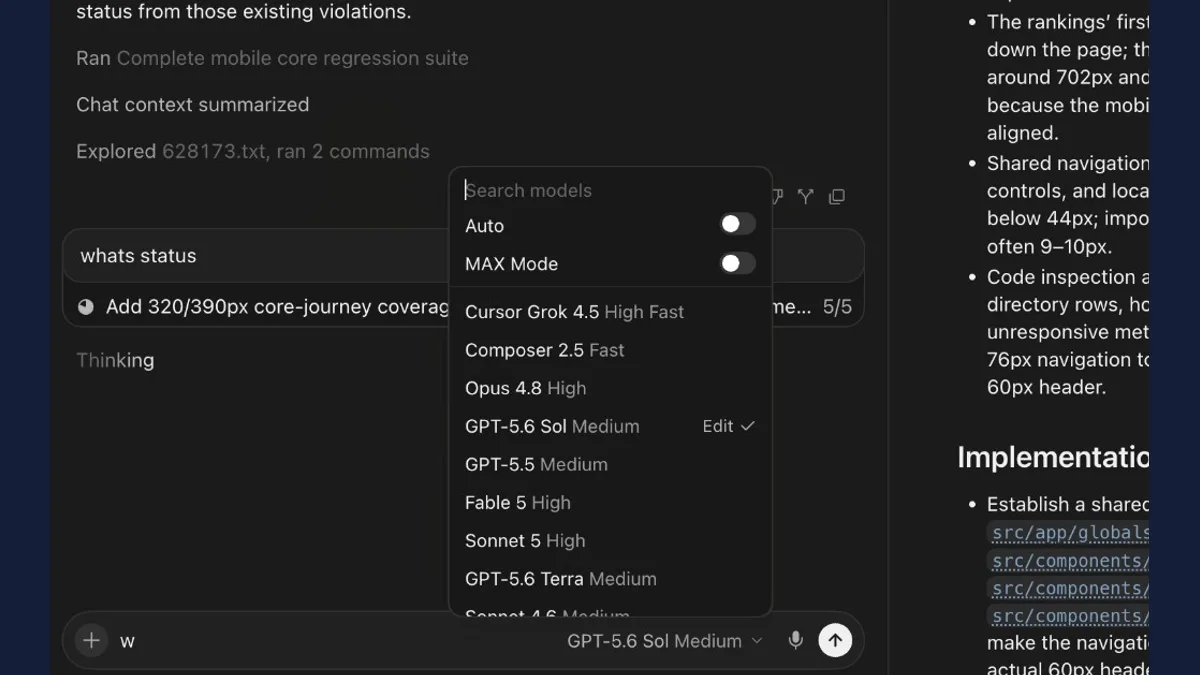
Over the past ten days I did something slightly obsessive. I ran the same real project work — planning, implementation, content writing, refactors, the lot — through every major AI coding model I could reach inside Cursor, and I kept honest notes on which one actually earned its keep. This is not a synthetic benchmark chart. It is what happened when I shipped real features and real words with each model, on real deadlines. The screenshot above is my Cursor model picker, and by the end of the ten days I had a firm opinion about almost every name in that list.
Here is the short version before the detail: there is no single winner. There is a best model for planning, a best model for writing, a best model for raw implementation speed, and a best model for value. Treating "which AI is best for coding?" as one question is the mistake. Below is exactly which model wins which job, why, and where I personally landed after living with all of them.
Key takeaway: For planning and thinking, Fable, Claude Opus 4.8 and GPT-5.6 Sol lead, with Grok closer than I expected. For content, Claude wins and GPT-5.6 is a hair behind. For fast, cheap implementation, Cursor's Auto Composer is unbeatable on value. For everyday cowork on a token budget, Claude Sonnet 5 is the model I keep open all day.
How I run these tests
I pay for both Claude Max and Cursor Ultra out of my own pocket, and I deliberately splurge on credits. Nobody sponsors this. I treat the monthly bill as tuition, and I think it is the best education in software you can buy right now. Ten days of real, shipping work across these models taught me more about how things actually get built in 2026 than a semester at Harvard or Stanford would. The reps are on real problems with real deadlines, not lectures. When I say a model is the best value, it is because I watched my own credit balance while it worked.
What AI coding models did I test?
I tested eight models across four vendors, all inside Cursor, over ten days of normal work. Grouping them by maker keeps the entity picture clean:
- Cursor Auto (Composer): Composer is Cursor's own in-editor model, tuned for speed inside the agent loop.
- Claude Sonnet 5, Claude Opus 4.8 and Fable — the Anthropic lineup I had access to, from the balanced Sonnet workhorse to the heavier Opus reasoner and the newer, planning-heavy Fable.
- GPT-5.6 Sol and GPT-5.6 Terra — OpenAI's latest builds, with Sol tuned harder for reasoning and Terra as its sibling.
- Cursor Grok — xAI's Grok wired into Cursor as an agent model.
Every model saw the same kinds of tasks: ambiguous feature requests that needed decomposing, multi-file implementations, a couple of gnarly refactors, and long-form writing. What follows is how they actually behaved, job by job.
How did I test these AI coding models?
I tested each model on the same real work, not on toy prompts, over ten consecutive days inside Cursor. That meant giving every model a fair mix of the four jobs I actually do: planning a feature from a vague brief, implementing it across multiple files, refactoring existing code, and writing long-form content. Where possible I handed the same task to more than one model so I could compare like for like.
I deliberately did not rely on public benchmarks. Leaderboard scores rarely predict how a model behaves in a messy, real repository with existing conventions, half-finished features and its own history. The only test I trust is whether a model can take something I actually needed shipped and get it to a state I would put my name on. Everything below is that kind of judgement, not a number from a scorecard.
Which AI model is best for planning and thinking?
For planning and deep thinking, the clear standouts were Fable, Claude Opus 4.8 and GPT-5.6 Sol — and Grok was genuinely not far behind. By "planning" I mean the unglamorous work that decides whether a feature ships cleanly: taking a vague request, decomposing it into the right sequence of steps, surfacing the edge cases before a single line is written, and noticing the thing that will break in production two weeks later.
Fable is the one that surprised me most here. In a long session it holds the whole shape of a problem in view and keeps reasoning about second-order consequences instead of rushing to code. Opus 4.8 is the most structured thinker — it lays out assumptions, trade-offs and a sequenced plan you can actually hand to another model to execute. GPT-5.6 Sol plans with real rigour too, and tends to be the most explicit about risks and failure modes.
Grok deserves a specific mention because it is the one people underrate. For architectural thinking and "should I even do it this way?" conversations, it held its own against models with far bigger reputations. If you have dismissed Grok as a novelty, that is out of date — inside Cursor it is a credible planning partner.
Which AI model is best for actually implementing and shipping code?
If you plan the work well up front, a single long Fable session can take an idea from prompt to deployed in one to three prompts — genuinely what you imagined, not a rough approximation of it. That was the most striking implementation result of the ten days. The catch is in the first half of the sentence: you have to plan well. Fable rewards a good brief more than any other model I used.
For implementation quality, Opus 4.8 and Grok are close and roughly comparable. Both write code that holds together across multiple files, both are willing to make a judgement call instead of stalling, and both recover well when a step fails. If Fable is the "plan it once, ship it whole" model, Opus 4.8 and Grok are the reliable everyday builders you reach for when the work is more iterative.
The lesson I keep relearning: implementation quality is mostly downstream of planning quality. The models that plan best also ship best, because most bad AI code is really a bad or missing plan wearing a syntax costume.
Which AI model writes the best content?
For content and copy, Claude wins the show, with GPT-5.6 a close tie. This was not close on style alone — Claude simply has better instincts about restraint. It knows when to stop, cuts filler, and keeps a consistent voice across a long piece without drifting into the generic "as an AI" cadence.
GPT-5.6 is right behind and occasionally ahead on structure — it is excellent at organising a messy set of points into a clean outline, and it is strong at the kind of scannable, answer-first formatting that both readers and AI search engines reward. If I am drafting something opinionated and human, I reach for Claude. If I am organising dense information into a tight structure, GPT-5.6 is the one I test against it.
The gap shows up most on second drafts. Ask Claude to tighten a piece and it makes it sharper without flattening the voice; ask most other models and they sand off the personality along with the filler. For anything that has to sound like a person wrote it — a review like this one, a landing page, a considered reply — that instinct for what to keep is worth more than any single clever sentence.
What is the fastest and best-value AI coding model?
Cursor's Auto Composer is the fastest model I tested for raw implementation, and on value for money it is simply the best model in the list. It is exceptionally quick at the actual mechanics of coding, reading files, making edits, running the loop, and because Composer is Cursor's own model it is priced to be used constantly rather than rationed.
Cursor Ultra is $200 a month and gives 20x the usage credits of Pro, built for developers who live in the editor all day. Composer, Cursor's own model, is priced to run constantly rather than be rationed.
That value point matters more than benchmarks. A model you can run all day without watching a meter changes how you work. For the large volume of everyday coding that does not need a heavyweight reasoner, wiring up a component, fixing a failing test, mechanical refactors, Composer is the default I now reach for first, and I escalate to a bigger model only when the problem earns it.
Is Claude Sonnet 5 good for pair-programming and everyday cowork?
Yes — for day-to-day cowork, planning and content writing on a sensible token budget, Claude Sonnet 5 is genuinely amazing. It is the model I keep open the longest. It plans well enough to be trusted, writes well enough to draft real copy, and does both without the token appetite of the heavier models.
Considering token usage, Sonnet 5 is the efficiency champion of this group. It gives you most of the quality of the flagship reasoners for a fraction of the cost, which makes it the right default for the long, chatty, back-and-forth sessions that make up most real work. Opus, Fable and GPT-5.6 Sol come out for the hard problems; Sonnet 5 handles everything in between.
How do the AI coding models compare at a glance?
If you only remember one thing per job, remember this scorecard:
| Job | Winner | Runner-up | Why it wins |
|---|---|---|---|
| Planning and thinking | Fable, Opus 4.8, GPT-5.6 Sol | Grok | Decompose vague briefs and surface edge cases before any code is written. |
| One-shot implementation | Fable | Opus 4.8 and Grok | Idea to deployed in 1 to 3 prompts in a well-planned long session. |
| Everyday builders | Opus 4.8 | Grok | Reliable multi-file builders for iterative shipping work. |
| Content writing | Claude | GPT-5.6 | Better restraint, consistent voice, and sharper second drafts. |
| Speed and value | Cursor Auto Composer | Claude Sonnet 5 | Fastest implementation, priced to run all day without rationing. |
| Cowork on a token budget | Claude Sonnet 5 | Opus, Fable, GPT-5.6 Sol | Most of the flagship quality for a fraction of the token cost. |
What AI coding models am I testing next?
This morning Meta announced a new model, and it is next on my list. I want to see whether it can compete with the planning tier — that is the bar now, not raw code completion. Alongside it I am lining up Google's Gemini and Kimi, both of which I have not yet put through the same ten-day treatment inside Cursor.
On design specifically I already have data. I have used Kimi and MiniMax for design work, and both do a genuinely good job at UI design planning — turning a loose product idea into sensible layout, hierarchy and component decisions before any code exists. That is a different skill from writing code, and it is one worth tracking separately, because the model that plans your interface well is not always the model that implements it fastest.
Frequently asked questions
What is the best AI coding model in 2026?
There is no single best AI coding model — it depends on the job. Fable, Claude Opus 4.8 and GPT-5.6 Sol lead on planning, Claude leads on content, and Cursor's Auto Composer wins on speed and value. Match the model to the task instead of chasing one winner.
Which AI model is best for planning and architecture?
Fable, Claude Opus 4.8 and GPT-5.6 Sol are the strongest planners, with Grok close behind. They decompose vague requirements into ordered steps and surface edge cases before code is written, which is the part that decides whether a feature ships cleanly.
Which AI model writes code the fastest?
Cursor's Auto Composer is the fastest for raw implementation inside the editor, and it is also the best value because it is priced to be used constantly. For mechanical, well-scoped coding it is the model to reach for first, escalating to a heavier reasoner only when needed.
Is Claude or ChatGPT better for coding?
For content and copy, Claude wins with GPT-5.6 a close tie. For planning, GPT-5.6 Sol and Claude Opus 4.8 are both top-tier. For everyday cowork on a token budget, Claude Sonnet 5 is the standout. In practice I use both and pick per task.
Which AI models are best for UI design?
Kimi and MiniMax both do a strong job at UI design planning — translating a product idea into layout, hierarchy and component structure before any code exists. Design planning is a distinct skill from code implementation, so the best design model is not always the best coder.
Which AI coding model gives the best value for money?
Cursor's Auto Composer offers the best value — it is fast and priced to run all day without rationing. Claude Sonnet 5 is the best value among the reasoning-capable models thanks to its low token usage relative to the quality it delivers.
That is where I am after ten days: Composer for speed and value, Sonnet 5 for everyday cowork, Fable, Opus 4.8 and GPT-5.6 Sol when a problem needs real thought, Claude when it needs real words, and Grok as the underrated all-rounder. Next up are Meta's new model, Gemini and Kimi — I will report back once they have earned or lost their place in the picker.
Related reading: Vibe coding is a team sport: how I ship with six AI models, WordPress, and SEO.