
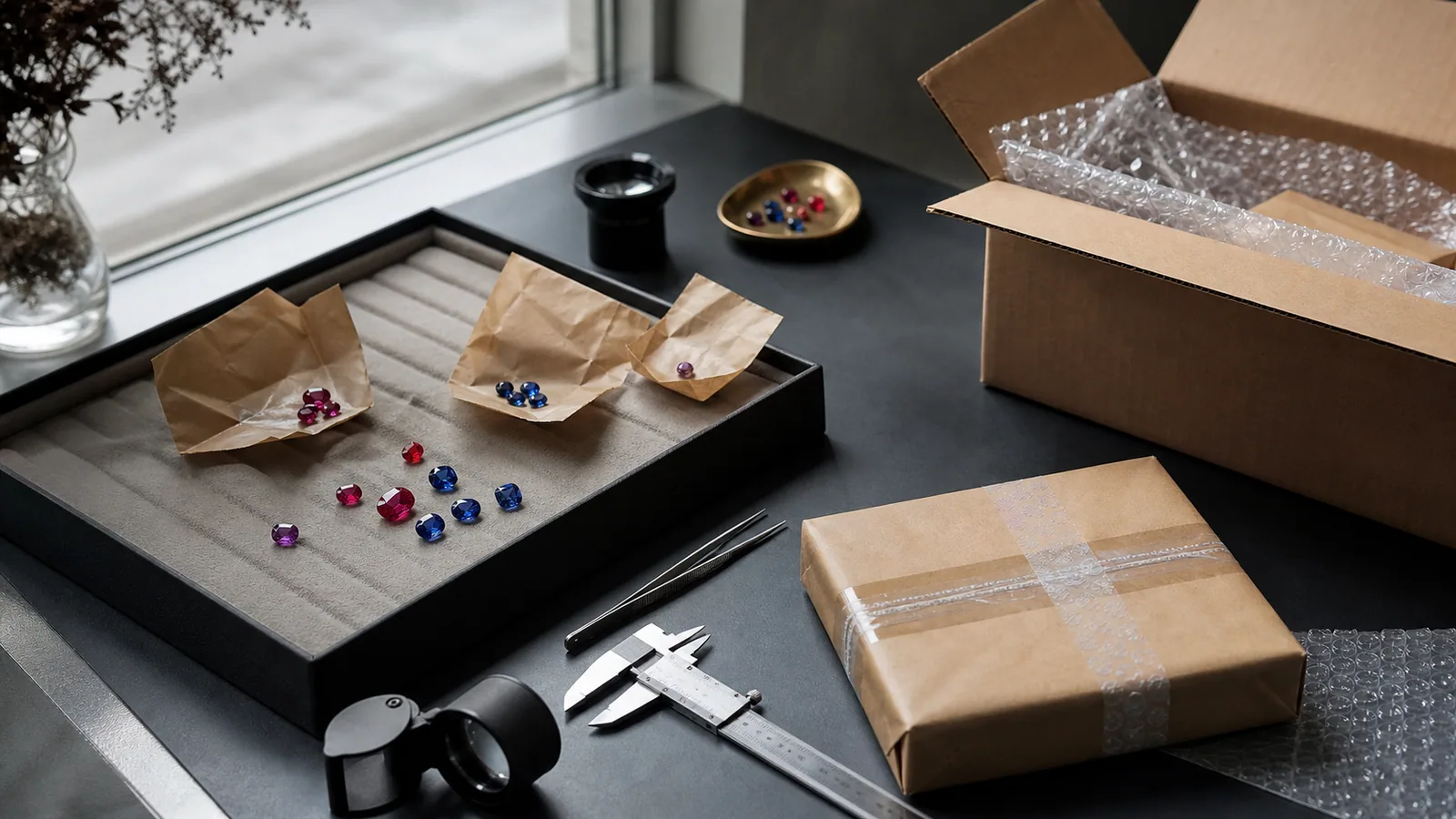
Loose gemstones are easier to inspect than mounted stones and harder to buy online than product photography suggests. Colour shifts with lighting and screens. A stone that faces up brightly in one video may show a large window or dark extinction when moved. Treatments and origin can change both price and care requirements.
The answer is not to avoid online dealers. It is to turn the purchase into an evidence process before money moves.
Use independent loose gemstone buying guides to understand the questions specific to sapphire, ruby, emerald, spinel and other varieties, then apply this checklist to the individual stone.
Disclosure: I founded GemsVerified. The directory and guides are my product; laboratory references and the practical checks remain independently verifiable.
Start with the intended use
A collector’s stone, an engagement-ring centre stone and a gem intended for immediate resale have different requirements. Daily wear puts durability and setting risk near the top. Collecting may give more weight to rarity, origin or an unusual inclusion scene. Resale adds liquidity and documentation.
Write down the purpose, maximum landed cost and claims that materially affect the price. This prevents a beautiful video from changing the buying brief halfway through the conversation.
Evaluate colour across more than one environment
Ask for footage in diffused daylight and a known indoor light source. Request a hand shot for scale and a neutral background. If colour change or fluorescence is part of the offer, ask how it was observed and under which light source.
Screens are not calibrated gemological instruments. The goal is not an exact remote colour grade. It is to see whether the stone remains attractive across ordinary conditions and whether the dealer is willing to show it outside the studio setup.
Look for windowing, extinction and uneven performance
A window is an area where light passes through the stone and the background appears visible. Extinction is an area that remains dark because light is not returning to the viewer. Both can be affected by cut, proportions, orientation and viewing angle.
Ask for a slow face-up tilt rather than a fast rotating video. Watch the centre, edges and corners. A stone can have strong colour and still perform poorly because too much of its face is transparent or black at normal viewing angles.
Treat treatment status as a price input
Many accepted treatments are common in the coloured-stone market. The issue is disclosure, durability and price, not the simplistic idea that every treated stone is bad. GIA’s treatment introduction explains how treatments can alter appearance and sometimes affect care.
Ask the dealer to state treatment status in writing. Compare that statement to the laboratory report. If the report says no indications of a treatment were observed, preserve the exact wording rather than paraphrasing it as an absolute guarantee that no treatment ever occurred.
Do not pay an origin premium for a story
A mine story, family history or purchase location is provenance evidence, not automatically a gemological origin conclusion. If country of origin materially changes the price, look for an appropriate independent origin report and understand that it remains an expert opinion.
Origin also does not override quality. Every deposit produces a range of material. A less fashionable origin can produce an exceptional stone, while a prestigious location can produce ordinary material.
Read the report against the listing
- Does the report identify the same species and variety claimed in the title?
- Do weight, measurements, shape and photograph match the offered stone?
- Are detectable treatments stated consistently?
- Is origin included in the report or only in the dealer’s description?
- Can the report number be checked on the laboratory’s official domain?
A report is valuable evidence, but it does not inspect the transaction. You still need to assess the dealer, return policy and stone-to-report match.
Calculate landed cost before comparing prices
The displayed price is not the final cost of a cross-border purchase. Add insured shipping, import VAT or sales tax, customs duty where applicable, payment charges, independent inspection and possible return shipping.
Ask who is the importer of record and which declared value will be used. Under-declaration creates insurance, customs and legal risk for the buyer as well as the seller.
Make insured shipping explicit
Confirm that the carrier accepts precious stones under the selected service. Ordinary courier cover may exclude jewellery, gems or high-value goods even when a generic insurance option appears at checkout.
The invoice, declared value, packaging process and tracking should align with the insurance terms. For a return, obtain written instructions from the dealer and use a service that covers the full value in the destination country.
Protect the inspection period
Agree the return window before payment and make sure it permits independent examination. Record the unboxing in one continuous video for a significant purchase, including the sealed parcel, label, packaging, stone and report.
Arrange the gemologist before the parcel arrives. A seven-day return window disappears quickly when a specialist appointment takes ten days.
Know when to walk away
- The report number cannot be verified and the laboratory will not confirm it.
- The seller refuses neutral-light video or basic measurements.
- Treatment or origin language changes after detailed questions.
- Bank details change immediately before payment without independent confirmation.
- The return policy prevents independent inspection.
- The price depends on guaranteed appreciation or a promised resale buyer.
A simple buying sequence
Shortlist the dealer, define the stone specification, request complete media, obtain written treatment and origin claims, verify the laboratory report, calculate landed cost, agree inspection and return terms, confirm payment details, then arrange an independent check during the return window.
That sequence cannot remove every risk. It converts an image-led purchase into a documented decision with several opportunities to stop.
Frequently asked questions
Is it safe to buy loose gemstones online?
It can be, when the dealer is identifiable, the stone is documented, important claims are independently tested, payment instructions are verified and the return period allows inspection. No platform or certificate removes the need for those checks.
Should I buy an untreated gemstone only?
Not automatically. Some treatments are common and stable; others affect value or care more substantially. Buy according to disclosed treatment, appearance, durability, price and your own collecting objective.
Can photographs show the true gemstone colour?
They can provide useful evidence but not a perfectly objective colour measurement. Ask for multiple lighting conditions, video and a return period so the stone can be assessed in person.