
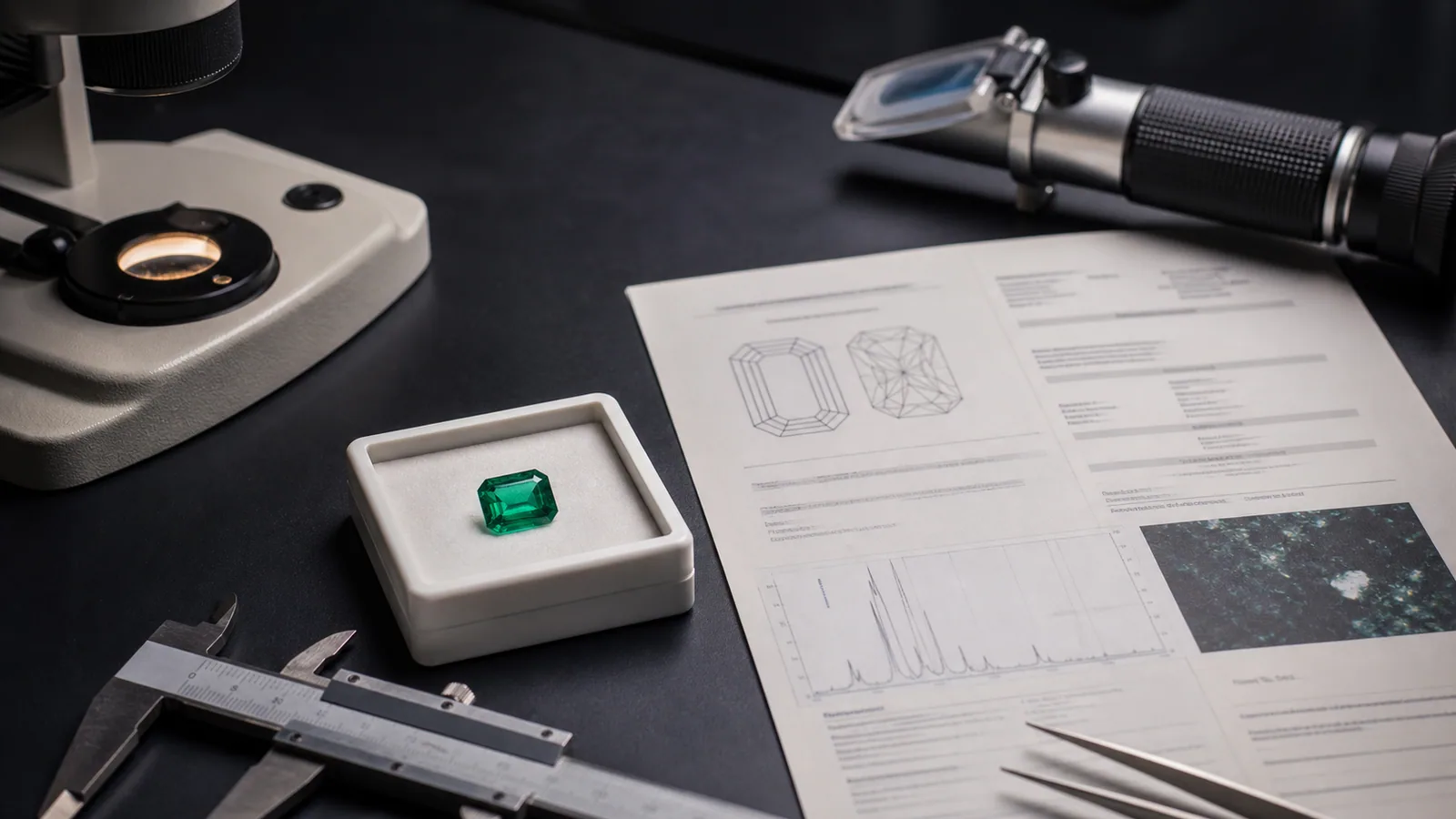
“Certified gemstone” sounds like a complete assurance. It is not. In the coloured-stone trade, the document is usually an identification or origin report issued by a gemological laboratory. It records findings about a submitted item. It does not certify the dealer, guarantee future value or decide whether the price is fair.
The distinction matters because a strong report is genuinely useful. Buyers get into trouble when they ask it to prove things outside its scope.
This guide to certified gemstones goes deeper into the terminology. The practical reading framework is below.
Disclosure: I founded GemsVerified. Its link is included as a relevant primary resource; independent laboratory sources are used for the technical claims below.
What a coloured-stone lab report can establish
The exact fields depend on the laboratory and service purchased, but a serious report may cover the following.
- Whether the submitted material is natural, laboratory-grown or an imitation.
- The gem species and variety, such as natural corundum identified as sapphire.
- Weight, measurements, shape, cutting style and observed colour.
- Detectable treatments or clarity enhancements.
- A geographic-origin opinion for eligible stones when that service was requested.
GIA’s current coloured-stone report services distinguish an Identification Report from an Identification and Origin Report. The extra conclusion is not automatic and is not available for every material.
What the report does not prove
It does not certify the seller
The laboratory examined an item, not the dealer’s business practices. A valid report can be held by a poor seller, copied into a fraudulent listing or paired with a different stone.
It does not guarantee the price
Identification and value are separate questions. Two natural, untreated sapphires of the same weight can have very different colour, cut and commercial value. A report may describe observable characteristics without grading beauty or endorsing the asking price.
It does not promise investment returns
A gemstone is not made liquid or profitable by the presence of paperwork. Resale spreads, buyer access, fashion, provenance and the condition of the stone all matter. Treat guaranteed-return language as a sales claim requiring evidence, not as a consequence of certification.
It does not make origin infallible
Geographic origin is an expert opinion built from inclusions, chemistry and reference data. GIA describes the scientific difficulty of origin determination, including overlap between deposits and the possibility of disagreement among major laboratories.
How to verify a gemstone report
1. Use the laboratory’s official website
Type the laboratory domain yourself or reach it through a trusted source. Do not depend on a QR code or verification link supplied by the seller, because either can point to a convincing copy of a real lab website.
2. Search the report number
Where online verification exists, confirm the number resolves to the expected record. Compare the result rather than accepting the existence of any result as proof.
3. Compare every identifying field
Check species, variety, weight, dimensions, shape, colour description, photograph and date. Small measurement differences may be explainable, but unexplained mismatches need resolution before payment.
4. Read comments and treatment language
The commercially important finding may be a short comment about heat, diffusion, resin, oil, glass filling or another enhancement. “Natural” describes formation; it does not mean untreated.
5. Confirm the service scope
A basic identification report and an origin report answer different questions. If the seller’s price depends on country of origin, confirm that the document actually includes an origin opinion rather than an inference made in the listing copy.
6. Match the paper to the stone
Online verification proves that the laboratory record exists. It does not prove that the stone in front of you is the item that was examined. Compare the physical details and obtain an independent inspection for a purchase where a mismatch would be costly.
Which laboratory should you trust?
Do not reduce the decision to a universal league table. Laboratories differ by speciality, geography, instruments, reporting language and market acceptance. Start with the claim you need tested, then ask whether the laboratory has the expertise and service scope to answer it.
Check whether the lab publishes its methods, sample reports, report-verification system and disclosure terminology. For a high-value stone, market participants may expect a report from a particular group of laboratories, regardless of whether another lab could identify the material competently.
The better buying question
Instead of asking “is this gemstone certified?”, ask four narrower questions: who examined it, what service did they perform, what did they conclude, and does the document match this stone?
That wording removes the false promise from “certified” while preserving the real value of independent laboratory analysis.
Frequently asked questions
Is a certified gemstone always natural?
No. A laboratory report may identify an item as natural, laboratory-grown or an imitation. Read the conclusion rather than treating the existence of a report as evidence of natural origin.
Can a natural gemstone still be treated?
Yes. Natural describes how the material formed. Heat, filling, dyeing, diffusion and other treatments may be applied later, which is why treatment disclosure is a separate report field.
Should every loose gemstone have a laboratory report?
Not necessarily. Laboratory fees may be disproportionate for inexpensive material. The value of independent testing rises with the price, rarity and importance of claims about treatment or geographic origin.