

The instinct is that more models means better answers. One more tab, one more perspective, triangulate your way to the truth. It works up to about three models and then reverses hard. Past that, every model you add costs more in reconciliation than it pays in insight, and the first thing to degrade is not your speed. It is your judgement about which answer was right.
Key takeaway: One model forces clear thinking. Two or three buys you a genuine second opinion. Past that you are not orchestrating models, you are chairing a committee that cannot remember what it agreed to ten minutes ago.
I drew this curve after a month where I had six models open more or less permanently, felt extremely productive, and shipped noticeably worse work.
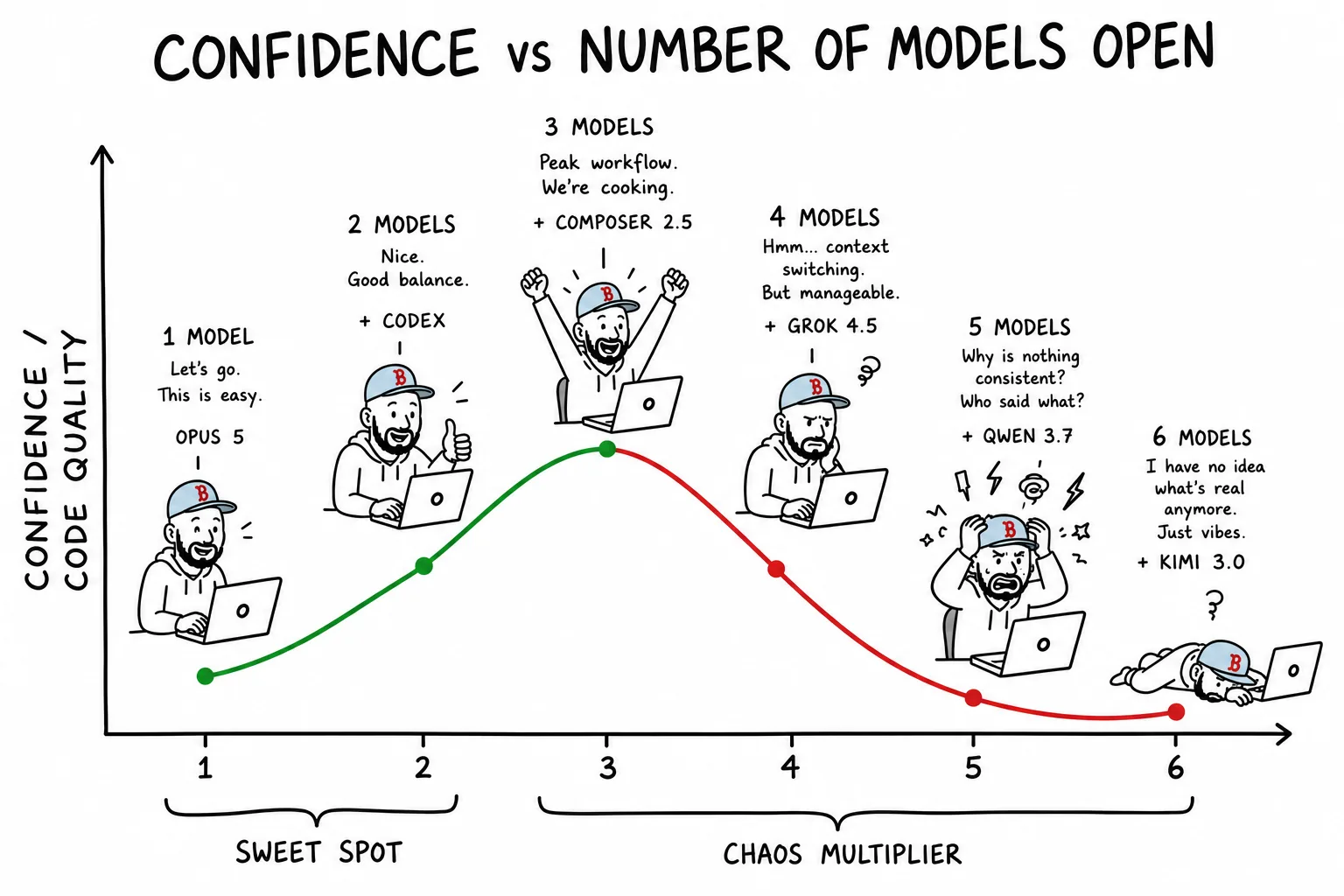
Six models open cost me a day on one redirect map
At my worst I had Opus 5 on an architecture problem, Codex halfway through the implementation, Composer live in the editor, Grok open for a second read, and Qwen and Kimi parked in two more tabs because someone on X said they were good at this. It felt like a cockpit. It was a group chat where nobody had read the brief.
The cost showed up in a redirect map. I was consolidating a few hundred old URLs on a large programmatic site, the kind of job where 95 percent right is a disaster because the 5 percent is silently 301ing revenue into a wall. I asked three models and got three defensible answers about the trailing-slash chain. Instead of picking one and reasoning it through, I merged them. The blend was worse than any of the three alone, because each was internally consistent and the merge was not. A day to unpick, entirely self-inflicted.
One model forces you to think clearly
The underrated property of a single model is that it puts the spec back on you. With exactly one thing to ask, you have to write a real brief: the input, what the output must satisfy, what is out of scope, what "done" means. That act of writing is most of the engineering. I have caught more design mistakes writing a prompt than in any code review.
With six models open, that discipline quietly evaporates. You stop writing briefs and start taking polls, and a vague question fired at six models returns six confident answers. Confidence is not evidence, it is just what these systems sound like. Almost all of the value in my Claude Code workflow sits upstream of the model.
Two or three models is the actual sweet spot
The reason three works is that the models are doing different jobs rather than the same job in parallel. Division of labour is additive. Duplication is not. One model holds the plan, one writes the code, one reads it back to you cold. Nobody is voting.
The moment two models are doing the same job, you have not bought redundancy. You have bought a tie-break that only you can resolve, and you are the least rested participant in the conversation.
When a specialist model actually earns a tab
Specialists are worth it when they are structurally different, not just differently branded. My test is simple: does it disagree with the others in a way I can learn from? A model that agrees with everything is a very expensive yes-man.
Codex earns its tab on implementation, especially long mechanical changes across many files where I want a diff rather than a conversation. Composer 2.5 earns it inside the editor, where the value is latency, not depth. Grok earns it on product and positioning questions, because it will happily tell me the idea is boring. Qwen and Kimi earn it when I want a different training distribution rather than another vote from the same neighbourhood. I have Kimi wired into a UI-audit script precisely because it notices what the others have learned to be polite about.
That last distinction is the whole game. Most of the time when people add a fifth model they are not looking for another opinion, they are looking for another confirmation. Those feel identical in the moment and they are opposites.
The hidden cost is reconciliation, not switching
Context switching is the cost everyone names, and it is real: you re-read the same file for the fourth time because you cannot remember which tab you told about the constraint. But it is not the expensive one.
The expensive one is that you become the merge conflict. Two models give you one disagreement to adjudicate. Three gives you three. Six gives you fifteen pairwise disagreements, and every one of them wants a decision from the same tired human. Nothing in your stack is doing that reconciliation for you. You are the integration layer, running at the end of the day, on a problem you have now read six slightly different framings of.
And the models cannot help you here, because none of them knows what the others said. You are the only one holding the full context, which is exactly the position you were trying to delegate out of.
AI orchestration is usually a human problem
When people say they need better orchestration, they usually mean they need a clearer brief. If three models give you three genuinely different answers, that is rarely a capability gap. It is almost always ambiguity in the question, and no amount of routing logic fixes an underspecified problem. It just distributes it.
The diagnostic I use now: if I cannot write down, in two sentences, what a correct answer would have to satisfy, opening another model is procrastination with a progress bar. Write the two sentences first. Sometimes the two sentences are the answer and I close every tab.
The workflow I actually run today
Opus 5 for thinking. Architecture, tradeoffs, the awkward question of whether the thing should be built at all. This is where I spend prompt effort, because a bad decision here is not recoverable by better code later.
Codex for implementation. Once the shape is decided, hand it the spec and let it work. I review the diff, not the reasoning.
Composer 2.5 for coding assistance. In-editor, fast, small scope. It is a better autocomplete, not a colleague, and treating it as a colleague is how you get 400 lines you did not ask for.
Grok for alternative perspectives. Deliberately not on the critical path. I go there when I suspect I have talked myself into something.
Qwen or Kimi when I want another opinion instead of another confirmation. Rarely. On purpose.
The part that matters is not the list. It is that these are almost never open at the same time. A sequence, not a cockpit: thinking, then implementation, then review, one model holding the pen at each stage. The chart peaks at three because three is how many stages are genuinely live on a good day. I compared two of these in Claude Code vs Cursor.
Better prompts beat more tabs
A well-specified problem given to one good model beats a vague problem given to six, and it is not close. More models feels better because opening a tab is instant and writing a brief is work. AI FOMO is the belief that the next model will do the thinking you have been avoiding. It will not. It will be more articulate about the wrong problem.
Discipline is unglamorous and it compounds. The people I know shipping the best work with these tools are not running the most models. They are running two or three, on purpose, with a clear division of labour and a written spec, and they are bored of the model-of-the-week discourse.
One thing to do today
Close every AI tab except one. Take the task you are actually on and write two sentences: what the input is, and what a correct output would have to satisfy. Give those two sentences to the one model you left open. If the answer is good, your bottleneck was never model capacity. If it is bad, you now know which of the two sentences was wrong, which is a thing six models could not have told you.
FAQ
How many AI models should I use at once?
Two or three, doing different jobs: one to think through the problem, one to implement, and optionally one to review or offer a contrarian read. Past three, the cost of reconciling conflicting answers grows faster than the value of the extra perspective, because you are the only participant who knows what all of them said.
Is it bad to use multiple AI models for the same task?
Running two models on the identical task is usually waste. It does not buy redundancy, it buys a tie-break that only you can resolve. Multiple models help when they have different roles, such as planning versus implementation, and hurt when they duplicate each other.
What is the real cost of switching between AI models?
The obvious cost is re-establishing context and re-reading the same files. The larger one is reconciliation: with six models you have fifteen pairwise disagreements to adjudicate, and nothing in your stack does that for you. You become the integration layer.
Do specialist models like Codex, Grok, Qwen or Kimi actually help?
Yes, when they are structurally different rather than differently branded, and when they have a defined job. The test is whether the model disagrees with your others in a way you can learn from. If it mostly agrees, you are paying for confirmation, not insight.
Related: my Claude Code workflow for the single-model discipline this argues for, and hiring a Claude Code developer if you would rather this was somebody else's problem.