
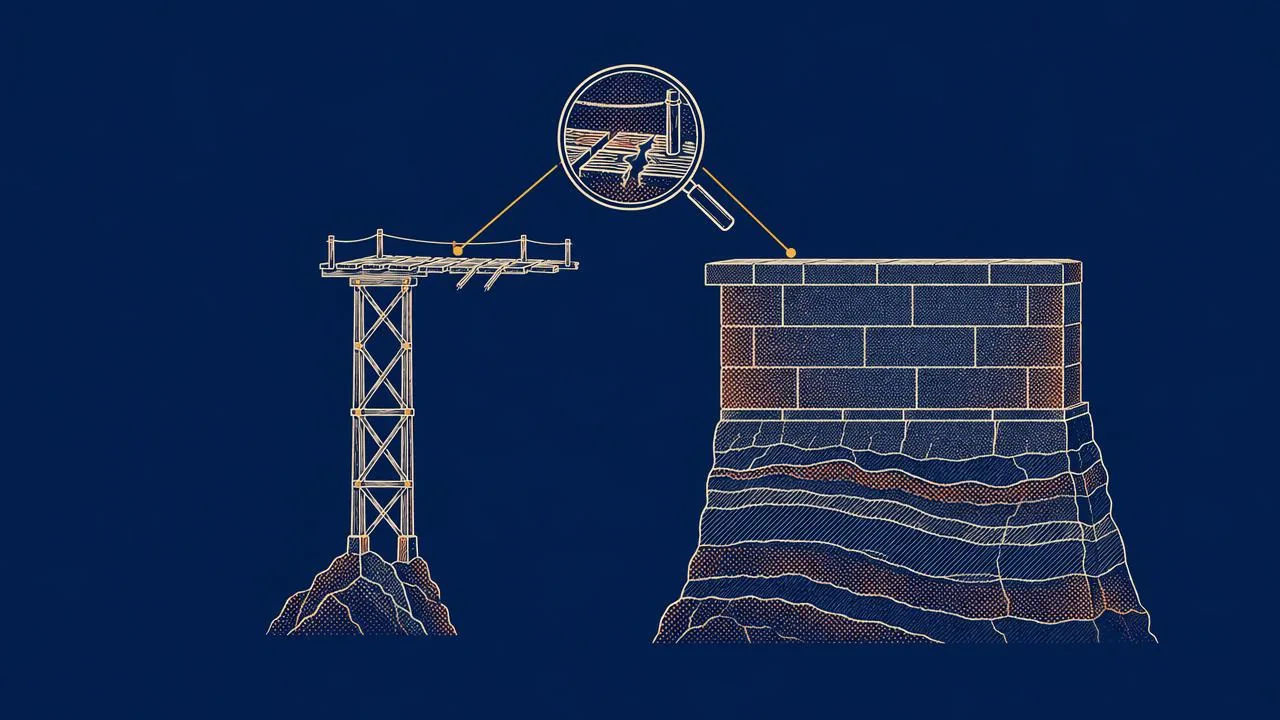
Look around the internet right now and ask yourself an uncomfortable question.
Every minute, thousands of new pages land on the web. Websites are scaffolded overnight. Entire blogs appear between meetings. Directories with tens of thousands of URLs launch before breakfast, while autonomous agents keep drafting and scheduling posts as their owners sleep.
I am not watching from the sidelines. I am part of this shift.
I use AI every day to build software, run research pipelines, automate workflows across eight languages, and structure articles like the one you are reading. Yet the more I build in 2026, the clearer one dividing line becomes.
For the first time in the history of the internet, publishing is becoming almost effortless. Thinking is not.
For twenty years, much of the SEO industry has chased shortcuts instead of building assets that deserve attention. Parasite SEO, expired domain speculation, private blog networks, paid link brokers and automated content farms are branches of the same impulse: harvesting the rewards of trust without paying the cost of earning it.
AI has democratised publishing. It hasn't democratised credibility.
What follows is my perspective, as a founder who builds directories, migrates legacy WordPress sites onto Next.js and Astro, and deals with the same indexing and core update realities you do, on why easy authority is ending and what replaces it.
What Is Parasite SEO, and Why Borrowed Authority Is Cracking
Parasite SEO means publishing commercial or affiliate pages on an established third-party website so you can borrow its ranking signals instead of building your own.
The temptation was obvious. Building an independent site takes years with no guarantee of page-one visibility. Paying an established newspaper or SaaS publication to host buyer guides in a quiet subfolder could rank almost immediately.
Let us be fair: not all third-party publishing violates policy. A genuine guest essay sharing first-hand expertise, earned digital PR coverage, or a clearly disclosed sponsorship written for the host audience has a legitimate purpose. Site reputation abuse happens when third-party pages exploit the host domain's authority with minimal editorial involvement from the site owner.
There is a fundamental difference between earning authority and renting it. One belongs to you. The other can disappear overnight.
Google formalised this under its site reputation abuse policy in March 2024 and followed with direct action against what Google itself called "parasite SEO". In August 2026, compliance with the EU's Digital Markets Act split enforcement regionally: from 30 August 2026, manual action demotions for site reputation abuse stopped applying to searchers inside the European Economic Area, while remaining active across the rest of the world including the US and UK. Search Console notifications still trigger, and Google retains algorithmic ways to isolate third-party sections from the parent domain's reputation.
If your business model depends on a regulator forcing a search engine to ignore abuse in one region while demoting it everywhere else, you do not own a durable business.
Would I Spend $50,000 Buying an Authoritative Domain Today?
Another classic shortcut has been paying $20,000, $50,000 or more at auction for aged or expired domains purely for their backlink history and inherited rankings. In earlier years, that maths frequently worked. Even recently, experienced operators found ways to make domain plays pay.
Would I spend $50,000 buying an authoritative domain purely for SEO metrics today? Absolutely not.
Buying an aged domain, a brandable name or a functioning business is legitimate. Google's expired domain abuse policy specifically targets repurposing expired domains with low-value content to manipulate search rankings. It is not that expired domains died on a single calendar date; it is that risk and return have shifted sharply. Any five-figure buyer today must examine five things honestly before wiring money:
- Historical content and ownership continuity: Google has decades of crawl archives showing what a domain actually published and who stood behind it.
- Topical alignment: Turning a retired civil engineering publication into a software review site creates an immediate conceptual mismatch.
- Real audience and branded demand: Strong backlink charts mean very little if nobody searches the domain name or visits directly anymore.
- Link profile provenance: Many high-scoring auction domains carry years of automated scraper links, dead directories or forgotten spam waves.
- Repurposing decay: Once crawlers digest a fresh template stack, unrelated subject matter and new ownership, historical ranking strength often unravels fast.
Remember too: Ahrefs Domain Rating and Moz Domain Authority are third-party vendor metrics, not Google's internal ranking scores. Google does not read your SaaS dashboard before ranking your commercial landing pages.
You can buy a domain. You cannot necessarily buy the trust that took its previous owner ten years to build.
A $50,000 domain can become a very expensive URL if its only business case is inherited SEO authority.
Buy a business, an audience or a brand. Be extremely careful about buying a number on an SEO dashboard.
PBNs, Link Farming and the Multi-Decade Obsession With Backlinks
For over twenty years, an entire market has existed around private blog networks, link farms, paid link placements and orchestrated link exchanges. Some operators still report short-term results from bought links today, and pretending otherwise would not be honest.
Even so, short-term survival is not long-term viability. Since the Penguin era through ongoing link-spam enforcement, Google's spam policies forbid buying or selling links to manipulate rankings, while distinguishing manipulative schemes from legitimate advertising tagged with rel="sponsored".

Agencies keep prescribing the same medicine: competitors have more backlinks, so buy another hundred this quarter. Nobody stops to ask a simpler question: what if nobody links to your website because your website offers nothing worth referencing?
The future of link building should be about being worth linking to.
As automated link-spam detection improves, businesses that earn attention through real work get a fairer shot. That is good for the open web.
The Great AI Content Explosion and Content Sniping
At the same time, generative AI removed the bottleneck on content volume. A small founder-led site can now publish faster than an old twenty-person newsroom.
Instead of using that leverage for depth, many teams defaulted to what I call content sniping: taking another publisher's research or framework, running a light AI rewrite to rearrange the sentences, and publishing fast without fresh verification or experience. This is a widespread publishing habit across the web rather than a claim about any single company, and Google's scaled content abuse and scraping policies address unoriginal mass output explicitly. (See how Google reads AI content policy in 2026.)
Neither Google nor AI answer engines catch everything; AI features and independent retrievers make mistakes too. Still, when ten articles say the same thing and one site did the primary testing, search systems have every reason to converge on the source.
Google is getting better at recognising the difference between someone who has something to say and someone who simply has something to publish.
Yes, I Use AI to Write Content Too
Let me be blunt so there is zero hypocrisy here: I use AI constantly, including to research and organise this manifesto.
For me, that is an engineering workflow, not a secret confession (see why raw AI content fails). AI handles the scaffolding: pulling official documentation, checking edge cases and stress-testing outlines. The opinions, disagreements, migration scars from moving companies off WordPress to Next.js and Astro, and final editorial accountability belong to me.
Google's generative AI content guidance states clearly that useful AI-assisted research and structuring are legitimate; spam and unoriginality are the problem. Outsourcing your writing speed to a model works. Outsourcing your thinking never does.
AI should amplify your intelligence, not replace your contribution.
Stop Publishing 20 Articles a Day: Quality at Scale
If your current strategy is publishing 20 mediocre AI posts a day, my recommendation is simple: slow down. Spend the week testing, interviewing clients, digging into real data, and publish 20 genuinely exceptional pieces a month instead, or fewer if your niche demands deeper engineering. That ratio is illustrative rather than universal, because volume itself is not the enemy.
In fact, readers of my portfolio know I run large programmatic builds: HostList.io covers over 30,000 hosts across roughly 91,000 pages, Not Another Sunday maps 133,000+ cafés across 46 countries, and gautamkhorana.com spans over 3,800 URLs across eight languages on Astro and Supabase. The difference between those systems and generative spam is Quality at Scale: proprietary structured datasets, clean Next.js or Astro templates, verified attributes and strict quality/noindex gates.

Every publishing model sits inside this two-by-two framework:
| Quality | Quantity | Outcome | What It Means in 2026 |
|---|---|---|---|
| Low quality | Low quantity | Limited value | Occasional generic posts with no audience or moat |
| Low quality | High quantity | Content pollution | Mass AI rewrites chasing keyword lists with zero oversight |
| High quality | Low quantity | Boutique publishing | Thoughtful essays and niche craft with smaller footprint |
| High quality | High quantity | Quality at Scale | Curated datasets, directories and multi-market publishing anchored in engineering |
Combining high quality with meaningful scale is the hardest quadrant to execute, which is why it holds the biggest commercial moat over the next decade.
AI has dramatically reduced the cost of quantity. It has not eliminated the cost of quality.
Google Respects Effort, and Crawling Is Not Indexing
Google's helpful content guidance explicitly lists effort, originality, talent and skill when describing people-first content, contrasting original analysis and carefully built systems against automated mass publishing.
To be clear, hard work is not a direct algorithmic scoring knob, human quality-rater assessments do not set rankings on individual URLs, and great websites can still wait months while mediocre pages rank today. I know how infuriating that feels because I have run into the exact same wall across our own portfolio.
When you ship large platforms on fast infrastructure, you learn early that clean engineering opens the door rather than finishing the race. Across HostList.io and Not Another Sunday, and whenever we migrate bloated WordPress builds onto streamlined Next.js or Astro architecture, shipping sub-second pages, valid schema and clean XML sitemaps is mandatory baseline hygiene. Yet even when crawlers visit daily and return 200 OK across thousands of URLs, Google crawling your website still does not guarantee Google will index every URL. Meeting Google's technical requirements only clears stage two of Google's crawling and indexing pipeline:

| Stage | What Happens | Common Misunderstanding |
|---|---|---|
| 1. Discovery | Found via XML sitemap or links | Assuming sitemap submission triggers indexing |
| 2. Crawling | Googlebot fetches rendered HTML | Confusing a clean 200 crawl with page approval |
| 3. Indexing | Selected for storage in the index | Treating "Crawled - currently not indexed" as pure tech bug |
| 4. Ranking | Competing on intent and trust | Expecting immediate rankings without authority |
| 5. Traffic | Earning clicks in Search or Overviews | Confusing impressions with buyer visits |
| 6. Conversion | Turning readers into real enquiries | Routing broad traffic to vague landing pages |
Crucially, Google indexes pages, not keywords. When founders say "my keywords aren't indexed", the real diagnosis sits in Search Console: Discovered, currently not indexed , Crawled, currently not indexed, duplicate canonical selection, or an indexed URL ranking too deep to get impressions. Not every indexing bottleneck is a penalty; domain age, near-duplication and thin differentiation all matter (see how I diagnose Crawled, Currently Not Indexed and large-site crawl budget lessons).
Look at the Google Search Status Dashboard: the November 2026 core update ran from 10 to 24 November 2026, followed immediately by Google preannouncing the December 2026 core update for longer, more complex questions and personalised results. (See my December 2026 core update analysis and Google's core update guidance.) Core updates, spam updates and manual actions are distinct systems, and none targets a single tactic alone. Together, however, they steadily raise the bar for what deserves an index slot.
I would rather spend five years building something that deserves to rank than five years worrying about which shortcut Google will discover next.
You Might Win at AEO While Losing at SEO
Search visibility in 2026 is no longer single-threaded. Answer Engine Optimisation (AEO) and Generative Engine Optimisation (GEO) run alongside classic Search, and the two do not always progress together. Across real sites I track, pages struggling for traditional Google clicks can still surface as citations inside ChatGPT, Perplexity or Gemini because external answer engines rely on distinct retrieval pipelines and live search indices.
Inside Google's ecosystem, AI Overviews and AI Mode still require supporting pages to be indexed and snippet-eligible in Search. Our six-month LLM citations study and multilingual GEO research showed the same practical rule: clear, verifiable, quotable structure improves citation odds across models, yet a citation only becomes commercially valuable when it reinforces brand trust or drives referral clicks that convert into enquiries. Chasing unlinked mentions in prompts for an obscure product nobody searches for still produces zero pipeline.
Most companies treat AEO and SEO as competing budgets. In reality, they share the same underlying asset: clear positioning, clean structured HTML, verified first-party evidence and a real brand reputation that makes skipping you look like an oversight. SEO is not dying into a brand-new acronym; it is widening into multi-surface credibility.
The Irony: Cheaper Content, More Expensive Measurement
There is a strange financial twist underneath this shift: producing words got nearly free, while measuring where your brand appears got substantially pricier.
Ahrefs' core plans ($129 Lite, $249 Standard, $449 Advanced monthly) now sit alongside Brand Radar add-ons starting at $199/month for base AI index visibility up to $699/month across platforms (plus custom prompt packages from roughly $50/month). Semrush's AI Visibility is priced at $99/month standalone per domain for 25 daily prompts, or bundled inside Semrush One plans from $199/month. While starter tiers bundle modest allowances, deeper cross-engine monitoring quickly adds recurring cost.
I use SEO platforms daily, yet dashboards never replace building something worth discovering. Before stacking another $300 to $700 per month on AI prompt trackers, make sure your foundation is backed by first-party Google Search Console logs, referral traffic and real sales enquiries.
We have made content production cheaper while potentially making the measurement of its success more expensive.
Seven Predictions for the Next Five to Ten Years
These are my personal predictions, not guaranteed facts:
- AI-content arbitrage will hit near-zero margin as everyone accesses identical base models.
- Original research, proprietary data and live builds will compound in value because rewrites cannot clone lived evidence.
- Borrowed and bought SEO shortcuts will offer worsening risk-adjusted returns across links, domains and subfolders.
- Brand authority will carry weight across both blue links and AI recommendations.
- Indexation selectivity will stay tight, forcing stronger architecture and genuine page differentiation.
- Discovery will remain multi-channel, spanning Google, AI engines, communities and direct branded demand.
- Quality at Scale will define the strongest digital operators, uniting modern engineering with editorial judgement.
If You Found This Article, Something Worked
Here is the irony I enjoy most. If you found this essay on Google, or because ChatGPT, Perplexity or Gemini cited it when asked where SEO is heading, the argument just proved its point in real time.
I did not spend $50,000 on an auctioned domain to share it, spin up a private blog network, or rent a corner of somebody else's publication. I thought through my own experience, used AI cleanly as an assistant, verified primary documentation, commissioned bespoke blueprint visuals, and published on a domain I own.
If you are dealing with unindexed pages, recovering from a core update or manual action, replatforming off legacy infrastructure onto faster Next.js or Astro architecture, or mapping your next five years of Search and AI visibility, get in touch and book a consultation. Let us talk through what you are building.
In an age where everyone can publish, the competitive advantage belongs to those who still know how to think.
FAQ
What is parasite SEO?
Parasite SEO is publishing commercial or affiliate pages on an established third-party website primarily to borrow its ranking strength rather than building first-party authority. While honest guest contributions and clearly disclosed sponsorships serve the host's readers, third-party sections published with minimal host oversight violate Google's site reputation abuse policy.
Does parasite SEO still work in 2026?
Short-term pockets still appear occasionally, complicated by Google's August 2026 DMA adjustment stopping manual action demotions for EEA searchers. Globally, however, active manual actions outside the EEA, Search Console notices and algorithmic isolation make rented authority far too fragile for a durable business.
Is buying an expired domain against Google's guidelines?
No. Buying an expired domain for a genuine brand, legitimate business acquisition or relevant rebuild is allowed. Google's expired domain abuse policy specifically forbids repurposing expired domains with low-value content solely to manipulate rankings.
Can you get cited in ChatGPT or Perplexity without ranking on Google?
Yes. Independent AI engines pull from separate retrieval systems and live web fetches alongside model knowledge. Google's own AI Overviews and AI Mode, however, require supporting pages to remain indexed and snippet-eligible in Google Search.
How do you recover from a Google manual action or core update drop?
Separate the two first. Manual actions show inside Google Search Console and require fixing the policy breach (such as link spam or site reputation abuse) before requesting reconsideration. Core updates have no manual penalty: compare full pre- and post-rollout weeks, audit page depth and differentiation, and fix root causes rather than making rushed mid-update changes.