

From 13 May to 16 November 2026, a scheduled job on this site put the same 15 questions to ChatGPT and Perplexity every week. Buyer questions, mostly: the kind people ask before hiring a developer or leaving WordPress. The job stored every answer and every source each engine cited. The total came to 1,769 answers and 9,746 citations.
Most writing about LLM citations is one person's screenshots or a vendor study built to sell a tracker. I don't sell one. So this is the raw version: what the two engines cited, how often they cited this site, what changed over six months, and what I'd do differently. Gemini was meant to be the third engine. It broke on 1 June, and that failure has its own section below.
The short version
- Perplexity cited sources in 99.9% of its answers, about 10 per answer, from 694 different domains.
- ChatGPT cited sources in 34.6% of its answers. Web search was switched on in every call, yet it searched every single week for five prompts and never once for the other ten. All five started with "Best".
- This site was cited in 14.4% of Perplexity answers (125 of 868) and in 2 of 901 ChatGPT answers.
- Six prompts produced every one of those Perplexity citations. Each had a page on this site that answers that exact question. Nine prompts never cited the site once in 26 weeks, including three London prompts, despite this site's London pages.
- Sources barely moved within a run and drifted week to week. Three copies of a prompt asked within two minutes shared 86% of their cited domains. One week later the overlap was 47%. Comparing the first week with the last, it was 9%.
- YouTube and Reddit were cited in 32.5% and 29.8% of Perplexity answers. Clutch was cited in 15.2%.
- The whole tracker cost $24.10 in API fees for six months, Gemini's empty answers included.
How the data was collected
The tracker is a Netlify scheduled function that calls the DataForSEO AI Optimization API once a week. Each prompt goes to each engine two or three times per run. The response text, the cited URLs and the position of this site among them land in a Supabase table, and the admin dashboard reads from that same table.
Three things about the method matter for reading the numbers:
- These are API answers, not the consumer apps. DataForSEO returned answers from GPT-4o mini for ChatGPT and from Sonar for Perplexity. The ChatGPT app you use in a browser runs different models, and its answers will differ. Treat the ChatGPT findings as "what the API model did". API-based trackers sample the same thing; some commercial tools scrape the apps instead.
- Fifteen prompts is a small set. They were picked to match the work this site sells: WordPress migration, Next.js, Claude Code, technical SEO in London. They are written the way a buyer would type them, not the way a keyword tool lists them. A sixteenth prompt asked "Who is Gautam Khorana?". It's reported separately because a brand question tells you little about anyone else's site.
- One run day is one sample of the engine's mood. There are 27 run days in the period. A gap in early September came from the DataForSEO balance running out, so September has two runs.
Everything below excludes the brand prompt unless it says otherwise. Two older prompts are excluded too, because they were unrelated to this site's services.
Finding 1: Perplexity always shows its sources, ChatGPT mostly doesn't
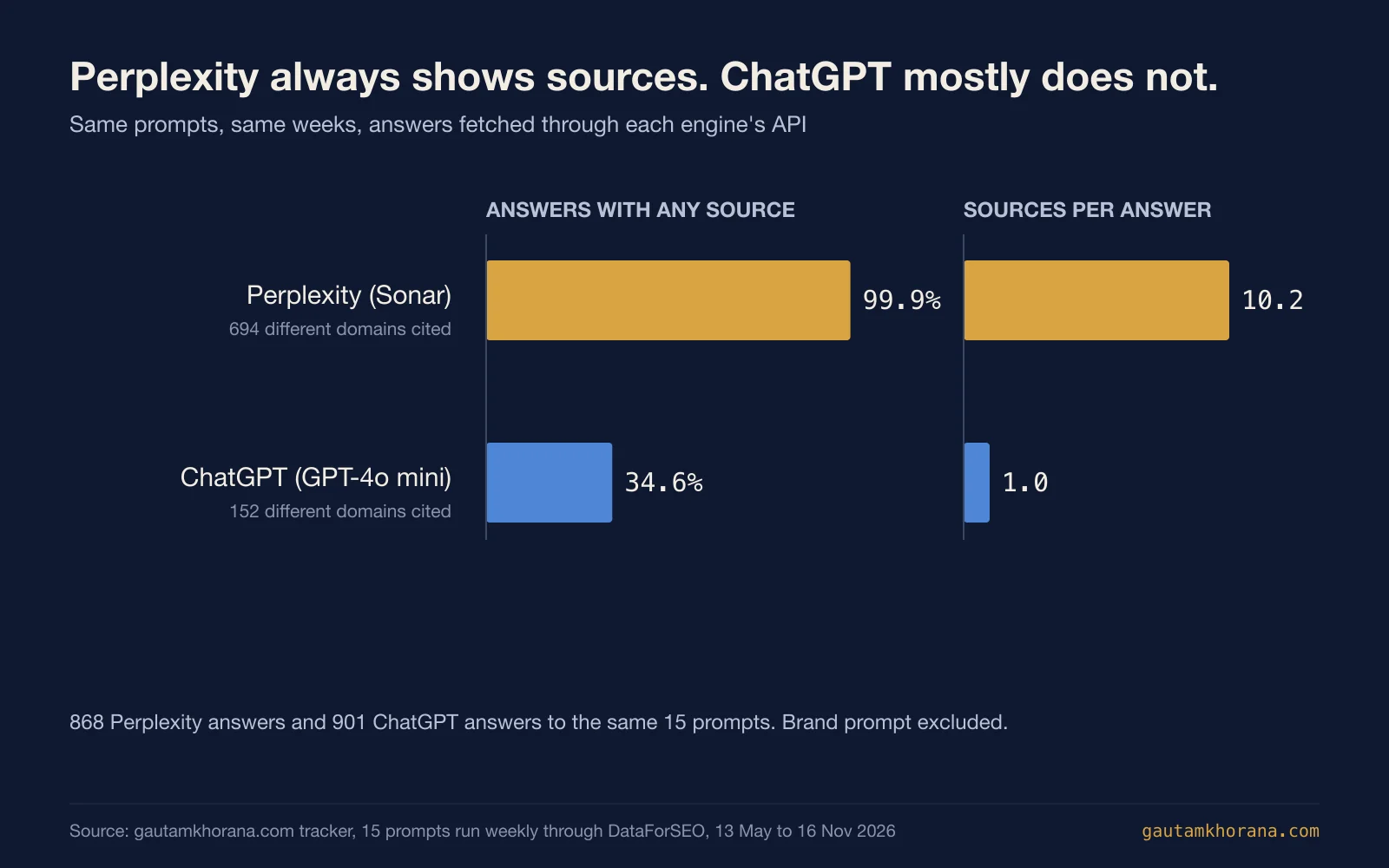
Perplexity answered all 15 prompts with sources, 867 times out of 868. The average answer cited 10.2 sources, and across six months it cited 694 different domains. If you want to know which sites an answer engine trusts for your topic, Perplexity tells you every time.
ChatGPT, through the API, behaved very differently. Only 312 of its 901 answers came with any source at all, and those that did carried about three each.
Every call had web search switched on, so the model chose when to use it. The split wasn't random. It was all or nothing, decided by the prompt.
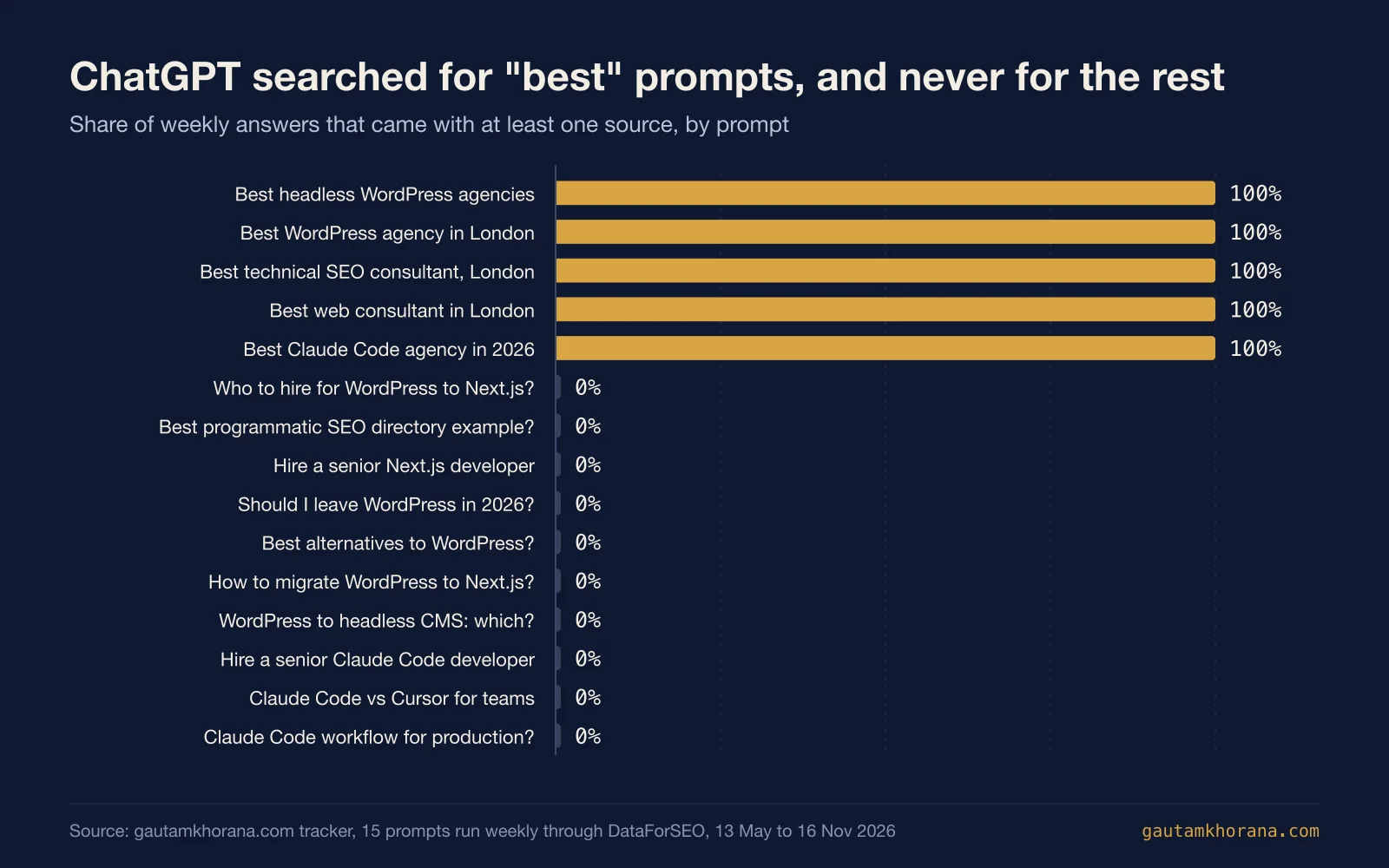
Every prompt that started with "Best" got a web search on every single run: best headless WordPress agencies, best WordPress agency in London, best technical SEO consultant in London, best web consultant in London, best Claude Code agency. The brand prompt did too. The other ten never got one. That included "Who should I hire for WordPress to Next.js migration?" and "Hire a senior Claude Code developer", which are as commercial as a prompt gets. GPT-4o mini answered those from what it already knew, with no sources and no way for a new page to get in.
This is the most useful finding in the dataset: you can't be cited where the model doesn't search. If the prompts that matter to you are answered from training data, a better page won't change the answer this month. What changes it is being mentioned widely enough to be in the training data, or the model deciding to search. The OpenAI crawler documentation is clear that OAI-SearchBot is what puts you in the search results ChatGPT can cite, so blocking it rules you out of even the prompts that do search.
When ChatGPT did search a London prompt, between a quarter and a third of its "sources" were Google Maps links to the agencies it named. google.com appeared in 18.5% of all ChatGPT answers, and every one of those links was a Google Maps search for an agency name. For local service prompts, the citation ChatGPT wants here is a business listing, not a blog post.
Finding 2: one page per question won the citations
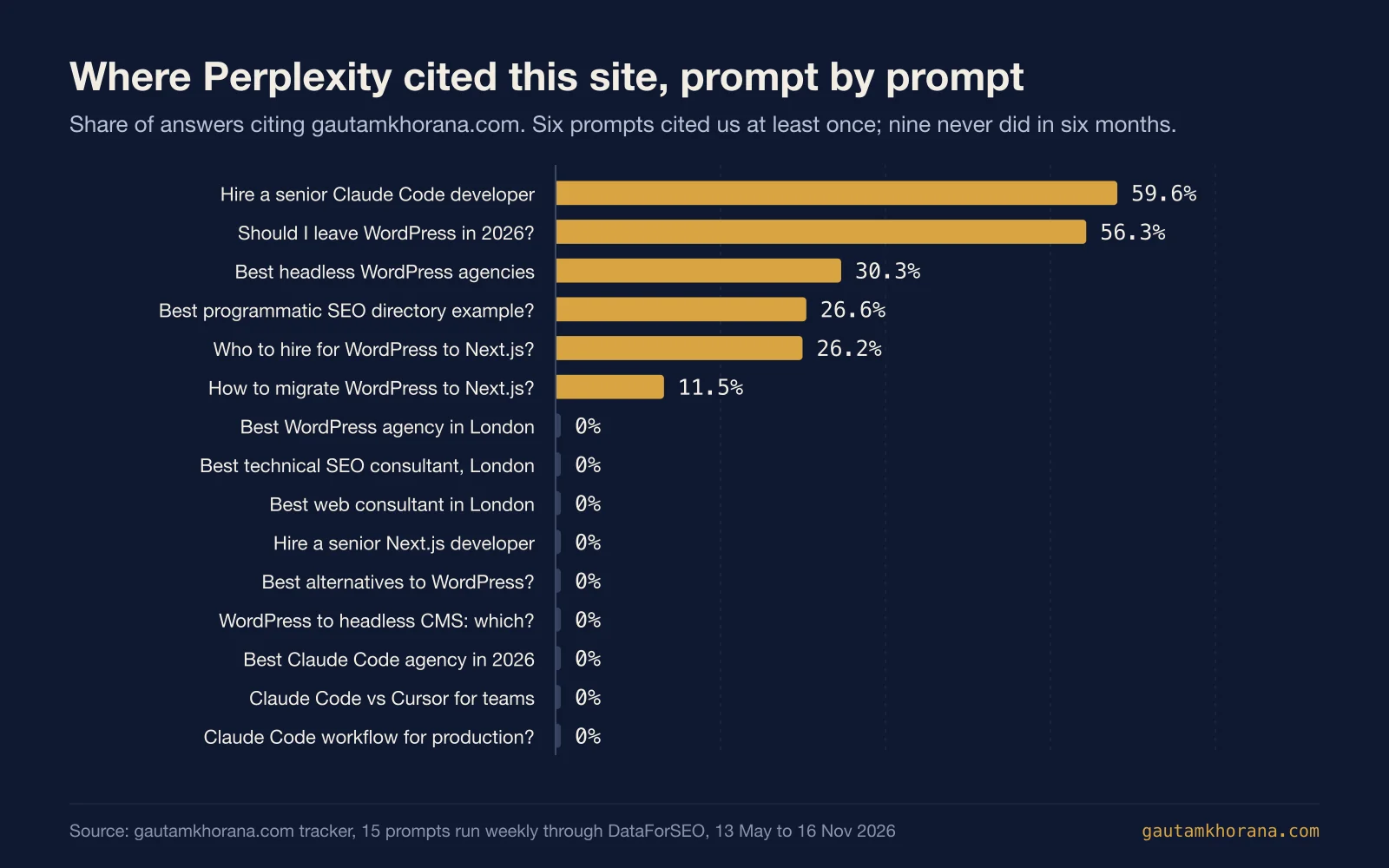
On Perplexity, six prompts cited this site and nine never did. The six share one obvious trait: a page here answered that question almost word for word.
| Prompt | Cited in | Page Perplexity cited most |
|---|---|---|
| Hire a senior Claude Code developer | 59.6% | /hire-claude-code-developer/ |
| Should I leave WordPress in 2026? | 56.3% | /leave-wordpress/ |
| Best headless WordPress agencies | 30.3% | /best-headless-wordpress-agencies-london/ |
| What is the best programmatic SEO directory example? | 26.6% | a 2026 programmatic SEO directory post |
| Who should I hire for WordPress to Next.js migration? | 26.2% | /wordpress-to-nextjs-migration/ |
| How do I migrate from WordPress to Next.js? | 11.5% | /wordpress-to-nextjs-migration/ |
Five URLs account for 117 of the 125 citations. When the site was cited, it was usually near the top: the median position was third among about ten sources.
The nine misses are just as telling. "What are the best alternatives to WordPress?" went to Zapier, Tooltester, Hygraph and Webstudio, which publish long, regularly updated lists on exactly that question. "Hire a senior Next.js developer" went to hiring marketplaces: Arc, ZipRecruiter, Toptal and Indeed. "Best Claude Code agency in 2026" went to agencies that publish their own "best Claude Code agencies" lists.
The London prompts hurt most, because this site has several London pages. In 26 weeks, Perplexity never cited them for "best web consultant in London" or "best technical SEO consultant in London". It cited directories instead: Clutch, DesignRush, Sortlist, Bark, Semrush's agency directory. It also cited the personal sites of individual London consultants. A page that says "London" isn't the same as being one of the London names those directories list.
Finding 3: the first citation took between five days and ten weeks
All five pages that won citations were live by 13 May, when the tracker started. Their first citations arrived at very different times:
- /leave-wordpress/ was first cited on 18 May, five days in.
- /best-headless-wordpress-agencies-london/ followed on 25 May.
- /hire-claude-code-developer/, the programmatic SEO post and /wordpress-to-nextjs-migration/ were all first cited between 20 and 23 July, about ten weeks in.
Three pages picked up in the same week could be my doing or Perplexity's, and I can't fully separate the two. The site had a round of performance, accessibility and internal-linking fixes in mid-July. But the engine changed that same week: Perplexity's answers to these prompts went from 8.8 sources on average on 13 July to 10.0 on 20 July, then to 17.5 on 3 August.
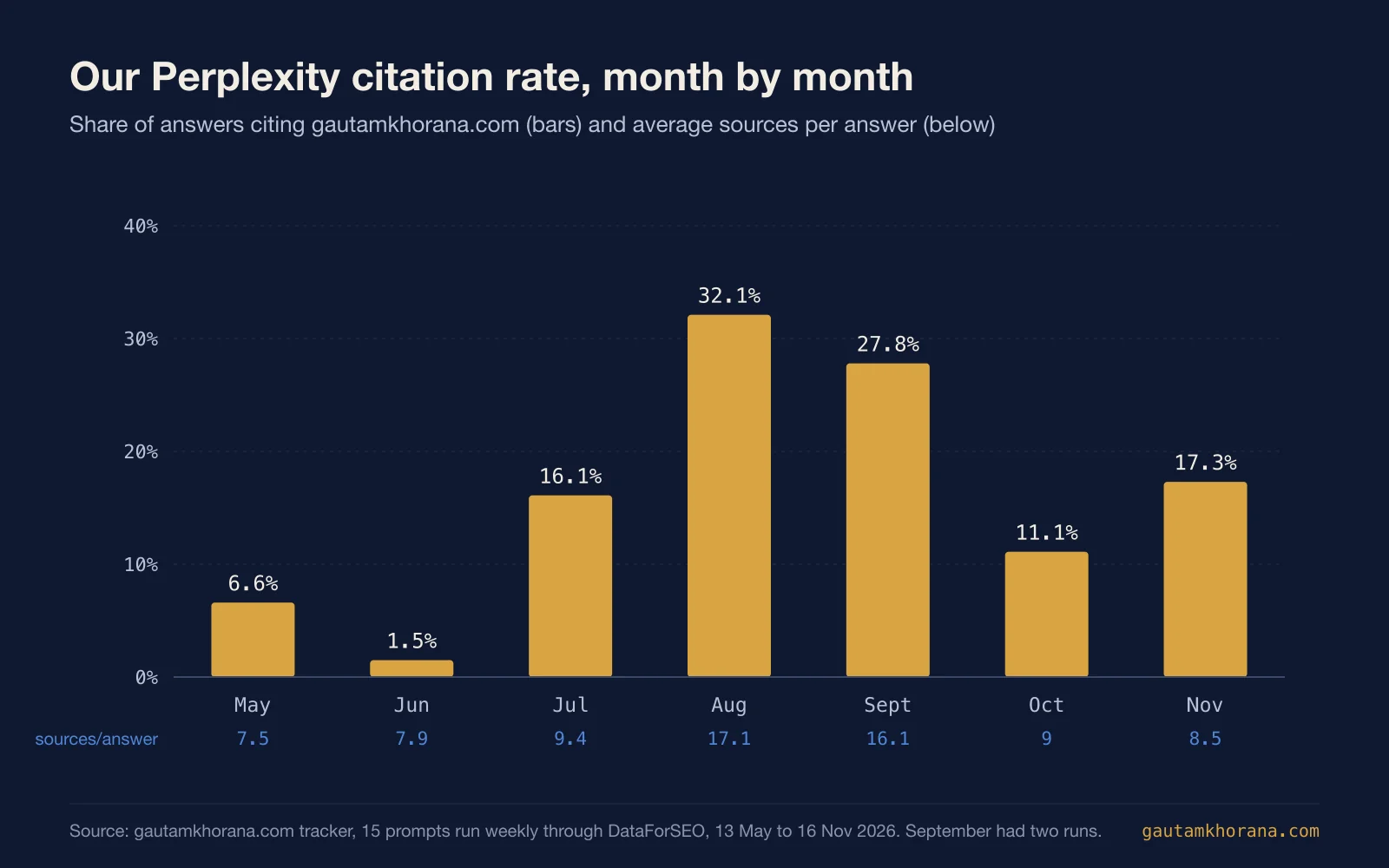
The monthly numbers back that up. In August, Perplexity's answers to these prompts cited 17.1 sources on average, up from 7.9 in June. The citation rate for this site went from 1.5% to 32.1% over the same months. Then the average fell back to around 9 in October, and the rate fell to 11.1% with it. More slots per answer meant more room for a smaller site. Some of what looks like "our GEO work paying off" in a dashboard is really the engine changing how many sources it shows.
Finding 4: sources hold within a run and drift week to week
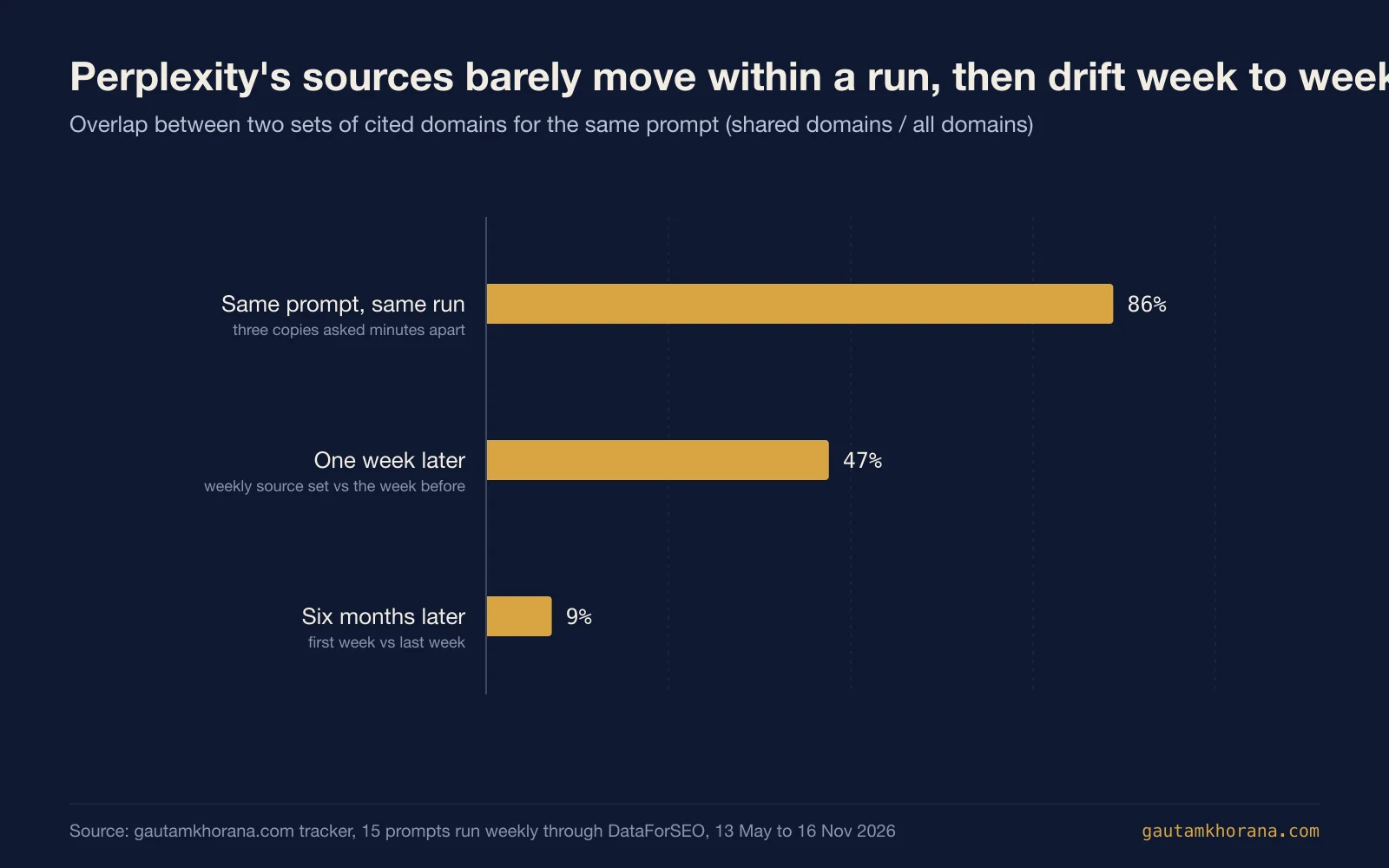
Each prompt was asked two or three times per run, within about two minutes. Those copies agreed closely: 86% of their cited domains were shared, and in 98% of runs they agreed on whether this site was cited at all.
Week to week, the overlap fell to 47%. Comparing each prompt's first week with its last, only 9% of the cited domains survived. Over six months, Perplexity's source list for a given question was almost completely replaced.
That looks like it contradicts SparkToro and Gumshoe's January 2026 study, which found a less than 1 in 100 chance of ChatGPT or Google's AI giving the same list of brands twice. It doesn't really, because the two studies measured different things. They compared ordered brand lists written by hundreds of people using the consumer apps. This one compares sets of cited domains from API calls a minute apart, which may come from the same search results. Rand Fishkin flagged that exact question in his study, whether API calls show the same variety people see in the apps, as unresolved.
Both point the same way for anyone tracking AI visibility. A single check tells you very little, and a ranking position inside an answer tells you even less. Measure the share of answers that cite you across many prompts and many weeks: one sample a week for six months told me far more than twenty samples on one afternoon would have.
Finding 5: who Perplexity cites for buyer questions
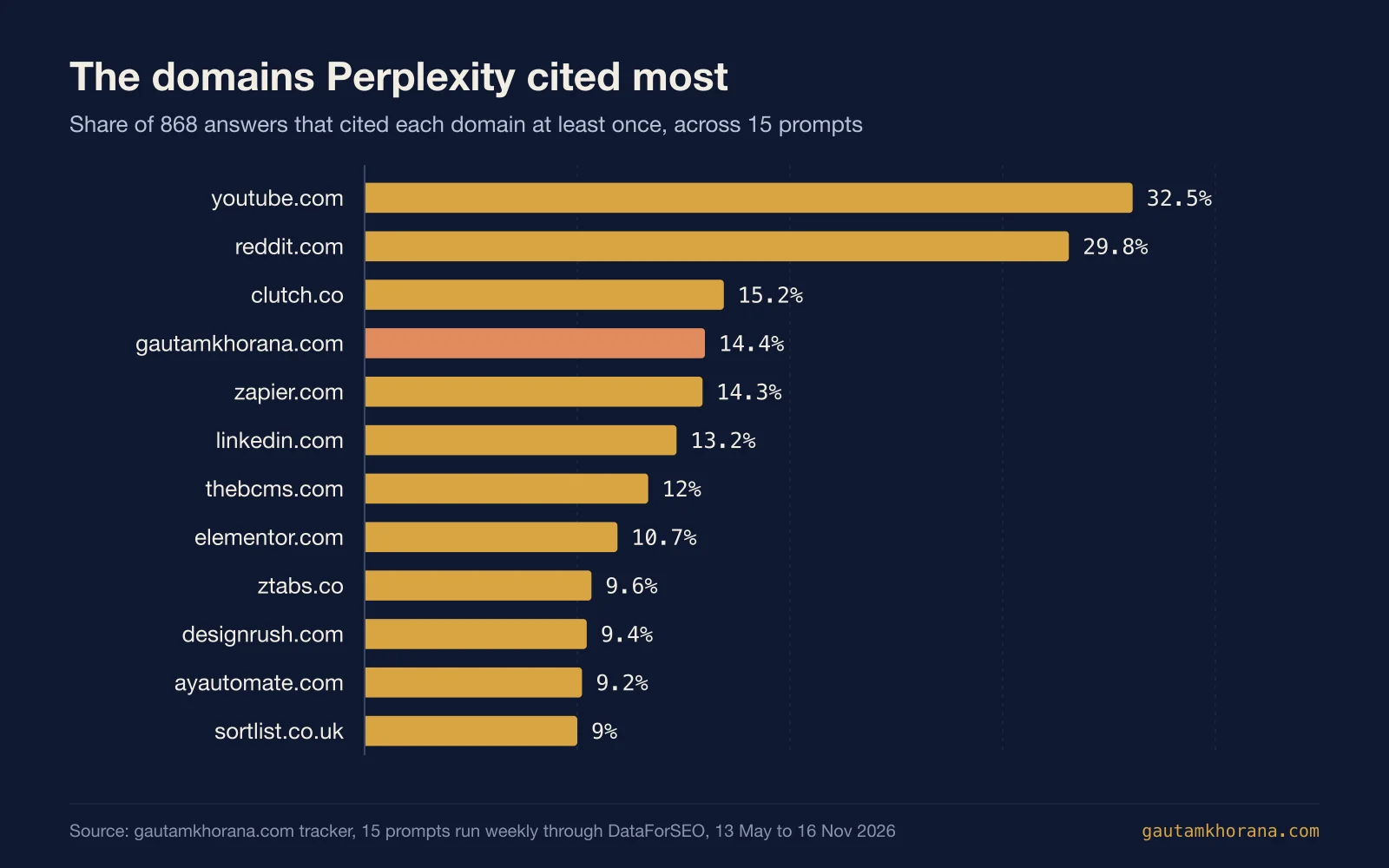
YouTube was cited in a third of all Perplexity answers, and Reddit in nearly as many. Ahrefs found the same pattern in Google: in its March 2026 study of 863,000 search results pages, YouTube was the most cited domain, and only 38% of cited pages ranked in the top 10 for the same query.
I've since built this into a broader public dataset at seo.here, an index I founded that tracks which firms five AI engines recommend for professional services, city by city. Across its boards, the most-cited sources are Wikipedia and Clutch, each in 11% of answers, then google.com (9%), Reddit (6%), The Manifest (6%) and GoodFirms (5%). Directories and review sites lead there too.
The rest of the list sorts into four groups:
- Directories and marketplaces: Clutch, DesignRush, Sortlist, Upwork, Arc, ZipRecruiter, Toptal and Indeed. They won the "best" and "hire" prompts.
- Vendor blogs: Zapier, BCMS, Elementor, Hygraph and Strapi. They won the "alternatives" and "which CMS" prompts with long comparison posts.
- Agencies that publish lists: several agencies were cited heavily for "best agency" prompts, often in lists they wrote themselves.
- Single-question pages: this site's five pages and a few consultants' personal sites.
The practical reading is simple. For any buyer question you have three options. Be the answer: a page that answers it directly. Be in the answer: listed on the directories and threads the engine already cites. Or be absent. Most of the work in LLM SEO is deciding which of the first two to go after for each prompt.
What it cost, and the Gemini failure
The tracker spent $24.10 in DataForSEO fees across all three engines. A Perplexity answer cost about $0.006, and a ChatGPT answer cost about $0.01. For comparison, the entry plans of the dedicated AI visibility tools I've looked at run from about $20 to $95 a month. Those tools do more than answer this narrow question: they give dashboards, cover many more prompts and engines, and sample the consumer apps. But if your question is "do these engines cite us for these 15 questions?", an API and a database table answer it for a few dollars a month.
Now the part I'm least proud of. Gemini was the third engine, and from 1 June every Gemini call failed. DataForSEO stopped accepting the model name the tracker sent, gemini-2.0-flash, and answered each call with a task-level error, "Invalid Field: 'model_name'", inside a successful HTTP response. My function spotted the task error. Then it saved the empty answer as a normal run. That added up to 996 empty answers marked as successful. For five months, the dashboard showed Gemini as "rarely cites us" when Gemini wasn't answering at all. The stored cost column was wrong too: it read the cost from the wrong level of the response, so the real figure above comes from the raw API responses.
If you build your own tracker, check three things:
- Does each engine actually return answer text? An empty answer that is logged as "not cited" looks exactly like a real result.
- Is the model you request still served? Pin a model and alert when it disappears.
- Is a task-level error saved as an error? Don't rely on the HTTP status alone, and don't turn a failed task into an empty answer.
The fix is small: request a current Gemini model and record a failed task as a failure. The real lesson is that a quiet zero needs checking before you report it.
What I'm changing because of this
- One page per buyer question I want to be cited for. 117 of the 125 citations this site won came from pages built around a single question. The new How to Rank in ChatGPT guide is the long version of that.
- Directory listings for the London prompts. No London page on this site was cited for a London prompt in six months, while Clutch, DesignRush and Sortlist were. That work is listings and reviews, not more pages.
- More prompts, the same weekly cadence. Fifteen prompts is enough to see patterns and too few to generalise. The next prompts cover AI visibility tools, the subject of the next posts here.
- Gemini back in, with checks. Its numbers will appear once there are a few months of real answers.
If you want the same analysis run on your own prompts, that's part of the AI SEO and GEO work I do. For a quick look at Google first, the free AI citation checker tests whether a page appears in AI Overviews.
FAQ
How often does ChatGPT cite sources?
In this study, GPT-4o mini through the API attached sources to 34.6% of its answers, with web search switched on in every call. The pattern was blunt: it searched every week for prompts that started with "Best" and never for questions phrased as "how", "who should I hire" or "should I". The consumer ChatGPT app uses other models and may behave differently, so treat this as one model's behaviour.
How many sources does Perplexity cite per answer?
Perplexity's Sonar model averaged 10.2 sources per answer across 868 answers. The monthly average moved between 7.5 and 17.1, peaking in August 2026.
Which websites do AI search engines cite most?
For these 15 buyer prompts, Perplexity cited YouTube in 32.5% of answers, Reddit in 29.8%, Clutch in 15.2%, Zapier in 14.3% and LinkedIn in 13.2%. Your topic will have its own leaders. Check which domains are cited for your prompts before deciding where to spend effort.
How long does it take to get cited by Perplexity?
For the pages here, the first citation came between five days and about ten weeks after tracking started. Three pages were first cited in the same week in July, when Perplexity started attaching more sources to each answer. Changes on the engine's side moved the numbers as much as anything on the site.
Are LLM citations stable enough to track?
Within a single run, yes: copies of the same prompt shared 86% of their sources. Across weeks, much less, with 47% overlap after a week and 9% after six months. Track the share of answers citing you across many prompts and weeks, not a single check or a position.