
I am 40. I am in the fittest shape of my life. That sentence would have sounded absurd to me five years ago, when I was 35, running an agency, sleeping badly, and treating food as fuel I did not have time to think about. The fitness part came from 366 classes at Barry's Bootcamp Queensway over 28 months. The nutrition part came from protein shakes, which I got into almost by accident and now cannot imagine living without.
This is not a sponsored post. There are no affiliate links and nothing for sale at the bottom. It is the honest account of how I went from someone who skipped breakfast to someone who owns five different protein brands and can tell you the difference between whey isolate and a clean vegan blend at 7am. If you are starting a fitness journey in your late thirties or forties and wondering whether protein actually matters, the short answer is yes. The longer answer, backed by the research I have read since, is below.
How Joe and the Juice got me hooked on clean protein
The gateway was Joe and the Juice. I started going for coffee and ended up ordering their protein shakes after workouts because they were fast, tasted good, and did not require me to own a blender or think about macros before my brain was online. They use Puori, a Danish brand founded in 2009 that publishes third-party test results for every batch and keeps the ingredient list short enough to read in one breath. Whey protein, a little sweetener, nothing else that needs a chemistry degree to pronounce.
That transparency mattered more than I expected. Puori partners with the Clean Label Project to screen every batch against 200+ contaminants including heavy metals, pesticides, and bisphenols, with results published online by batch number. Most mainstream protein powders are fine. Some are not. Puori's whole pitch is that you know exactly what you are drinking, which sounds like marketing until you have tried a chalky budget whey that lists "natural and artificial flavours" as if that is a feature. Joe and the Juice normalised the idea that a post-workout shake could be part of a routine, not a bodybuilding affectation. I was hooked on the habit before I was hooked on any particular brand.
What I learned from that first year: the best supplement is the one you will actually take. Puori through Joe and the Juice was convenient, tasted good, and felt clean. Those three properties matter more than marginal differences in protein quality between reputable brands. Convenience beats optimisation every time when you are building a habit from zero.
Why protein intake actually matters, especially after 35
The official recommended daily allowance for protein in the UK and US is 0.8 grams per kilogram of body weight. That number was set decades ago for sedentary adults and is widely considered the floor, not the target, for anyone who exercises. The International Society of Sports Nutrition position stand on protein and exercise recommends 1.4 to 2.0 g/kg/day for most exercising individuals, with higher intakes of 2.3 to 3.1 g/kg/day during caloric restriction to maximise lean body mass retention.
The landmark Morton et al. meta-analysis in the British Journal of Sports Medicine analysed 49 studies with 1,863 participants and found that dietary protein supplementation significantly enhanced gains in muscle strength and fat-free mass during resistance training. The breakpoint for fat-free mass gains was approximately 1.62 g/kg/day: intakes beyond that level did not produce further measurable gains in muscle mass for most people. Critically, the study also found that protein supplementation becomes less effective with increasing age — which means that if you are starting fitness in your late thirties or forties, getting enough protein is not optional. It is the variable that compensates for the age-related decline in anabolic response.
After 35, two physiological shifts accelerate. First, muscle mass starts declining unless you actively fight it. Sarcopenia — age-related muscle loss — begins around 30 and accelerates after 40 if you are sedentary. Second, your body becomes slightly less efficient at using dietary protein for muscle repair, a phenomenon called "anabolic resistance." Research on older adults consistently recommends at least 1.2 to 1.5 g/kg as a minimum, with active forty-year-olds pushed toward the full 1.6 to 2.2 g/kg range. The ISSN also recommends distributing protein across the day — roughly every 3 to 4 hours — with each serving containing 20 to 40 grams and enough leucine to trigger muscle protein synthesis.
For weight loss, protein is arguably more important than for muscle gain. When you are in a caloric deficit, your body will burn both fat and muscle unless you signal it otherwise. Adequate protein — combined with resistance training — tells your body to preserve lean mass while it strips fat. The ISSN position stand explicitly notes that higher protein intakes during hypocaloric periods (2.3 to 3.1 g/kg/day) may be needed to maximise lean body mass retention. That is why people who cut calories without enough protein end up "skinny fat": lighter on the scale, same soft shape, slower metabolism. I lost roughly eight kilograms during my first year at Barry's. I kept the muscle because I was eating and drinking enough protein to match the work.
For muscle gain, protein is necessary but not sufficient. You also need progressive overload — heavier weights, harder intervals, more reps over time — and enough total calories. Protein without training builds nothing. Training without protein repairs slowly and incompletely. The shake is the easy half of that equation, and the half most people skip because cooking a chicken breast at 8am after a 7am class requires a level of organisation I did not have when I started.
The anabolic window is wider than you think
For years, gym culture insisted you had a 30-minute post-workout window to consume protein or lose the gains. The current evidence is more forgiving. The ISSN position stand notes that the anabolic effect of exercise lasts at least 24 hours, though it diminishes with time. What matters more than precise timing is total daily protein intake and distribution. That said, I still drink my shake within 30 minutes of finishing a Barry's class, partly because the Fuel Bar is right there and partly because the ritual anchors the habit. The science says the window is wide. The psychology says make it automatic.
The brands I have actually used
FORM — the vegan protein I recommend to everyone
When I wanted to rotate off whey, FORM Nutrition was the vegan protein that stuck. Superblend Protein is pea and brown rice based, delivers 20g of protein and over 7g of fibre per serving, and includes a blend of greens, superfoods, and prebiotics alongside the protein itself. The chocolate salted caramel is the flavour I reorder. The ingredient list reads like food rather than a chemistry set: no artificial sweeteners, no gums I cannot identify, compostable packaging with no plastic scoop.
What makes FORM stand out in a crowded vegan protein market is that it tastes genuinely good with just water, which most plant proteins do not. Pea protein has a reputation for grittiness and an earthy aftertaste. FORM has solved that problem well enough that I recommend it constantly to friends who are dairy-sensitive, plant-curious, or just tired of whey bloat. It is not cheap — roughly £32 for a pouch — but neither is buying a bad powder three times before you find one that works. FORM also includes added vitamin D3 and B12 in the blend, which is a practical detail for anyone eating mostly plant-based in a country where sunshine is unreliable.
AG1 — the one I cannot live without
Athletic Greens, now branded AG1, is the daily habit that has nothing to do with protein and everything to do with staying functional on a schedule that does not allow slow mornings. One scoop in water, first thing. Seventy-five vitamins, minerals, probiotics, and adaptogens in a form I will actually drink. AG1 is not a protein supplement — it is a whole-food micronutrient base — and that distinction matters. I am not going to claim it replaces a balanced diet. It does not. But on days when I am back-to-back from 7am and eating lunch at 2pm, AG1 is the baseline that keeps me from running on caffeine and willpower alone.
I have tried stopping AG1 twice. Both times I restarted within a week. The difference I notice is subtle but consistent: slightly better energy in the late morning, less craving for sugar at 3pm, and a general sense that my baseline nutrition is covered even when my meals are not ideal. For an operator running an agency across four time zones, that baseline matters. AG1 costs roughly £79 to £99 per month depending on subscription, which is real money. It is the only supplement expenditure besides protein and creatine that I have maintained consistently for over two years, which tells you something about perceived return.
Naked Whey, Naked Creatine, and Hermosa — what I use now
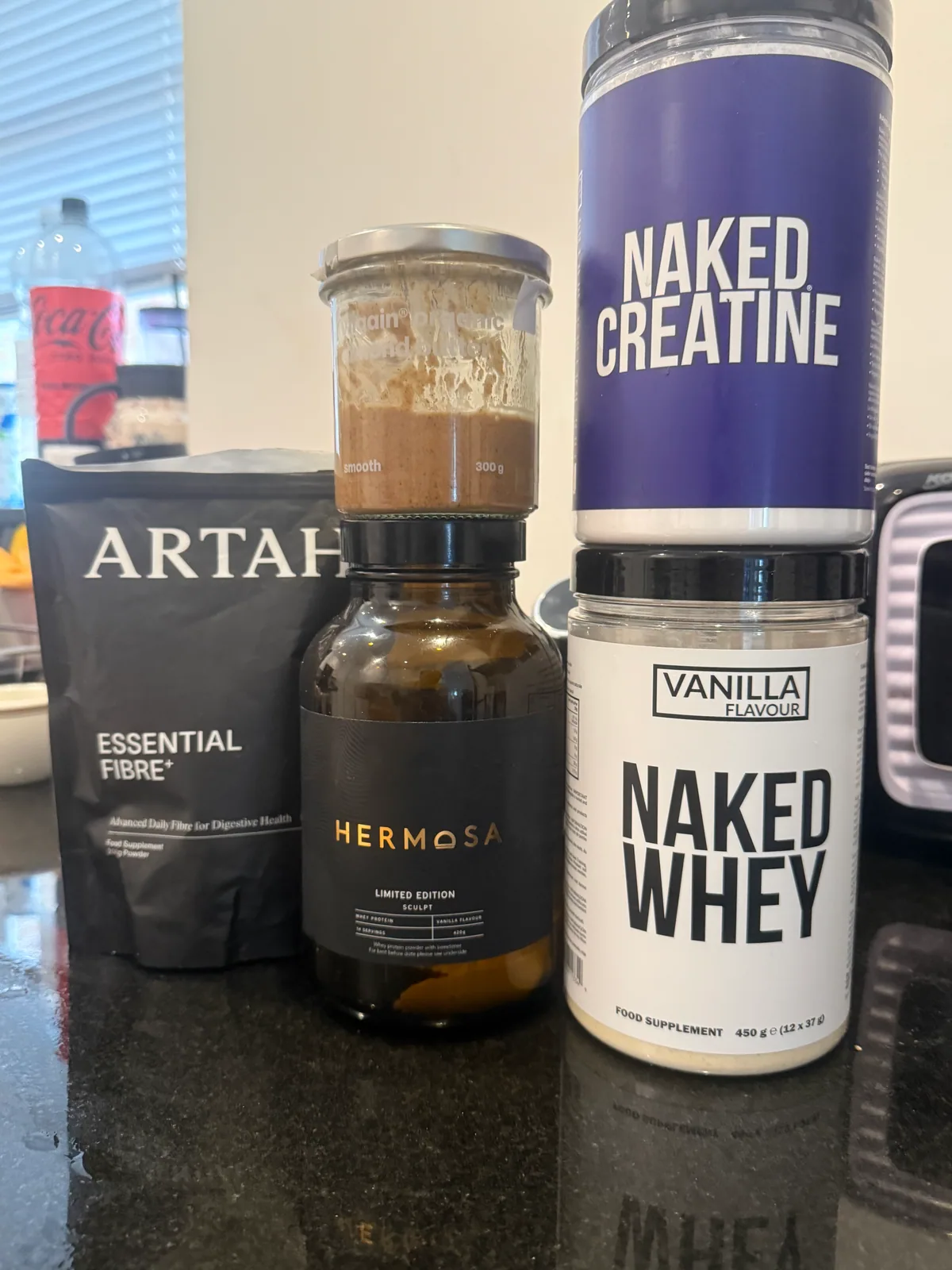
The current stack on my counter tells the story. Naked Whey is exactly what the name promises: one ingredient, whey protein concentrate from grass-fed cows, no sweeteners, no flavours, no additives. I add my own banana, blueberries, or coffee and control the taste myself. A single scoop delivers roughly 25g of protein at about £1 per serving, which is among the best value in the category for the ingredient quality. Naked Nutrition built their brand on radical transparency — the label is the entire marketing strategy — and for someone who has tried enough flavoured powders to distrust them, that simplicity is the point.
Naked Creatine sits on top of the whey tub in the photo — creatine monohydrate, one ingredient, the most studied sports supplement in existence. The ISSN position stand on creatine reviewed over 500 peer-reviewed publications and concluded that creatine monohydrate is the most effective ergogenic nutritional supplement currently available for increasing high-intensity exercise capacity and lean body mass during training. Five grams daily, mixed into the shake, no loading phase required. Short- and long-term supplementation (up to 30 g/day for 5 years) is safe and well-tolerated in healthy individuals from infants to the elderly. I have been taking it daily for over two years with no side effects beyond slightly fuller muscles and better recovery between hard classes.
Hermosa Sculpt is the whey protein owned by and exclusive to Barry's Bootcamp in the UK. I discovered it at the studio Fuel Bar — mocha protein creatine after a Red Room class — and now buy the tubs for home. Hermosa has supplied Barry's UK Fuel Bars since 2014. Grass-fed whey, vanilla or chocolate, low sugar, gluten-free, soy-free, GMO-free. The vanilla Sculpt whey is what goes into the Coco Loco and Blueberry Cobbler shakes on the Barry's menu. If you have read my Barry's essay, the post-class shake is half the habit. Hermosa is what is in it.
Why I use both Naked and Hermosa: Naked for home blending where I control every ingredient and want zero sweeteners. Hermosa for when I want a flavoured base that already tastes good with just milk and fruit, or when I am replicating a Barry's Fuel Bar recipe at home. They serve different jobs in the same routine. The Biona almond butter jar in the photo is nearly empty because I put a tablespoon in most shakes. Fat slows gastric emptying, which keeps you fuller longer and blunts the blood sugar spike from fruit. It also makes the texture richer. Artah Essential Fibre+ goes in when I am not getting enough from food — a daily blend of plant fibres for regularity, gut health, and appetite support that disappears into a smoothie without turning it into wallpaper paste.
What goes in the blender
The base is always a plant milk: coconut milk for creaminess, almond milk when I want it lighter. Sometimes coconut water instead, especially after a hard class when I want hydration more than calories. I do not use dairy milk — not for any ideological reason, just because plant milks taste better in a smoothie and I prefer the fat profile. Coconut milk adds medium-chain triglycerides that digest quickly and provide steady energy without the insulin spike of fruit alone.
The add-ons that never change: a tablespoon of ground flax seeds for omega-3 alpha-linolenic acid and soluble fibre, a teaspoon of chia seeds for texture and slow-release energy, and four drops of vitamin D3 because London winters are long and blood tests confirmed I was deficient. The NHS guidance on vitamin D recommends that all adults in the UK consider a daily 10 microgram (400 IU) supplement between October and March, and year-round if you have dark skin, cover most of your skin outdoors, or work indoors. Vitamin D is not just for bones — it plays a role in muscle function, immune response, and mood regulation. Deficiency is common in the UK: Public Health England estimates that roughly one in five adults and one in six children have low vitamin D levels.
Flax and chia serve double duty. Flax provides lignans and ALA omega-3, which most Western diets lack. Chia absorbs liquid and thickens the shake while providing soluble fibre that feeds gut bacteria. Together with the Artah fibre booster, my morning shake delivers 8 to 12 grams of fibre before I have eaten any solid food — roughly a third of the 30g daily target that most UK adults miss.
Blueberry banana — the default
One banana, a handful of frozen blueberries, one scoop of Naked Whey or Hermosa Sculpt vanilla, 250ml almond milk, a tablespoon of ground flax, a teaspoon of chia, a tablespoon of Biona almond butter, four drops of vitamin D3, and a teaspoon of Artah Essential Fibre+ if needed. Blitz for thirty seconds. Roughly 35g protein, 8g fibre, 400 calories. This is the shake I make when I want something that tastes like food rather than a supplement. The frozen blueberries keep it cold without ice, which waterlogs the texture.
Coffee banana — the weekday morning
Same base but swap the blueberries for a shot of espresso or 100ml cold brew. The coffee version is my weekday default because it replaces the second espresso I would otherwise drink on an empty stomach. Caffeine plus protein plus fat is a better morning combination than caffeine alone — the protein and fat slow caffeine absorption, which reduces the jitters-and-crash cycle that pure espresso on an empty stomach produces. I use Hermosa chocolate whey in this one when I want it to taste like a mocha, which is most days.
Protein and weight loss: what actually happened
I did not count calories during my first year at Barry's. I did not track macros. I showed up to class three times a week, drank a protein shake after each session, and made a rough effort to eat protein at every meal — eggs, chicken, fish, Greek yoghurt, another shake if I missed lunch. The weight came off slowly and steadily: roughly eight kilograms over twelve months, mostly fat, without the hunger and irritability that usually accompanies caloric restriction.
The mechanism is well understood. Protein has the highest thermic effect of any macronutrient — your body burns 20 to 30% of protein calories during digestion, compared to 5 to 10% for carbohydrates and 0 to 3% for fat. Protein also increases satiety hormones (GLP-1, PYY) and suppresses ghrelin, the hunger hormone, more effectively than carbs or fat. When you replace a 400-calorie pastry breakfast with a 400-calorie protein shake, you eat less at lunch without trying. The deficit happens without willpower because the shake keeps you full.
The resistance training at Barry's was the other half. High-intensity interval training combined with strength work creates a metabolic environment where protein is preferentially used for muscle repair rather than stored as fat. The Morton meta-analysis confirmed that protein supplementation plus resistance training produces significantly greater fat-free mass gains than training alone. I was not doing anything clever. I was doing the basics consistently: train hard, eat protein, repeat.
Protein and muscle gain: years two and three
Weight loss plateaued after year one, which is normal and healthy. What changed in years two and three was body composition, not scale weight. Shoulders got wider. Arms got definition. Clothes fit differently at the same weight because muscle replaced fat. This is the recomposition phase that most people miss because they stop when the scale stops moving.
Muscle gain after 35 requires three inputs: adequate protein (1.6 to 2.2 g/kg/day), progressive overload (heavier weights or harder intervals over time), and sufficient sleep for recovery. I was hitting the first two. Sleep remained a work in progress with two young children and a business that spans time zones. The protein shake helped compensate for imperfect recovery by ensuring that whatever repair my body could do overnight had the raw materials available.
Creatine played a measurable role here. The ISSN creatine position stand notes that creatine supplementation increases intramuscular creatine and phosphocreatine stores, which improves the capacity for high-intensity exercise and accelerates recovery between sets. In practical terms: I could push harder on the floor section at Barry's, recover faster between treadmill sprints, and maintain strength on days when sleep was short. Five grams of Naked Creatine in my morning shake costs about 15p per day. It is the highest return-on-investment supplement in my entire stack.
What 40 actually looks like
I started fitness at 36. I am 40 now. The thing nobody tells you about getting fitter in your forties is that the ceiling is higher than you think and the floor is lower than you remember. I am stronger, leaner, and recover faster than I was at 30, when I was doing nothing structured. I am also more tired on days I skip protein, skip AG1, or try to run a hard class on toast and coffee. The body at 40 is not a declining machine — it is a system that responds extremely well to consistent input if you stop treating it like an afterthought.
The research backs this up. The Morton meta-analysis found that protein supplementation was more effective in resistance-trained individuals — meaning the longer you train, the more protein matters, not less. Age reduces the efficacy slightly, but consistent training plus adequate protein more than compensates. I am living proof of that curve: starting at 36, peaking at 40, with no sign of plateauing because the inputs are still compounding.
My blood markers reflect the change. Vitamin D went from deficient to optimal after daily drops. Resting heart rate dropped from the high 70s to low 60s. Recovery heart rate after a hard Barry's class — how quickly my pulse returns to baseline — improved by roughly 20% over two years. These are not vanity metrics. They are functional indicators that the system is working.
The full stack, summarised
For anyone who wants the short version of what I actually use and why: [Puori](https://puori.com/) via [Joe and the Juice](https://www.joejuice.com/) got me started on clean protein. [FORM Superblend](https://formnutrition.com/plant-based-nutrition/form-superblend-plant-based-vegan-protein/) is what I recommend for vegan protein. [AG1](https://drinkag1.com/) is the daily micronutrient base I cannot skip. [Naked Whey](https://uk.nakednutrition.com/) and [Naked Creatine](https://uk.nakednutrition.com/) are my home staples for unflavoured protein and creatine. [Hermosa Sculpt](https://livehermosa.com/) from Barry's is the flavoured whey for post-class and mocha shakes. [Artah Essential Fibre+](https://artah.co/) fills the fibre gap. [Biona](https://www.biona.co.uk/) almond butter adds fat and richness. Flax, chia, and vitamin D3 are pantry staples. Blueberry-banana and coffee-banana are the two recipes on rotation.
The protein shake is not magic. It is logistics. It is the fastest way to hit 30 to 40 grams of complete protein within an hour of training, without cooking, without deciding, without the decision fatigue that kills most nutrition habits. The brands matter less than the habit. But the brands I have landed on — after years of experimenting — are the ones whose ingredient lists I trust enough to put in my body every single day.
If you are starting where I started — late, busy, sceptical — pick one shake recipe, one protein you trust, and make it automatic for thirty days before you optimise anything else. Read the ISSN protein position stand if you want the science. Read my Barry's essay if you want the fitness half of the story. The fittest I have ever been at 40 started with a Joe and the Juice counter and a blender I almost did not buy.