
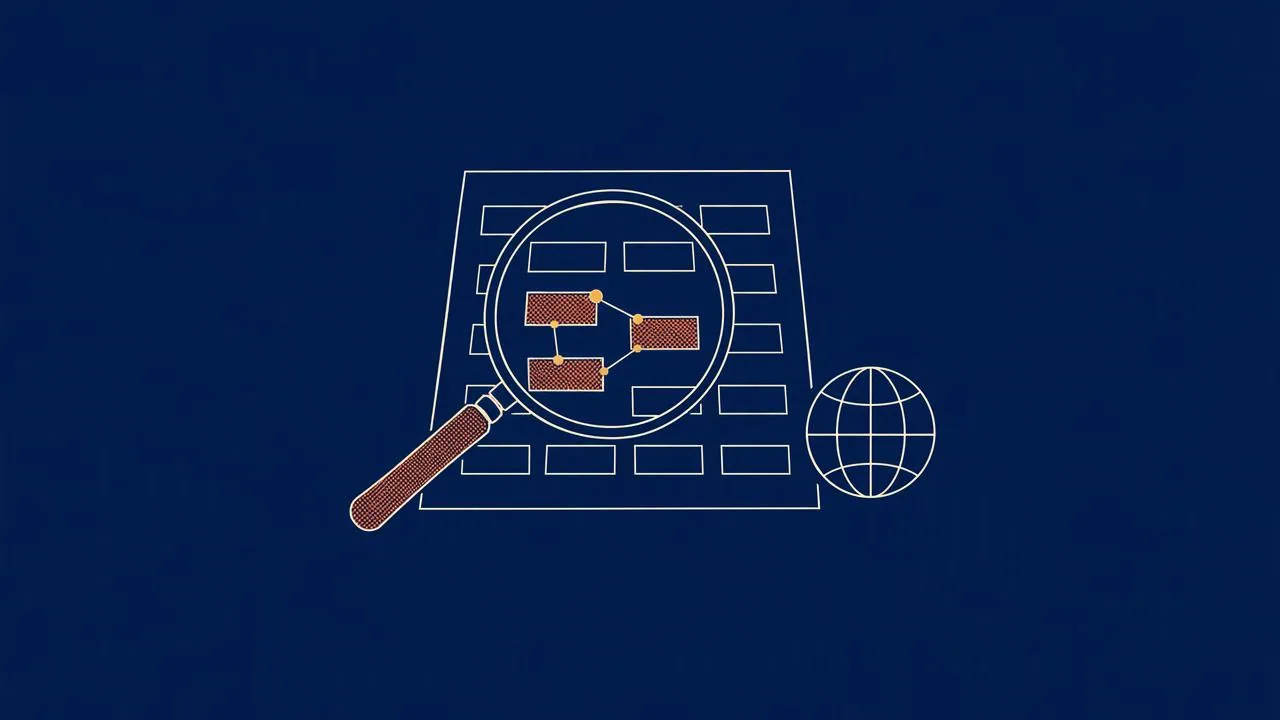
ICANN published the full set of 2026 Round applications on 7 October 2026: 1,615 applications, 333 of them brand applications, submitted between 30 April and 12 August. Treat that public list as the authoritative source for which AI labs and big-tech firms applied for which strings. This post sets out how to pull those names out yourself, how to lay out the table, and how to tell brand strings, generic strings and contention sets apart. I’m deliberately not printing company-by-company rows. ICANN says it is the only source for complete, verified application data, and I’d rather point you at that record than repeat anyone’s rumours.
Why technology companies show up in a round like this
Start with the source language. ICANN’s CEO Kurtis Lindqvist described the applications as organisations around the world “innovating new ways to build trusted online identities, serve their communities, and connect with Internet users.” That statement describes the round as a whole, not any one firm.
The round was designed to widen choice. The Applicant Guidebook says the 2026 Round aims to encourage a competitive environment in the DNS market, including more choice for end-users and communities. The 2012 round added over 1,200 new gTLDs, so there is precedent for companies of every size taking part.
I could guess why a technology company might want its own top-level domain. I’m not going to guess about intentions here. If a company has said something public about its application, a press release, a blog post, a filing, quote that. If it hasn’t, the application itself is all you have, and the application tells you what was requested, not why.
The list also shows how concentrated the round is. The Reveal Day figures split by region, with 864 applications from North America and 506 from Europe, against 218 from Asia/Australia/Pacific, 16 from Africa and 11 from Latin America and the Caribbean. (CircleID counts applicants by region, which gives different numbers. Don’t mix the two.) For a fuller summary of the numbers, see our overview of the revealed applications.
The table: a worksheet for AI and big-tech strings
A ready-made table of tech applicants would go stale quickly. The published data is a snapshot of primary string data as of 7 October 2026, and ICANN says the final number and types of applications will only be confirmed on String Confirmation Day, 17 November 2026. Applicants also have a Replacement Period, 8 to 21 October 2026, in which they can swap to a second-choice string.
Use this layout, with each column mapped to data ICANN publishes. Fill the rows from the Application Publication and Statistics site, not from a news story.
| String | Applicant | Type | Contention status |
|---|---|---|---|
| Primary string exactly as listed in the published application data | Applying entity named in the public portion of the application | Brand or generic, as ICANN's data classifies it | Whether the string appears in ICANN's contention set list |
| Replacement string, if the applicant filed one | Same entity | Re-check; a switch could change the picture | Re-check after 21 October and again on 17 November |
The published data includes primary strings, variant or replacement strings, a list of contention sets and the public portions of each application. That gives the four columns everything they need.
How to build your own version
- Open the APS site and search the applications list for the strings or applicant names you care about.
- Open each application's public portion and copy the string and the applying entity exactly as shown.
- Record whether it is a brand application or a generic one, using ICANN's own classification.
- Cross-check the string against ICANN's contention set list (there's a CSV download).
- Date-stamp every row, then repeat after the Replacement Period and after String Confirmation Day.
Tooling caveat: ICANN’s user guide notes that parts of the APS site are inactive and show no data at launch, and updated contention information on String Confirmation Day is published outside APS. Expect gaps.
ICANN has been blunt about outside sources. Before Reveal Day, it said some potential applicants had publicly disclosed strings and encouraged everyone to stay wary of anything not coming directly from ICANN. Good advice. A string mentioned in a trade-press article but absent from the published list doesn’t belong in your table.
Brand strings versus generic strings
This distinction does most of the work when you read the list, so get it straight.
A brand string matches a company or product name. The 333 brand applications in the snapshot are applications of that type. In general terms, a brand applicant is applying to run a registry for its own name, which usually means it controls who gets addresses under it. Our dot-brand explainer covers the mechanics.
A generic string is a dictionary-style word or category term. The same word could matter to many businesses, which is why generic strings are where competing applications tend to appear.
In practice the difference looks like this:
- Brand string: the applicant is typically the only party with a legitimate claim, so contention is less likely (though not impossible, if someone else applies for the same or a confusingly similar string).
- Generic string: more than one organisation may want it. If several applied, they end up in a contention set.
- What a generic string might allow: depending on the applicant's plans, addresses under it could be offered to other parties. Check the public application for what the applicant says it will do.
- What a brand string might allow: a company could use its own name at the right-hand end of its web addresses. Again, read the application, not the assumption.
This matters for AI and big-tech names because a company name and a technology term can overlap. A string that looks like a product name to one person looks like a category word to another. Don’t classify by instinct. Use the type ICANN’s data shows, and note where it surprises you.
Contention sets and how technology strings get out of them
The basic rule is clear. Applications for the same or a confusingly similar string are placed into a contention set. CircleID gives a concrete example of identical-string contention: .ace has three active applications, from Fore Course LLC, ShortDot (Ireland) Limited and Registry Services LLC. That isn’t a technology string, but it shows what a set looks like in the data.
How a set gets resolved
In the 2026 Round, contention can be resolved only through Community Priority Evaluation (CPE) or an ICANN auction. Private auctions, joint ventures and any other arrangement to settle contention privately are strictly prohibited. That is a real change in behaviour for anyone who remembers deal-making between applicants in earlier rounds, and it applies equally to a big-tech firm and a one-person registry.
So if an AI-related generic string has several applicants, the realistic endings are:
- One applicant qualifies through CPE (which is for community-based applications, and ICANN reports 16 of those in the snapshot).
- The set goes to an ICANN auction.
- Applicants withdraw. ICANN offers a 65 percent refund of the evaluation fee for withdrawals in the final 10 days after String Confirmation Day, with requests due by 23:59 UTC on 27 November 2026.
Withdrawal is the one exit that doesn’t need a winner, and it isn’t a private deal with a rival. It is a decision by one applicant.
How big is the contention picture?
Nobody can give you a final number yet. A registry-services firm, BRS Registry Services, reports 263 contention sets and 891 applications in contention, based on the Reveal Day file, and describes that as a first measure, not the final result. CircleID noted that ICANN’s statistics dashboard hadn’t yet populated those totals. Treat the 263 and 891 as one firm’s reading of ICANN’s file.
For scale, ICANN’s 2013 announcement on the previous round reported 230 exact match contention sets and 754 total applications in contention. Different round, different rules, different applicant pool. Use it as background, not a forecast.
Sets will move. ICANN warns that replacement strings could end up in contention later, for example through a singular/plural notification or a string confusion objection. The updated contention list lands on 17 November 2026, and the Community Input and Objections Period then runs to 16 March 2027. If a tech string is not in a set today, that’s a snapshot, not a guarantee.
What this means for users, and what it doesn't change
Start with the sobering part. These are requests to operate top-level domains, not approvals. CircleID reported that ICANN’s statistics showed no contracted or delegated applications from the 2026 round. Nothing on the list exists in the live DNS yet. The String Evaluation Stage is expected to last 180 days, and the Prioritization Draw, which sets the processing order, is due in the first half of 2027 on a date still to be set.
So what could change for ordinary users, eventually? Possibly this: if a company runs its own top-level domain, addresses ending in it could become a cleaner signal of what's official, because the operator controls who registers under it. That's the logic behind brand registries generally. It's a possibility that depends on how each registry is run, not something any application promises.
What it does not change:
- Existing domains and sites carry on exactly as they are.
- Lookalike and phishing addresses on other extensions don't go away. A fake can still sit under any domain that is open to registration.
- A new string doesn't tell you anything about a company's AI products, its roadmap or its plans. Only the company's own statements do that.
- The user still has to know which address to trust. A dedicated namespace helps only if people learn to recognise it.
If you’re a rights holder rather than a reader, the live question is whether anyone has applied for a string that matches or imitates your mark. The route there runs through objections and the community input period, and MarkMonitor’s piece on why Reveal Day matters to brand holders makes the same point about reviewing strings, applicants and contention sets. If you need to match your own marks against what was applied for, our brand identity and trademark service is where that groundwork starts.
FAQ
Can I trust a list of AI company applications from a news site?
Only as a lead. ICANN has stated it is the only source for complete and verified application information. Check any string and applicant against ICANN’s published data before repeating it.
Why do the application totals differ between sources?
They measure different things at different moments. ICANN’s 22 September notice gave 1,616 paid applications proceeding out of 1,663 submitted. The Reveal Day figure is 1,615, and BRS Registry Services notes one more application was still in administrative review, which brings it to 1,616.
Do applicants have to use the string they applied for?
Not necessarily. Those who filed a replacement string can switch to it during the Replacement Period, 8 to 21 October 2026, if it is eligible. A replacement can’t be used if it is identical to another applied-for primary or replacement string.
When will the final list of strings be fixed?
String Confirmation Day, 17 November 2026, publishes the final list of strings and an updated list of contention sets. It also opens the Community Input and Objections Period.
The sharpest caveat is the simplest: the published list is a snapshot, and the Replacement Period and String Confirmation Day can both change what’s in it. Build your table from ICANN’s own data, date-stamp every row, and re-check on 17 November 2026.