
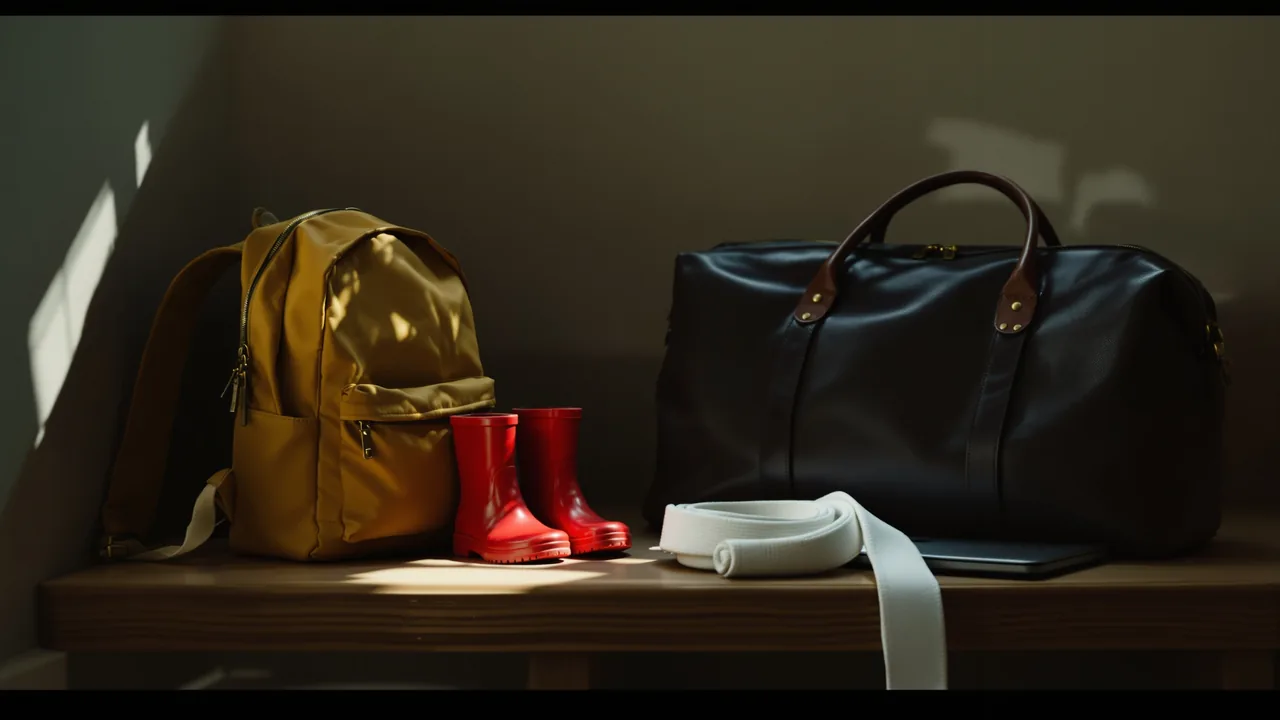
Tarini goes to nursery for four hours a day. Four hours sounds like a small, orderly unit. It suggests a handover, a clean block of productive work, a collection, and then normal life. That is not how it feels. She is out of the flat for four hours and in my head for the other twenty.
The four hours contain the obvious things: the nursery bill, the bag by the door, the negotiations about shoes, the walk in, the handover and the walk back. The other twenty contain everything less measurable: whether she ate, whether she slept, whether somebody was kind to her, whether she was kind to somebody else, and whether the tiny mark on her knee was there this morning.
This is not a guide to choosing a nursery. It is what four hours of nursery has done to my understanding of time, money, work, fear and the type of father I am trying to become.
Four hours is not four hours
Nursery starts before the front door opens. There is breakfast, clothes, the correct cup, the wrong socks, the emergency return for something that was apparently essential but had not been mentioned during the previous forty minutes. A four-hour session has a long runway.
On a good morning she walks in without looking back. This is objectively the result you want. It is also a surprisingly brutal way to discover that your child has a functioning life that does not require you in the room.
On a difficult morning the handover is slower. You leave with the particular guilt that comes from doing something necessary while the person you love most would prefer you did not. Five minutes later the nursery sends an update and she is completely fine. You are relieved, then faintly offended by how completely fine she is.
The walk home is quiet. For a few minutes the flat is exactly as I used to claim I wanted it: no background negotiation, no interruption, no small person asking for the same thing in four increasingly creative ways. Then the silence becomes suspicious and I check the time.
The nursery bill is not really buying childcare
The expense is real. Four hours a day looks part-time on a clock and much less part-time on an invoice. London has a talent for making basic family logistics feel like a premium subscription, and nursery is one of the cleanest examples.
It would be easy to reduce the calculation to working hours bought versus nursery fees paid. That is how an operator brain wants to assess it. Put the cost on one side, put four uninterrupted hours on the other, and decide whether the return is acceptable.
But the invoice is not only buying time for us. It is buying her a small world that was not designed by her parents. Other children, other adults, shared rules, food she might reject at home and accept without question there, conflicts we cannot immediately solve for her, and the early discovery that she can be safe without us standing two feet away.
That independence has value even when it is uncomfortable to watch. So does the work block. Both can be true: nursery can be painfully expensive and still be worth more than the hours written on the schedule.
The high is freedom. The low is also freedom
There is a version of parental honesty that people avoid because it sounds ungrateful: sometimes drop-off feels fantastic. I can finish a thought. I can take a call without muting myself every ninety seconds. Coffee can remain hot long enough to become coffee rather than evidence from an earlier part of the day.
The guilt arrives almost immediately. If I enjoy the quiet, does that mean I wanted her gone? Of course not. It means attention is finite and a young child consumes it with the efficiency of a data centre. Missing someone and enjoying the space they leave can happen at exactly the same time.
Collection has its own high. The door opens, she sees me, and for a few seconds I am the only person in London. Then she remembers something more interesting inside and turns around. Parenting is useful for keeping a man's ego within operating limits.
The small emergencies
A small emergency begins with a sentence like: another child pushed her at the park.
The immediate response in my body is wildly disproportionate. I want names. I want a reconstruction. I want to understand where every adult was positioned and why there was no perimeter around the slide. Somewhere inside me, a minor playground collision has become a failure of international diplomacy.
Then the sensible part catches up. The other child is also a child. Children push, grab, fall, misread each other and learn the boundary partly by crossing it. The playground is not a courtroom and I am not there to prosecute a three-year-old.
My job is to check that she is all right, help her name what happened, step in when an adult genuinely needs to step in, and keep my reaction the same size as the event. That last part is harder than it sounds. A father can turn protection into fear very quickly if every scraped knee becomes proof that the world is dangerous.
I do not want her to believe she needs me to remove every difficult person from her path. I want her to know I am there, that she can tell me, and that she can also recover, speak up and go back to playing.
Then there are the real ones
There are also situations where nobody is debating whether a plaster will do. We are getting dressed at speed, making calls and heading to the emergency room.
I am not going to publish the clinical details because they belong to her. What I remember is the change in the quality of the fear. Small worry is noisy. It produces theories, questions and a running commentary. Real fear is quiet. The world reduces itself to the next useful action.
Get there. Answer the questions. Hold her. Listen carefully. Keep the phone charged. Do not make her carry your panic as well as whatever she is already carrying.
An emergency room corrects the illusion that good parenting is a system capable of preventing every bad outcome. You can be attentive, prepared and sensible and still find yourself under fluorescent lights wishing you could swap places. The only control available is how you show up in that room.
Those nights make the small situations easier to size correctly. A push in the park deserves comfort and perspective. A real emergency deserves everything. Learning the difference is part of the job.
The completely rational jiu-jitsu response
This is approximately the point at which I decided that taking up jiu-jitsu and beefing up was a sensible parenting strategy.
To be clear, jiu-jitsu is not a proportionate response to nursery geopolitics. I am not preparing to settle a dispute near the sandpit. The official reasons are fitness, discipline and learning something difficult. The unofficial reason is that becoming a father has activated an ancient and slightly ridiculous part of my brain that would like to be physically capable of handling every possible situation.
The useful lesson is unlikely to be fighting. It is staying calm while uncomfortable, not wasting energy in panic and learning that strength without control is mostly noise. Those are better things for a daughter to see than a father permanently scanning the horizon for threats.
I already know from 366 classes at Barry's that the only exercise I sustain is the kind somebody else schedules and tells me how to do. Jiu-jitsu has the additional advantage of making a grown man immediately aware of how little he knows. Humility with improved shoulder strength feels like a reasonable package.
I want her to have super-duper high standards
I want to be wildly successful at work. That ambition existed before I became a father, but the reason for it has changed.
It is not only about giving her an easier life, although financial security matters. It is about making competence, effort and ambition look normal. I want her to grow up with super-duper high standards for her own work, for the people she trusts and, eventually, for whoever wants a place in her life.
High standards should not mean being impressed by titles, money or noise. They should mean expecting people to keep their word, do difficult things properly, treat others well when there is nothing to gain, and remain steady when a situation becomes inconvenient. She should see those behaviours often enough that the absence of them feels immediately wrong.
The standard is set at home long before anyone explains it. It is in how adults speak to each other, whether apologies happen without qualification, whether work gets done without becoming an excuse for permanent absence, and whether success makes someone more generous or merely more important in their own head.
There is a trap here. It would be easy to use providing as a noble explanation for missing everything. Nobody wants the biography of a father who built an impressive life but was never available inside it. If success does not include nursery collection, the story at dinner and being reachable on the frightening nights, it is a partial success at best.
Four hours has changed how I work
A nursery clock is a useful defence against work expanding forever. Meetings can overrun. Email can regenerate itself. A collection time does not care that somebody has added three final points to the agenda.
I work harder inside those four hours because the boundary is real. There is less browsing, less low-level switching and less pretending that an entire day is available. The work either fits the block or it waits. Constraints that used to feel irritating now produce some of my clearest hours.
Then I collect her and the role changes. Not perfectly. The phone still exists and urgent work remains urgent. But I am better at recognising that work asking for attention is not the same as work deserving it.
Why I built girl.dad
This mixture of ordinary joy, low-grade worry, expensive logistics and occasional terror is part of why I built girl.dad. It is a place for dads raising daughters: honest guides, days out, experiences and stories from people trying to show up properly without pretending they have fatherhood solved.
The internet has endless advice about optimising children. I am more interested in useful places, honest accounts and the small things that make fathers more present. Most of family life is not a breakthrough. It is repetition, patience and finding somewhere good to go on Saturday morning.
The other twenty hours
By bedtime the nursery bag is ready again. Something needs washing. Something else has vanished. I am thinking about tomorrow's meetings, whether she is settling properly, the invoice, the bruise I have already checked three times, and whether taking up a combat sport in middle age is wisdom or a very elaborate reaction to fatherhood.
I used to think being responsible for someone meant knowing what to do. It turns out much of it is learning which moments require action, which require calm, and which require you to sit on the floor and pay attention to a story with no discernible plot.
Four hours at nursery. The other twenty in my head. All twenty-four, in one way or another, belong to the same job.